Department of Hygiene and Zoonosis, Faculty of Vet. Medicine, University of Sadat City, Sadat City, Egypt.
College of Agriculture, Environment and Nutrition Sciences, Tuskegee University, Tuskegee, Alabama, United States of America.
PLoS One. 2020 Oct 29;15(10):e0240442. doi: 10.1371/journal.pone.0240442. eCollection 2020.
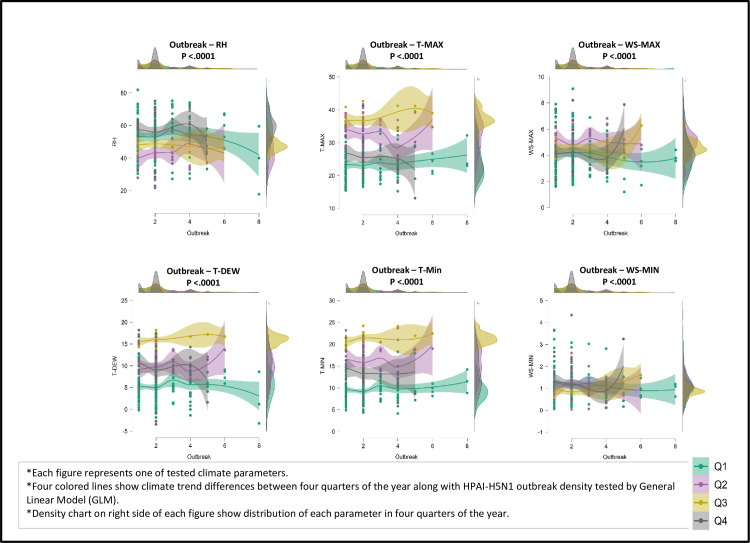
Long endemicity of the Highly Pathogenic Avian Influenza (HPAI) H5N1 subtype in Egypt poses a lot of threats to public health. Contrary to what is previously known, outbreaks have been circulated continuously in the poultry sectors all year round without seasonality. These changes call the need for epidemiological studies to prove or deny the influence of climate variability on outbreak occurrence, which is the aim of this study. This work proposes a modern approach to examine the degree to which the HPAI-H5N1disease event is being influenced by climate variability as a potential risk factor using generalized estimating equations (GEEs). GEE model revealed that the effect of climate variability differs according to the timing of the outbreak occurrence. Temperature and relative humidity could have both positive and negative effects on disease events. During the cold seasons especially in the first quarter, higher minimum temperatures, consistently show higher risks of disease occurrence, because this condition stimulates viral activity, while lower minimum temperatures support virus survival in the other quarters of the year with the highest negative effect in the third quarter. On the other hand, relative humidity negatively affects the outbreak in the first quarter of the year as the humid weather does not support viral circulation, while the highest positive effect was found in the second quarter during which low humidity favors the disease event.
高致病性禽流感(HPAI)H5N1 亚型在埃及的长期流行对公共卫生构成了很大威胁。与之前所知的不同,疫情在全年的家禽部门中持续不断地传播,没有季节性。这些变化要求进行流行病学研究,以证明或否认气候变化对疫情发生的影响,这就是本研究的目的。本工作提出了一种现代方法,使用广义估计方程(GEE)来检查 HPAI-H5N1 疾病事件在多大程度上受到气候变化作为潜在风险因素的影响。GEE 模型表明,气候变化的影响因疫情发生的时间而异。温度和相对湿度对疾病事件可能既有积极影响,也有消极影响。在寒冷季节,特别是在第一季度,较高的最低温度始终显示出更高的疾病发生风险,因为这种情况会刺激病毒活动,而在一年中的其他季度,较低的最低温度会支持病毒存活,在第三季度的影响最大。另一方面,相对湿度在一年的第一季度对疫情有负面影响,因为潮湿的天气不利于病毒传播,而在第二季度则发现了最高的正效应,在这一季度,低湿度有利于疾病发生。