Regional Infectious Diseases Unit, Western General Hospital, Edinburgh, United Kingdom.
British Society of Antimicrobial Chemotherapy, Birmingham, United Kingdom.
PLoS One. 2020 Oct 29;15(10):e0240471. doi: 10.1371/journal.pone.0240471. eCollection 2020.
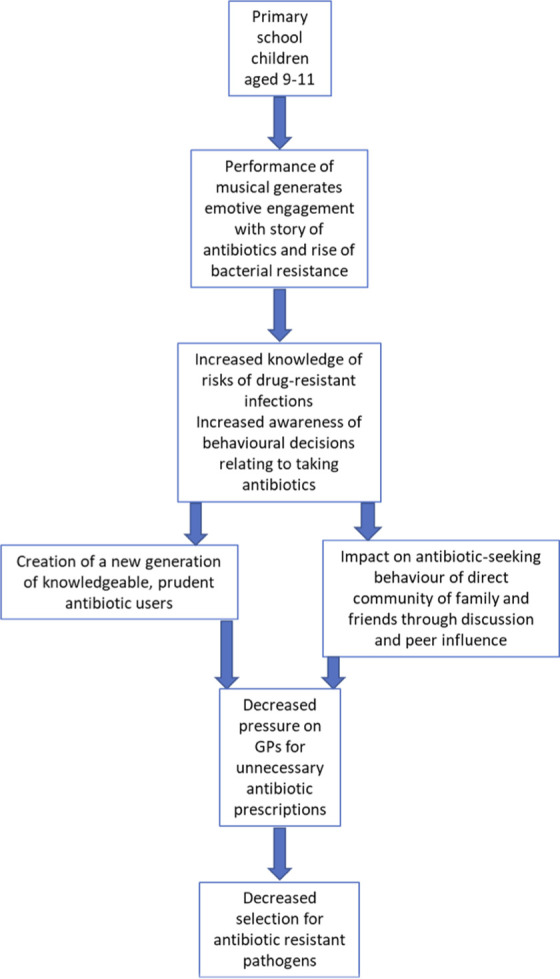
A primary school musical ("The Mould that Changed the World") was developed as a unique public engagement strategy to combat antimicrobial resistance (AMR) by engaging children in the story of the discovery of antibiotics, the risks of drug-resistant infections and the importance of prudent antibiotic use.
The musical intervention was implemented in two UK primary schools by music specialists through a series of workshops, associated learning resources and performances to relatives. Participating children (n = 182), aged 9 to 11 years, were given an online questionnaire in the classroom before rehearsals began and at two weeks post-performance with a six-month evaluation in one school. The impact of the musical was analysed using generalised linear models to control for confounding factors. For the qualitative evaluation, fifteen participating children were selected randomly from each school to take part in semi-structured focus groups (n = 5 per group) before rehearsals began and two weeks post-performance.
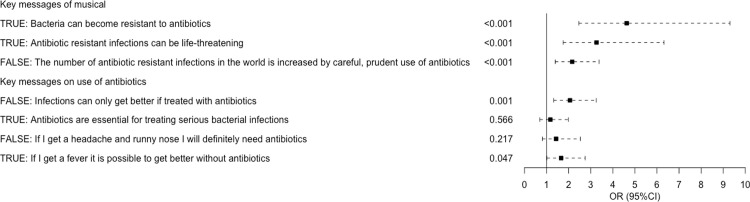
Knowledge gain was demonstrated with children being more likely to answer questions on key messages of the musical correctly at two weeks post- performance (response rate 88%, n = 161) compared with the pre-rehearsal questionnaire (response rate 99%, n = 180) (bacteria can become resistant to antibiotics OR 4.63, C.I. 2.46-9.31 p<0.0001, antibiotic resistant infections can be life threatening OR 3.26 C.I. 1.75-6.32 p = 0.0001, prudent use of antibiotics will slow the rise of antibiotic resistant infections OR 2.16, C.I. 1.39-3.38, p = 0.0006). Long term knowledge gain was demonstrated by a consistent level of correct answers on key messages between two weeks (response rate 95%, n = 89) and 6 months post musical (response rate 71%, n = 67). Following the musical children participating in the focus groups (n = 30) articulated a greater understanding of AMR and the risks of antibiotic overuse. They discussed motivation to minimise personal antibiotic use and influence attitudes to antibiotics in their family and friends.
This study demonstrates that musical theatre can improve both short and long-term knowledge. It demonstrates a hitherto infrequently reported change in attitude and motivation to change behaviour in children at an influential age for health beliefs. This unique public health tool has the potential for high impact particularly if rolled out within national education programmes for primary school aged children.
一部小学音乐剧(《改变世界的霉菌》)被开发为一种独特的公众参与策略,通过让孩子们参与发现抗生素的故事、耐药感染的风险以及谨慎使用抗生素的重要性,来对抗抗菌素耐药性(AMR)。
音乐专家通过一系列的工作坊、相关学习资源和对亲属的表演,在两所英国小学实施了音乐剧干预措施。参加的儿童(n=182)年龄在 9 至 11 岁之间,在排练前和演出后两周在教室里接受了在线问卷调查,并在一所学校进行了六个月的评估。使用广义线性模型分析音乐剧的影响,以控制混杂因素。对于定性评估,从每所学校中随机选择 15 名参与的儿童(每组 5 名),在排练前和演出后两周参加半结构化焦点小组。
知识的增长表现为,与排练前问卷(应答率 99%,n=180)相比,孩子们在演出后两周回答音乐剧关键信息的正确答案的可能性更高(应答率 88%,n=161)(细菌会对抗生素产生耐药性 OR 4.63,置信区间 2.46-9.31,p<0.0001,抗生素耐药性感染可能危及生命 OR 3.26,置信区间 1.75-6.32,p=0.0001,谨慎使用抗生素将减缓抗生素耐药性感染的发生 OR 2.16,置信区间 1.39-3.38,p=0.0006)。长期知识的增长表现为,在音乐剧演出后两周(应答率 95%,n=89)和六个月(应答率 71%,n=67)之间,关键信息的正确答案比例保持一致。在音乐剧之后,参加焦点小组的儿童(n=30)表达了对 AMR 和抗生素过度使用风险的更深理解。他们讨论了个人减少抗生素使用的动机,以及对家庭和朋友中抗生素态度的影响。
这项研究表明,音乐剧可以提高短期和长期的知识水平。它表明,在对健康信念有影响的年龄,儿童的态度和改变行为的动机发生了变化,这是一种罕见的变化。这种独特的公共卫生工具具有很大的影响力,特别是如果在全国小学教育计划中推广。