Institute of Social Science, University of Tokyo, 7 -3-1 Hongo, Bunkyo-ku Tokyo, 113-0033, Japan.
Institute of Social Science, University of Tokyo, 7 -3-1 Hongo, Bunkyo-ku Tokyo, 113-0033, Japan.
Public Health. 2020 Nov;188:51-53. doi: 10.1016/j.puhe.2020.08.005. Epub 2020 Aug 13.
The purpose of this study is to show that social distancing is a public good under the COVID-19 pandemic.
We apply economic theory to analyse a cross-sectional survey.
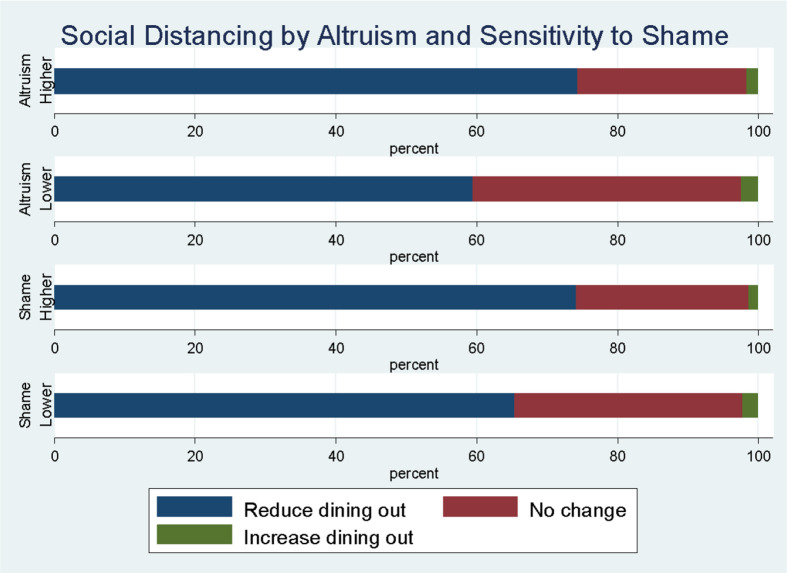
Economic theory is complemented with empirical evidence. An online survey of those aged 30-49 years in Japan (n = 2177) was conducted between April 28 and May 7. Respondents were selected by quota sampling with regard to age group, gender and prefecture of residence. Our main figure shows the proportion of people who increased/did not change/decreased social distancing, relative to the level of altruism and sensitivity to public shaming. The results of OLS and logit models are shown in Supplementary Materials.
Social distancing is a public good under the COVID-19 pandemic for which the free-rider problem is particularly severe. Altruism and social norms are crucial factors in overcoming this problem. Using an original survey, we show that people with higher altruistic concerns and sensitivity to shaming are more likely to follow social distancing measures.
Altruism and social norms are important for reducing the economic cost of the pandemic.
本研究旨在表明,社交距离是 COVID-19 大流行下的一种公共品。
我们运用经济理论来分析一项横断面调查。
经济理论辅以经验证据。我们于 2020 年 4 月 28 日至 5 月 7 日在日本对 30-49 岁人群进行了一项在线调查(n=2177)。调查对象通过年龄组、性别和居住县的配额抽样进行选择。我们的主要图表显示了与利他主义和对公众羞辱的敏感性相对应的增加/不变/减少社交距离的人数比例。OLS 和对数模型的结果显示在补充材料中。
社交距离是 COVID-19 大流行下的一种公共品,其中搭便车问题尤为严重。利他主义和社会规范是克服这一问题的关键因素。通过一项原创调查,我们表明,利他主义和对羞辱更敏感的人更有可能遵守社交距离措施。
利他主义和社会规范对于降低大流行病的经济成本很重要。