Neumann-Böhme Sebastian, Sabat Iryna, Attema Arthur E
Hamburg Center for Health Economics, University of Hamburg, Hamburg, Germany.
EsCHER, Erasmus School of Health Policy and Management, Erasmus University Rotterdam, Rotterdam, Netherlands.
Front Health Serv. 2022 Jul 14;2:871891. doi: 10.3389/frhs.2022.871891. eCollection 2022.
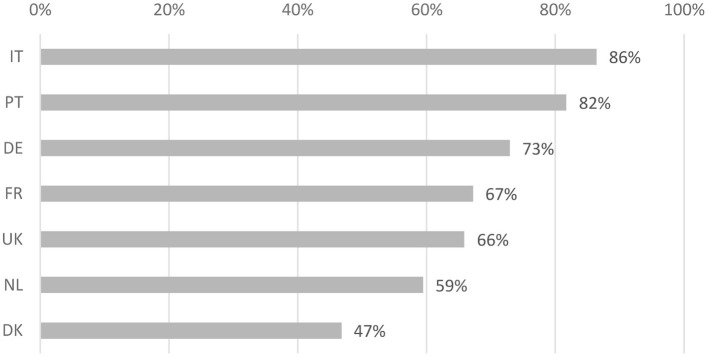
In the Corona pandemic, especially in the phase before vaccines were available, people's risk of infection with COVID-19 was dependent on the adherence to pandemic behaviors (e. g., wearing masks) of others around them. To explore whether altruistic individuals are more likely to engage in pro-social behaviors to protect others during the pandemic, we use data from the European COVID Survey (ECOS). The data was collected in September 2020 and consisted of a representative sample from seven European countries ( = 7,025). Altruism was measured as a deviation from purely self-interested behavior by asking respondents how much they would be willing to donate from an unexpected gain to the equivalent of 1000€. Respondents who were willing to donate more than 0 Euros (68.7%) were treated as altruistic; on average, respondents were willing to donate 11.7% (SD 17.9) of the gain. Controlling for country, sociodemographics, general risk aversion and COVID-specific risk aversion, we find that individuals classified as altruistic were more likely to behave pro-socially. More specifically, we find that altruistic respondents were more likely to wait at home for test results and wear a mask where it is recommended. They would also stay about 1 day longer under quarantine without symptoms after visiting a high-risk country and were less likely to go to a supermarket with COVID symptoms. We find no significant effect for wearing a mask in places where it is mandatory and for inviting more than six people into the house. Furthermore, we find that the subjective risk assessment of COVID-19 also plays a role in these behaviors. Our results support evidence from the literature that suggests that adherence to pro-social pandemic behaviors may be increased if public health officials emphasize the altruistic nature of these behaviors.
在新冠疫情期间,尤其是在疫苗可用之前的阶段,人们感染新冠病毒的风险取决于周围其他人对防疫行为(如佩戴口罩)的遵守情况。为了探究利他主义者在疫情期间是否更有可能采取亲社会行为来保护他人,我们使用了欧洲新冠调查(ECOS)的数据。这些数据于2020年9月收集,来自七个欧洲国家的代表性样本(n = 7025)。利他主义通过询问受访者愿意从一笔意外之财中拿出多少钱捐赠给相当于1000欧元的金额来衡量,以此作为偏离纯粹利己行为的程度。愿意捐赠超过0欧元的受访者(68.7%)被视为利他主义者;平均而言,受访者愿意捐赠收益的11.7%(标准差17.9)。在控制了国家、社会人口统计学、一般风险厌恶和特定于新冠的风险厌恶因素后,我们发现被归类为利他主义的个体更有可能表现出亲社会行为。更具体地说,我们发现利他主义的受访者更有可能在家等待检测结果,并在建议佩戴口罩的地方佩戴口罩。在访问高风险国家后,他们在无症状的情况下接受隔离的时间也会延长约1天,并且感染新冠症状后去超市的可能性更小。我们发现在强制佩戴口罩的地方以及邀请超过六人进入家中这方面没有显著影响。此外,我们发现对新冠病毒的主观风险评估在这些行为中也起到了作用。我们的结果支持了文献中的证据,即如果公共卫生官员强调这些行为的利他性质,可能会增加对亲社会防疫行为的遵守。