Muellner Almuth E, Buerstmayr Maria, Eshonkulov Bobur, Hole David, Michel Sebastian, Hagenguth Julia F, Pachler Bernadette, Pernold Ricarda, Buerstmayr Hermann
Institute for Biotechnology in Plant Production, University of Natural Resources and Life Sciences, Konrad Lorenz Straße 20, 3430, Vienna, Tulln, Austria.
Saatzucht Donau GesmbH. & CoKG, Saatzuchtstrasse 11, 2301, Probstdorf, Austria.
Theor Appl Genet. 2021 Feb;134(2):489-503. doi: 10.1007/s00122-020-03708-8. Epub 2020 Oct 29.
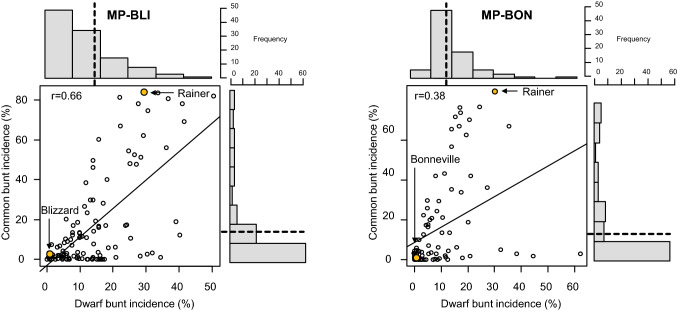
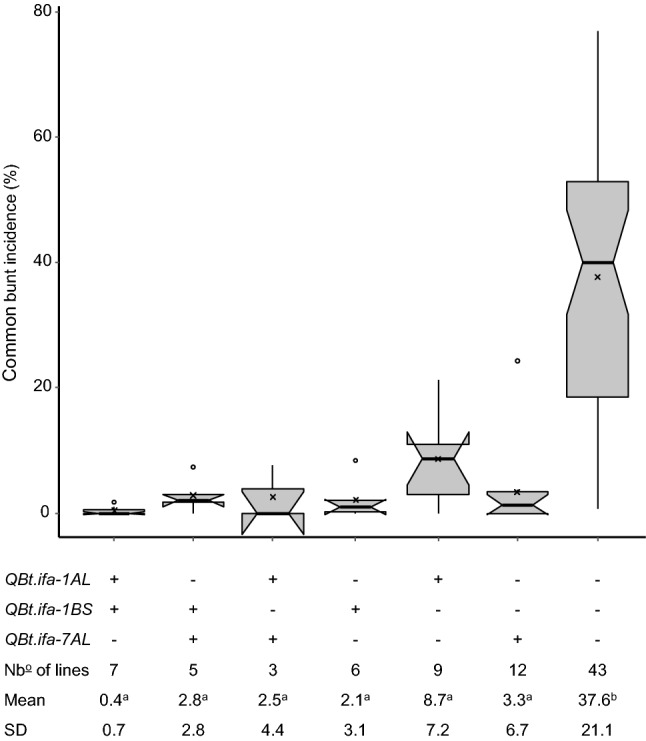
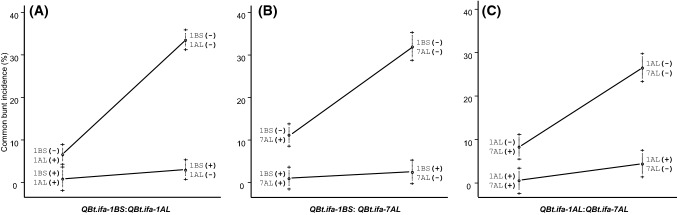
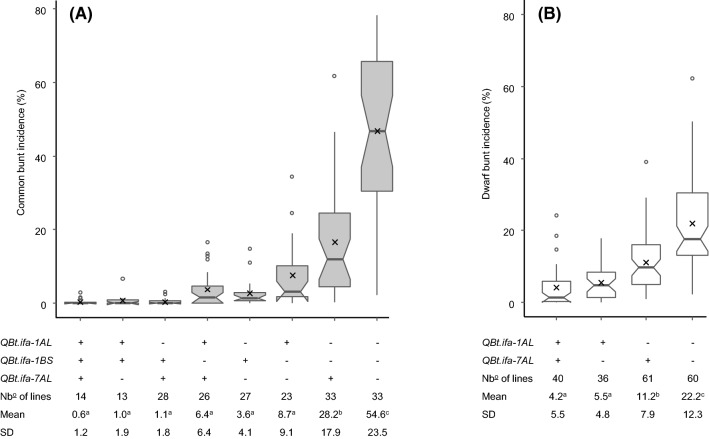
Resistance QTL on chromosomes 1AL and 7AL are effective against common and dwarf bunt, QTL on 1BS affects common bunt and QTL on 7DS affects dwarf bunt in bread wheat. Common bunt, caused by Tilletia caries and T. laevis, and dwarf bunt, caused by T. controversa, negatively affect grain yield and quality of wheat and are particularly destructive in low-input and organic production systems. Two recombinant inbred line (RIL) populations derived by crossing the highly and durably resistant cultivars 'Blizzard' and 'Bonneville' to the susceptible cultivar 'Rainer' were evaluated for their resistance to common and dwarf bunt in artificially inoculated field and greenhouse trials over two growing seasons and genotyped with a 15 K SNP array. Bunt resistance QTL were mapped to chromosomes 1AL, 1BS, 7AL and 7DS. Common bunt resistance was regulated by the major QTL QBt.ifa-1BS and QBt.ifa-1AL together with the moderate effect QTL QBt.ifa-7AL. Dwarf bunt resistance was on the other hand regulated by the QTL QBt.ifa-1AL, QBt.ifa-7AL and QBt.ifa-7DS. Common bunt resistance QTL exhibited pronounced epistatic effects, while epistatic effects were of smaller magnitude for dwarf bunt QTL. Kompetitive Allele-Specific PCR (KASP) markers were developed from SNPs associated with bunt resistance QTL and successfully used for QTL validation in an independent set of RILs. These KASP markers have the potential to support targeted introgression of QTL into elite wheat germplasm and accelerate breeding for enhanced bunt resistance. Durable protection against both common and dwarf bunt can be achieved by combining multiple resistance genes in the same genetic background.
1AL和7AL染色体上的抗腥黑穗病数量性状位点(QTL)对网腥黑穗病和矮腥黑穗病有效,1BS上的QTL影响网腥黑穗病,7DS上的QTL影响面包小麦中的矮腥黑穗病。由小麦光腥黑粉菌和小麦平滑腥黑粉菌引起的网腥黑穗病,以及由小麦矮腥黑粉菌引起的矮腥黑穗病,对小麦的籽粒产量和品质产生负面影响,并且在低投入和有机生产系统中具有特别大的破坏性。通过将高抗且持久抗病的品种“暴风雪”和“邦纳维尔”与感病品种“雷纳”杂交得到的两个重组自交系(RIL)群体,在两个生长季节的人工接种田间试验和温室试验中评估了它们对网腥黑穗病和矮腥黑穗病的抗性,并用一个15K单核苷酸多态性(SNP)芯片进行了基因分型。将抗腥黑穗病QTL定位到1AL、1BS、7AL和7DS染色体上。网腥黑穗病抗性由主效QTL Qbt.ifa-1BS和Qbt.ifa-1AL以及中效QTL Qbt.ifa-7AL共同调控。另一方面,矮腥黑穗病抗性由QTL Qbt.ifa-1AL、Qbt.ifa-7AL和Qbt.ifa-7DS调控。网腥黑穗病抗性QTL表现出明显的上位性效应,而矮腥黑穗病QTL的上位性效应较小。竞争性等位基因特异性PCR(KASP)标记由与抗腥黑穗病QTL相关的SNP开发而来,并成功用于一组独立的RILs中的QTL验证。这些KASP标记有潜力支持将QTL定向导入优良小麦种质,并加速培育增强抗腥黑穗病的品种。通过在相同遗传背景中组合多个抗性基因,可以实现对网腥黑穗病和矮腥黑穗病的持久保护。