Chen Nian, Li Yuwen, Fan Haozhi, Tian Anran, Yuan Hui, Jiang Zhengyi, Yu Yunxi, Ruan Lili, Hu Pingping, Yue Ming, Li Jun, Zhu Chuanlong
Department of Infectious Disease.
Department of Pediatrics.
Medicine (Baltimore). 2020 Oct 23;99(43):e22635. doi: 10.1097/MD.0000000000022635.
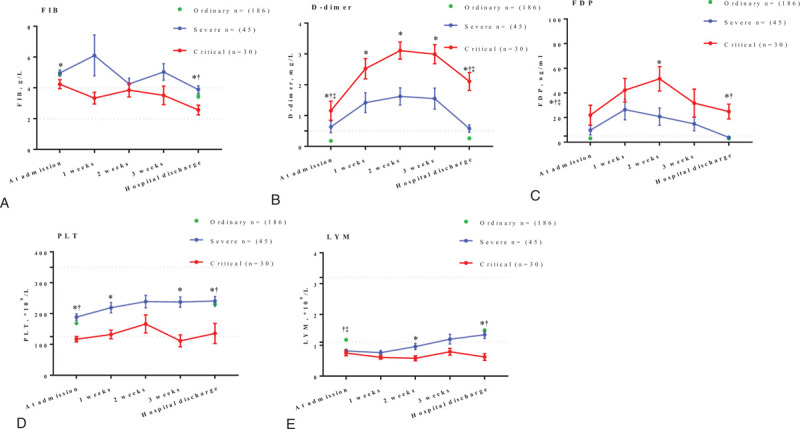
Coronavirus Disease 2019 (COVID-19) has became a major problem affecting global health security.To assess the differences and dynamic changes of blood coagulation function in COVID-19 patients with different severity.A total of 261 COVID-19 patients from January 24 to March 25, 2020 in Huangshi, Hubei Province were enrolled.We designed a retrospective observational study. Clinical information, including age, blood routine and blood coagulation function, were collected. According to the Diagnosis and Treatment Guidelines for COVID-19 (seventh version) that issued by the National Health Committee of the People's Republic of China, patients were divided into 3 subgroups: 186 ordinary, 45 severe and 30 critical ones. We compared the differences in blood coagulation factors among groups.Average age in critical group (71.47 ± 11.48 years) was the oldest of 3 subgroups. At admission, statistically differences could be observed among ordinary, severe and critical patients in D-dimer (0.18 ± 0.33, 0.63 ± 1.13 and 1.16 ± 1.58 mg/L), fibrinogen/fibrin degradation products (FDP) (3.11 ± 5.30, 9.82 ± 23.91 and 21.94 ± 40.98 μg/ml), platelet [(169 ± 62.85), (188 ± 71.56) and (117 ± 38.31) × 10/L)] and lymphocyte count [(1.18 ± 0.46), (0.82 ± 0.35) and (0.75 ± 0.39) × 10/L)], respectively (P < .05). During hospitalization, the peak values of coagulation and valley values of blood routine were monitored. There were significant differences among ordinary, severe and critical patients in D-dimer (0.26 ± 0.46, 1.39 ± 1.51 and 2.89 ± 1.68 mg/L), FDP (3.29 ± 5.52, 23.68 ± 39.07 and 56.11 ± 49.94 μg/ml), platelet [(164 ± 55.53), (171 ± 69.96) and (84 ± 57.80) × 10/L)] and lymphocyte count [(1.10 ± 0.46), (0.65 ± 0.35) and (0.55 ± 0.31) × 10/L)], respectively (P < .001). D-dimer and FDP in the course of disease in severe/critical groups showed a first upward and then downward trend.We concluded that coagulation function indexes such as D-dimer and FDP could be served as markers to estimate COVID-19 patients condition. Close monitoring of coagulation function may be helpful for early diagnosis of severe patients and guidance of treatments.
2019冠状病毒病(COVID-19)已成为影响全球卫生安全的一个主要问题。为评估不同严重程度的COVID-19患者凝血功能的差异及动态变化。纳入了2020年1月24日至3月25日湖北省黄石市的261例COVID-19患者。我们设计了一项回顾性观察性研究。收集了包括年龄、血常规和凝血功能在内的临床信息。根据中华人民共和国国家卫生健康委员会发布的《新型冠状病毒肺炎诊疗方案(试行第七版)》,将患者分为3个亚组:186例普通型、45例重型和30例危重型。我们比较了各组凝血因子的差异。危重组的平均年龄(71.47±11.48岁)是3个亚组中最大的。入院时,普通型、重型和危重型患者的D-二聚体(0.18±0.33、0.63±1.13和1.16±1.58mg/L)、纤维蛋白原/纤维蛋白降解产物(FDP)(3.11±5.30、9.82±23.91和21.94±40.98μg/ml)、血小板[(169±62.85)、(188±71.56)和(117±38.31)×10⁹/L]及淋巴细胞计数[(1.18±0.46)、(0.82±0.35)和(0.75±0.39)×10⁹/L]存在统计学差异(P<0.05)。住院期间,监测了凝血峰值和血常规谷值。普通型、重型和危重型患者的D-二聚体(0.26±0.46、1.39±1.51和2.89±1.68mg/L)、FDP(3.29±5.52、23.68±39.07和56.11±49.94μg/ml)、血小板[(164±55.53)、(171±69.96)和(84±57.80)×10⁹/L]及淋巴细胞计数[(1.10±0.46)、(0.65±0.35)和(0.55±0.31)×10⁹/L]也存在显著差异(P<0.001)。重型/危重组患者病程中的D-二聚体和FDP呈先上升后下降趋势。我们得出结论,D-二聚体和FDP等凝血功能指标可作为评估COVID-19患者病情的标志物。密切监测凝血功能可能有助于重症患者的早期诊断和治疗指导。