Sun Yue, Huang Yucheng, Chen Tiantian, Li Xueping, Chen Jiayi, Wang Zhuozhi, Lin Kexin, Gao Yongxiang, He Lisha
College of Basic Medicine.
College of Clinical Medicine.
Medicine (Baltimore). 2020 Oct 23;99(43):e22841. doi: 10.1097/MD.0000000000022841.
A large number of clinical studies have confirmed that after treatment with traditional Chinese medicine components such as sinomenine (SIN), the matrix -metalloproteinase3 (MMP-3) level of patients with rheumatoid arthritis (RA) shows a significant decrease, whereas MMP-3 can be involved in degrading bone matrix in humans, so in the progression of bone and joint injury in patients with RA, serum MMP-3 can be used as an important biochemical marker. The traditional Chinese medicine components commonly used in clinical practice include total glucosides of paeony (TGP), SIN, and tripterygium glycosides, which have the characteristics of disease-modifyinganti-rheumatic drugs and non-steroidal anti-inflammatory drugs, while they can reduce the toxic side effects of methotrexate (MTX), and their combination with other drugs such as MTX and leflunomide (HWA486) has become an important regimen for the treatment of RA in clinical practice. Therefore, we designed this study protocol to evaluate the adjuvant effect of commonly used traditional Chinese medicine components combined with MTX in the treatment of osteoarticular injury in RA.
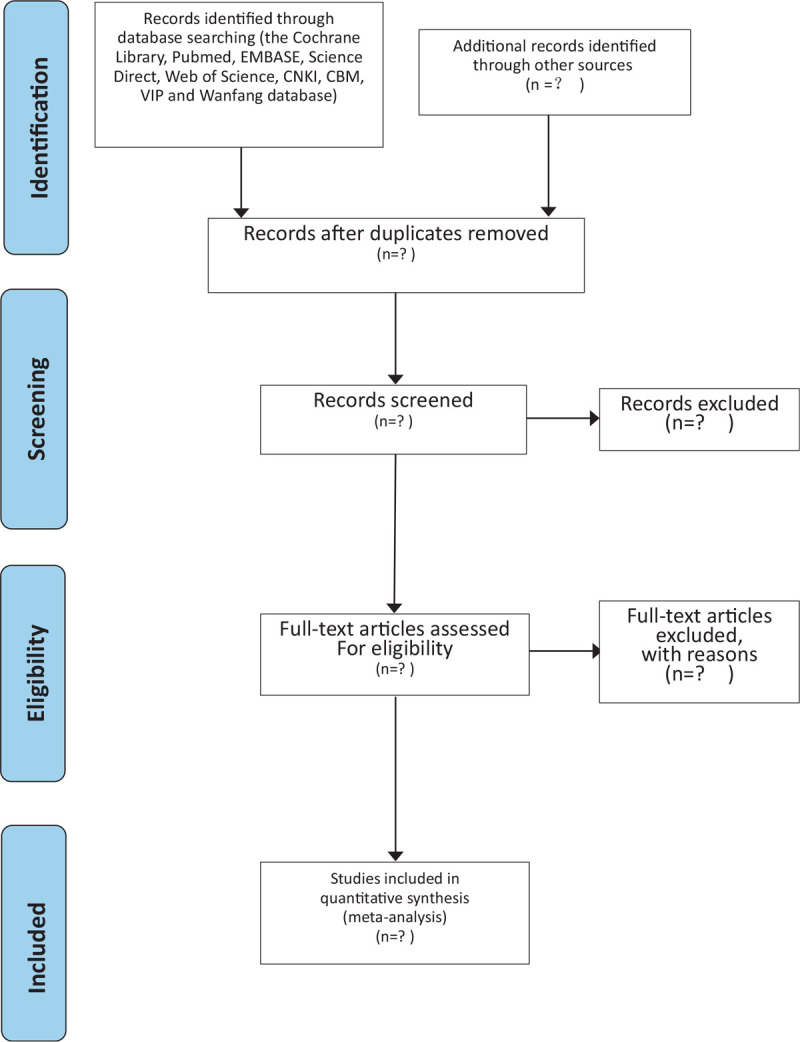
The search time was set from January 2000 to September 2020 in this study. EMBASE database, Cochrane Library, PubMed, Web of Science, Science Direct, Chinese National Knowledge Infrastructure, China Biology Medicine disc (CBM), Chinese Scientifific Journals Database (VIP), and Wanfang Database were used as search sources to select the traditional Chinese medicine components that reduce MMP-3 and use MTX in the treatment of RA. Clinical randomized controlled trials were used, and inclusion criteria and exclusion criteria were set for screening. In this study, MMP-3, erythrocyte sedimentation rate (ESR), C-reactive protein (CRP), cyclic peptide containing citrulline (CCP) and rheumatoid factor (RF) were used as the main outcomes, and the improvement of Disease Activity Score 28 (DAS28), joint bone mineral density, Clinical Disease Activity Index (CDAI), and other clinically relevant symptoms was selected as the secondary outcomes. Revman software version 5.3 was used for statistical analysis of data and risk assessment of deviation in this meta-analysis. In this study, one researcher performed study direction selection, literature inquiry, and literature download, and 2 independent reviewers performed literature data extraction and literature quality assessment. Dichotomized data are expressed as relative risk, continuous data are expressed as mean difference or standard mean difference, and finally fixed-effect model or random-effect model is used for synthesis according to the heterogeneity of data.
To evaluate the effect of downregulation of MMP-3 level by traditional Chinese medicine components combined with MTX on the progression of bone injury in patients with RA by serum MMP-3, ESR, CRP, CCP, and RF.
This study protocol can be used to evaluate the efficacy and safety of traditional Chinese medicine components combined with MTX in the treatment of bone injury in patients with RA.
This study is a secondary study based on the published clinical research; therefore, approval from an ethics committee is not required for this study. In accordance with the Preferred Reporting Items for Systematic Reviews and Meta-Analysis Protocol (PRISMA-P), the results of this study will be published in peer-reviewed scientific journals and conference papers. REGISTRATION NUMBER:: is INPLASY202090064.
大量临床研究证实,使用青藤碱(SIN)等中药成分治疗后,类风湿关节炎(RA)患者的基质金属蛋白酶3(MMP-3)水平显著降低,而MMP-3可参与人体骨基质的降解,因此在RA患者骨与关节损伤的进展过程中,血清MMP-3可作为一项重要的生化指标。临床常用的中药成分包括白芍总苷(TGP)、SIN和雷公藤多苷,它们具有改善病情抗风湿药和非甾体抗炎药的特点,同时可降低甲氨蝶呤(MTX)的毒副作用,其与MTX和来氟米特(HWA486)等其他药物联合已成为临床治疗RA的重要方案。因此,我们设计了本研究方案,以评估常用中药成分联合MTX治疗RA骨与关节损伤的辅助效果。
本研究的检索时间设定为2000年1月至2020年9月。以EMBASE数据库、Cochrane图书馆、PubMed、Web of Science、Science Direct、中国知网、中国生物医学文献数据库(CBM)、中文科技期刊数据库(VIP)和万方数据库为检索源,筛选降低MMP-3且使用MTX治疗RA的中药成分。采用临床随机对照试验,并设定纳入标准和排除标准进行筛选。本研究以MMP-3、红细胞沉降率(ESR)、C反应蛋白(CRP)、瓜氨酸环肽(CCP)和类风湿因子(RF)作为主要结局指标,选取疾病活动度评分28(DAS28)、关节骨密度、临床疾病活动指数(CDAI)等临床相关症状的改善情况作为次要结局指标。本Meta分析采用Revman 5.3软件进行数据的统计分析和偏倚风险评估。本研究由一名研究人员进行研究方向选择、文献检索和文献下载,由2名独立评价员进行文献数据提取和文献质量评估。二分类数据以相对危险度表示,连续性数据以均数差或标准化均数差表示,最后根据数据的异质性采用固定效应模型或随机效应模型进行合并。
通过血清MMP-3、ESR、CRP、CCP和RF评估中药成分联合MTX下调MMP-3水平对RA患者骨损伤进展的影响。
本研究方案可用于评估中药成分联合MTX治疗RA患者骨损伤的疗效和安全性。
本研究是基于已发表的临床研究进行的二次研究;因此,本研究无需伦理委员会批准。按照系统评价和Meta分析方案的首选报告项目(PRISMA-P),本研究结果将发表在同行评审的科学期刊和会议论文中。注册号:INPLASY202090064。
