Zhu Yanyan, Huang Muhua, Zhao Yanlin, Pei Yixiu, Wang Yao, Wang Lei, He Ting, Zhou Fuqing, Zeng Xianjun
Department of Radiology, The First Affiliated Hospital, Nanchang University.
Neuroimaging Lab, Jiangxi Province Medical Imaging Research Institute, Nanchang, Jiangxi, People's Republic of China.
Medicine (Baltimore). 2020 Oct 23;99(43):e22860. doi: 10.1097/MD.0000000000022860.
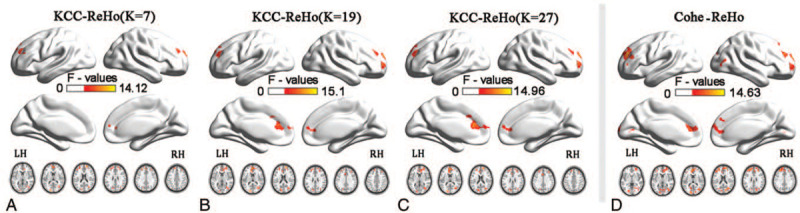
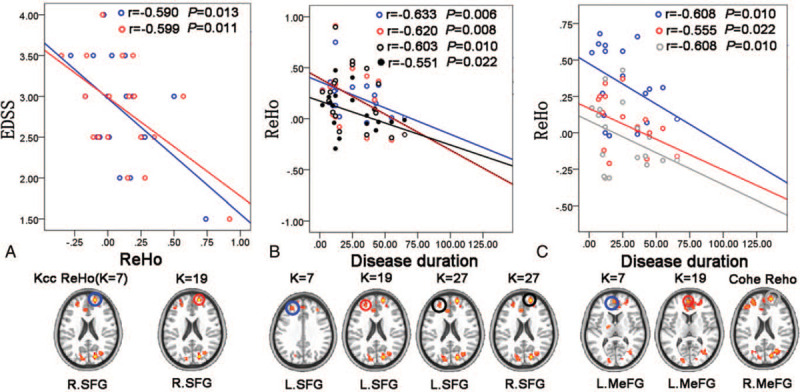
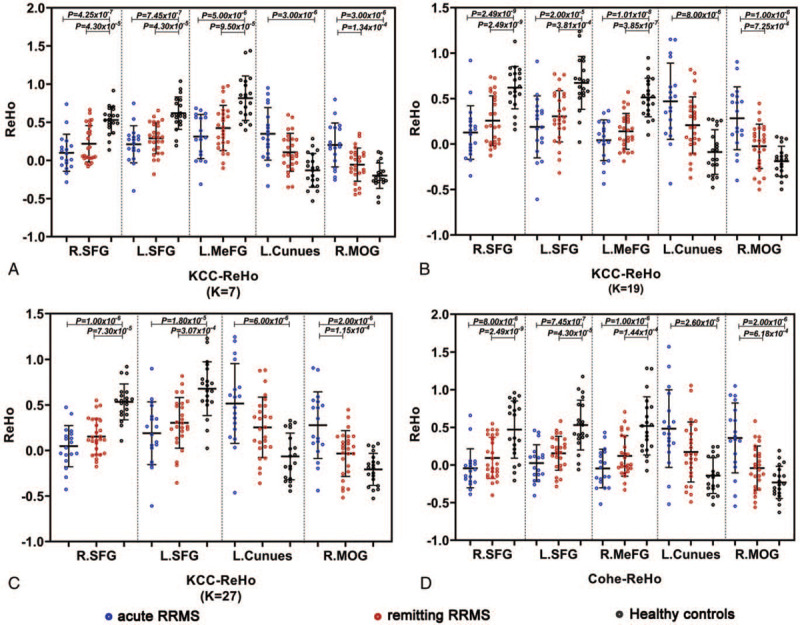
Using Kendall's coefficient of concordance (KCC-) and Coherence (Cohe-) regional homogeneity (ReHo) to explore the alterations of brain local functional connectivity in acute and remitting relapsing-remitting multiple sclerosis (RRMS), and its clinical relevance.18 acute RRMS, 26 remitting RRMS and 20 healthy controls received resting-state functional magnetic resonance imaging scanning. After data preprocessing and ReHo (KCC-ReHo and Cohe-ReHo) calculation, analysis of variance and followed post hoc analysis was used to compare the KCC-ReHo or Cohe ReHo maps across groups.After analysis of variance analysis, regions with significant among-group differences detected by the 2 ReHo analysis were overlapped, these overlapped regions located in the left superior frontal gyrus (SFG), right SFG, left cuneus and right middle occipital gyrus (P < .01, Gaussian random field theory correction). Followed post hoc tests showed that, compared with healthy controls,Both acute and remitting RRMS patients has disease-related brain dysfunction, interestingly, relative to remitting RRMS, the acute RRMS patients mobilized more brain regions involving visual information processing in an attempt to maintain functional stability. In addition, our results also provide a methodological consideration for future ReHo analysis.
使用肯德尔和谐系数(KCC-)和一致性(Cohe-)局部一致性(ReHo)来探究复发缓解型多发性硬化症(RRMS)急性发作期和缓解期脑局部功能连接的改变及其临床相关性。18例RRMS急性发作期患者、26例RRMS缓解期患者和20名健康对照者接受静息态功能磁共振成像扫描。在进行数据预处理和ReHo(KCC-ReHo和Cohe-ReHo)计算后,采用方差分析及随后的事后分析来比较各组间的KCC-ReHo或Cohe-ReHo图谱。经过方差分析,通过两种ReHo分析检测到的组间差异显著的区域存在重叠,这些重叠区域位于左侧额上回(SFG)、右侧SFG、左侧楔叶和右侧枕中回(P<0.01,高斯随机场理论校正)。随后的事后检验表明,与健康对照者相比,RRMS急性发作期和缓解期患者均存在与疾病相关的脑功能障碍,有趣的是,相对于RRMS缓解期患者,RRMS急性发作期患者动员了更多涉及视觉信息处理的脑区,试图维持功能稳定性。此外,我们的结果还为未来的ReHo分析提供了方法学上的思考。