• 文献检索
  • 文档翻译
  • 深度研究
  • 学术资讯
  • Suppr Zotero 插件Zotero 插件
  • 邀请有礼
  • 套餐&价格
  • 历史记录
应用&插件
Suppr Zotero 插件Zotero 插件浏览器插件Mac 客户端Windows 客户端微信小程序
定价
高级版会员购买积分包购买API积分包
服务
文献检索文档翻译深度研究API 文档MCP 服务
关于我们
关于 Suppr公司介绍联系我们用户协议隐私条款
关注我们

Suppr 超能文献

核心技术专利:CN118964589B侵权必究
粤ICP备2023148730 号-1Suppr @ 2026

文献检索

告别复杂PubMed语法,用中文像聊天一样搜索,搜遍4000万医学文献。AI智能推荐,让科研检索更轻松。

立即免费搜索

文件翻译

保留排版,准确专业,支持PDF/Word/PPT等文件格式,支持 12+语言互译。

免费翻译文档

深度研究

AI帮你快速写综述,25分钟生成高质量综述,智能提取关键信息,辅助科研写作。

立即免费体验

COVID-19 相关神经系统疾病:CNS 入侵和血脑相关性的潜在途径。

COVID-19-Associated Neurological Disorders: The Potential Route of CNS Invasion and Blood-Brain Relevance.

机构信息

Cerebrovascular Research, Department of Biomedical Engineering, Lerner Research Institute, Cleveland Clinic, Cleveland, OH 44195, USA.

Department of Biomedical Engineering and Molecular Medicine, Cleveland Clinic Lerner College of Medicine of Case Western Reserve University, Cleveland, OH 44195, USA.

出版信息

Cells. 2020 Oct 27;9(11):2360. doi: 10.3390/cells9112360.

DOI:10.3390/cells9112360
PMID:33120941
原文链接:https://pmc.ncbi.nlm.nih.gov/articles/PMC7692725/
Abstract

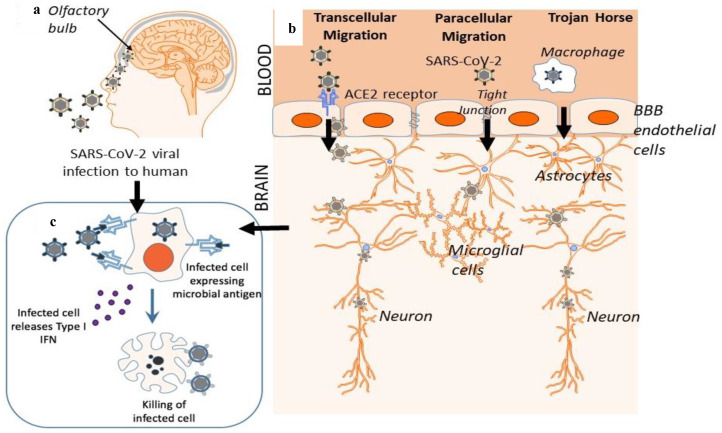
Severe acute respiratory syndrome coronavirus 2 (SARS-CoV-2) is a novel human coronavirus that has sparked a global pandemic of the coronavirus disease of 2019 (COVID-19). The virus invades human cells through the angiotensin-converting enzyme 2 (ACE2) receptor-driven pathway, primarily targeting the human respiratory tract. However, emerging reports of neurological manifestations demonstrate the neuroinvasive potential of SARS-CoV-2. This review highlights the possible routes by which SARS-CoV-2 may invade the central nervous system (CNS) and provides insight into recent case reports of COVID-19-associated neurological disorders, namely ischaemic stroke, encephalitis, encephalopathy, epilepsy, neurodegenerative diseases, and inflammatory-mediated neurological disorders. We hypothesize that SARS-CoV-2 neuroinvasion, neuroinflammation, and blood-brain barrier (BBB) dysfunction may be implicated in the development of the observed disorders; however, further research is critical to understand the detailed mechanisms and pathway of infectivity behind CNS pathogenesis.

摘要

严重急性呼吸综合征冠状病毒 2(SARS-CoV-2)是一种新型的人类冠状病毒,引发了 2019 年冠状病毒病(COVID-19)的全球大流行。该病毒通过血管紧张素转换酶 2(ACE2)受体驱动途径入侵人体细胞,主要靶向人体呼吸道。然而,越来越多的神经系统表现报告表明 SARS-CoV-2 具有神经侵袭性。本综述强调了 SARS-CoV-2 可能入侵中枢神经系统(CNS)的可能途径,并提供了对 COVID-19 相关神经系统疾病的最新病例报告的深入了解,即缺血性中风、脑炎、脑病、癫痫、神经退行性疾病和炎症介导的神经系统疾病。我们假设 SARS-CoV-2 的神经侵袭、神经炎症和血脑屏障(BBB)功能障碍可能与观察到的疾病的发展有关;然而,为了了解中枢神经系统发病机制背后的详细机制和感染途径,还需要进一步的研究。
https://cdn.ncbi.nlm.nih.gov/pmc/blobs/876b/7692725/821efb0edc4c/cells-09-02360-g001.jpg

相似文献

1
COVID-19-Associated Neurological Disorders: The Potential Route of CNS Invasion and Blood-Brain Relevance.COVID-19 相关神经系统疾病:CNS 入侵和血脑相关性的潜在途径。
Cells. 2020 Oct 27;9(11):2360. doi: 10.3390/cells9112360.
2
Neuroinvasion, neurotropic, and neuroinflammatory events of SARS-CoV-2: understanding the neurological manifestations in COVID-19 patients.SARS-CoV-2 的神经入侵、嗜神经性和神经炎症事件:了解 COVID-19 患者的神经表现。
Neurol Sci. 2020 Oct;41(10):2657-2669. doi: 10.1007/s10072-020-04575-3. Epub 2020 Jul 28.
3
The neurology of COVID-19 revisited: A proposal from the Environmental Neurology Specialty Group of the World Federation of Neurology to implement international neurological registries.重新审视 COVID-19 相关神经学:世界神经病学联合会环境神经病学专业组提出实施国际神经学登记的建议。
J Neurol Sci. 2020 Jul 15;414:116884. doi: 10.1016/j.jns.2020.116884. Epub 2020 May 7.
4
Cross-Talk Between Key Players in Patients with COVID-19 and Ischemic Stroke: A Review on Neurobiological Insight of the Pandemic.新型冠状病毒肺炎与缺血性脑卒中患者关键因素相互作用:对大流行神经生物学认识的综述。
Mol Neurobiol. 2020 Dec;57(12):4921-4928. doi: 10.1007/s12035-020-02072-4. Epub 2020 Aug 19.
5
Understanding the neurotropic characteristics of SARS-CoV-2: from neurological manifestations of COVID-19 to potential neurotropic mechanisms.了解 SARS-CoV-2 的神经嗜性特征:从 COVID-19 的神经系统表现到潜在的神经嗜性机制。
J Neurol. 2020 Aug;267(8):2179-2184. doi: 10.1007/s00415-020-09929-7. Epub 2020 May 26.
6
The involvement of the central nervous system in patients with COVID-19.COVID-19 患者的中枢神经系统受累情况。
Rev Neurosci. 2020 May 26;31(4):453-456. doi: 10.1515/revneuro-2020-0026.
7
SARS-CoV-2 and the Nervous System: From Clinical Features to Molecular Mechanisms.严重急性呼吸综合征冠状病毒 2 型与神经系统:从临床特征到分子机制。
Int J Mol Sci. 2020 Jul 31;21(15):5475. doi: 10.3390/ijms21155475.
8
Possible routes of SARS-CoV-2 invasion in brain: In context of neurological symptoms in COVID-19 patients.新冠病毒侵犯大脑的可能途径:在 COVID-19 患者的神经系统症状方面。
J Neurosci Res. 2020 Dec;98(12):2376-2383. doi: 10.1002/jnr.24717. Epub 2020 Aug 31.
9
Optimized Pseudotyping Conditions for the SARS-COV-2 Spike Glycoprotein.SARS-COV-2 刺突糖蛋白的优化假型条件。
J Virol. 2020 Oct 14;94(21). doi: 10.1128/JVI.01062-20.
10
COVID-19 and the nervous system.新型冠状病毒肺炎与神经系统。
J Neurovirol. 2020 Apr;26(2):143-148. doi: 10.1007/s13365-020-00840-5. Epub 2020 May 23.

引用本文的文献

1
Implicating neuroinflammation in hippocampus, prefrontal cortex and amygdala with cognitive deficit: a narrative review.海马体、前额叶皮质和杏仁核中的神经炎症与认知缺陷的关联:一项叙述性综述。
3 Biotech. 2025 Sep;15(9):320. doi: 10.1007/s13205-025-04468-2. Epub 2025 Aug 30.
2
The blood-brain barrier in health, neurological diseases, and COVID-19.健康、神经疾病和新冠肺炎中的血脑屏障
Fundam Res. 2022 Mar 12;2(5):817-826. doi: 10.1016/j.fmre.2022.03.003. eCollection 2022 Sep.
3
Need for awareness and surveillance of long-term post-COVID neurodegenerative disorders. A position paper from the neuroCOVID-19 task force of the European Academy of Neurology.

本文引用的文献

1
Acute Demyelinating Encephalomyelitis (ADEM) in COVID-19 Infection: A Case Series.急性脱髓鞘性脑脊髓炎(ADEM)合并 COVID-19 感染:病例系列。
Neurol India. 2020 Sep-Oct;68(5):1192-1195. doi: 10.4103/0028-3886.299174.
2
CSF Biomarkers in Patients With COVID-19 and Neurologic Symptoms: A Case Series.COVID-19 伴有神经系统症状患者的脑脊液生物标志物:病例系列研究。
Neurology. 2021 Jan 12;96(2):e294-e300. doi: 10.1212/WNL.0000000000010977. Epub 2020 Oct 1.
3
Encephalopathy in COVID-19 patients; viral, parainfectious, or both?新冠病毒感染患者的脑病:病毒感染、感染后状态,还是两者皆有?
对新冠后长期神经退行性疾病的认识和监测需求。欧洲神经病学学会神经新冠-19工作组的立场文件。
J Neurol. 2025 May 6;272(6):380. doi: 10.1007/s00415-025-13110-3.
4
Clinical and immunological features in patients with neuroimmune complications of COVID-19 during Omicron wave in China: a case series.中国奥密克戎毒株流行期间新冠病毒感染相关神经免疫并发症患者的临床及免疫学特征:病例系列研究
Front Immunol. 2024 Dec 18;15:1499082. doi: 10.3389/fimmu.2024.1499082. eCollection 2024.
5
SARS-CoV-2 Infection and Alpha-Synucleinopathies: Potential Links and Underlying Mechanisms.SARS-CoV-2 感染与α-突触核蛋白病:潜在关联及潜在机制。
Int J Mol Sci. 2024 Nov 10;25(22):12079. doi: 10.3390/ijms252212079.
6
The Development of Epilepsy Following CNS Viral Infections: Mechanisms.中枢神经系统病毒感染后继发癫痫的发生机制。
Curr Neurol Neurosci Rep. 2024 Nov 16;25(1):2. doi: 10.1007/s11910-024-01393-4.
7
The Role of ACE2 in Neurological Disorders: From Underlying Mechanisms to the Neurological Impact of COVID-19.ACE2 在神经紊乱中的作用:从潜在机制到 COVID-19 对神经系统的影响。
Int J Mol Sci. 2024 Sep 15;25(18):9960. doi: 10.3390/ijms25189960.
8
Neuropsychiatric symptoms associated with the COVID-19 and its potential nervous system infection mechanism: the role of imaging in the study.与新型冠状病毒肺炎相关的神经精神症状及其潜在的神经系统感染机制:影像学在该研究中的作用
Psychoradiology. 2021 Dec 22;1(4):199-211. doi: 10.1093/psyrad/kkab019. eCollection 2021 Dec.
9
Brain temperature and free water increases after mild COVID-19 infection.轻度 COVID-19 感染后大脑温度和自由水增加。
Sci Rep. 2024 Mar 28;14(1):7450. doi: 10.1038/s41598-024-57561-6.
10
Implications of COVID-19 in Parkinson's disease: the purinergic system in a therapeutic-target perspective to diminish neurodegeneration.新型冠状病毒肺炎对帕金森病的影响:从治疗靶点角度看嘌呤能系统对减少神经退行性变的作用。
Purinergic Signal. 2024 Oct;20(5):487-507. doi: 10.1007/s11302-024-09998-7. Epub 2024 Mar 9.
eNeurologicalSci. 2020 Dec;21:100275. doi: 10.1016/j.ensci.2020.100275. Epub 2020 Sep 21.
4
Non-neuronal expression of SARS-CoV-2 entry genes in the olfactory system suggests mechanisms underlying COVID-19-associated anosmia.SARS-CoV-2 进入基因在嗅觉系统中的非神经元表达提示了 COVID-19 相关嗅觉丧失的潜在机制。
Sci Adv. 2020 Jul 31;6(31). doi: 10.1126/sciadv.abc5801. Epub 2020 Jul 24.
5
COVID-19 and Multiple Sclerosis: Predisposition and Precautions in Treatment.新型冠状病毒肺炎与多发性硬化症:治疗中的易感性与预防措施
SN Compr Clin Med. 2020;2(10):1802-1807. doi: 10.1007/s42399-020-00504-9. Epub 2020 Sep 3.
6
Prevalence and impact of COVID-19 in Parkinson's disease: evidence from a multi-center survey in Tuscany region.COVID-19 在帕金森病中的流行情况和影响:来自托斯卡纳地区多中心调查的证据。
J Neurol. 2021 Apr;268(4):1179-1187. doi: 10.1007/s00415-020-10002-6. Epub 2020 Sep 3.
7
Parainfectious encephalitis in COVID-19: "The Claustrum Sign".新型冠状病毒肺炎相关感染后脑炎:“屏状核征”
J Neurol. 2021 Jun;268(6):2031-2034. doi: 10.1007/s00415-020-10185-y. Epub 2020 Sep 3.
8
Clinical course of a 66-year-old man with an acute ischaemic stroke in the setting of a COVID-19 infection.一名66岁男性在新型冠状病毒肺炎感染背景下发生急性缺血性卒中的临床病程。
BMJ Case Rep. 2020 Aug 24;13(8):e235920. doi: 10.1136/bcr-2020-235920.
9
An inflammatory cytokine signature predicts COVID-19 severity and survival.炎症细胞因子特征可预测 COVID-19 严重程度和存活情况。
Nat Med. 2020 Oct;26(10):1636-1643. doi: 10.1038/s41591-020-1051-9. Epub 2020 Aug 24.
10
Impact of COVID-19 on Alzheimer's Disease Risk: Viewpoint for Research Action.2019年冠状病毒病对阿尔茨海默病风险的影响:研究行动观点
Healthcare (Basel). 2020 Aug 21;8(3):286. doi: 10.3390/healthcare8030286.