Pais Ricardo, Ruano Luís, P Carvalho Ofélia, Barros Henrique
EPIUnit-Instituto de Saúde Pública, Universidade do Porto, Rua das Taipas, n° 135, 4050-600 Porto, Portugal.
Departamento de Epidemiologia Clínica, Medicina Preditiva e Saúde Pública, Faculdade de Medicina da Universidade do Porto, Alameda Prof. Hernâni Monteiro, 4200-319 Porto, Portugal.
Geriatrics (Basel). 2020 Oct 27;5(4):84. doi: 10.3390/geriatrics5040084.
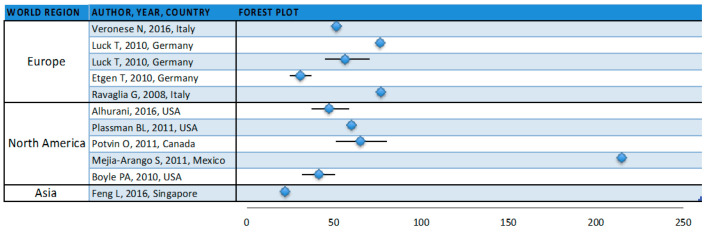
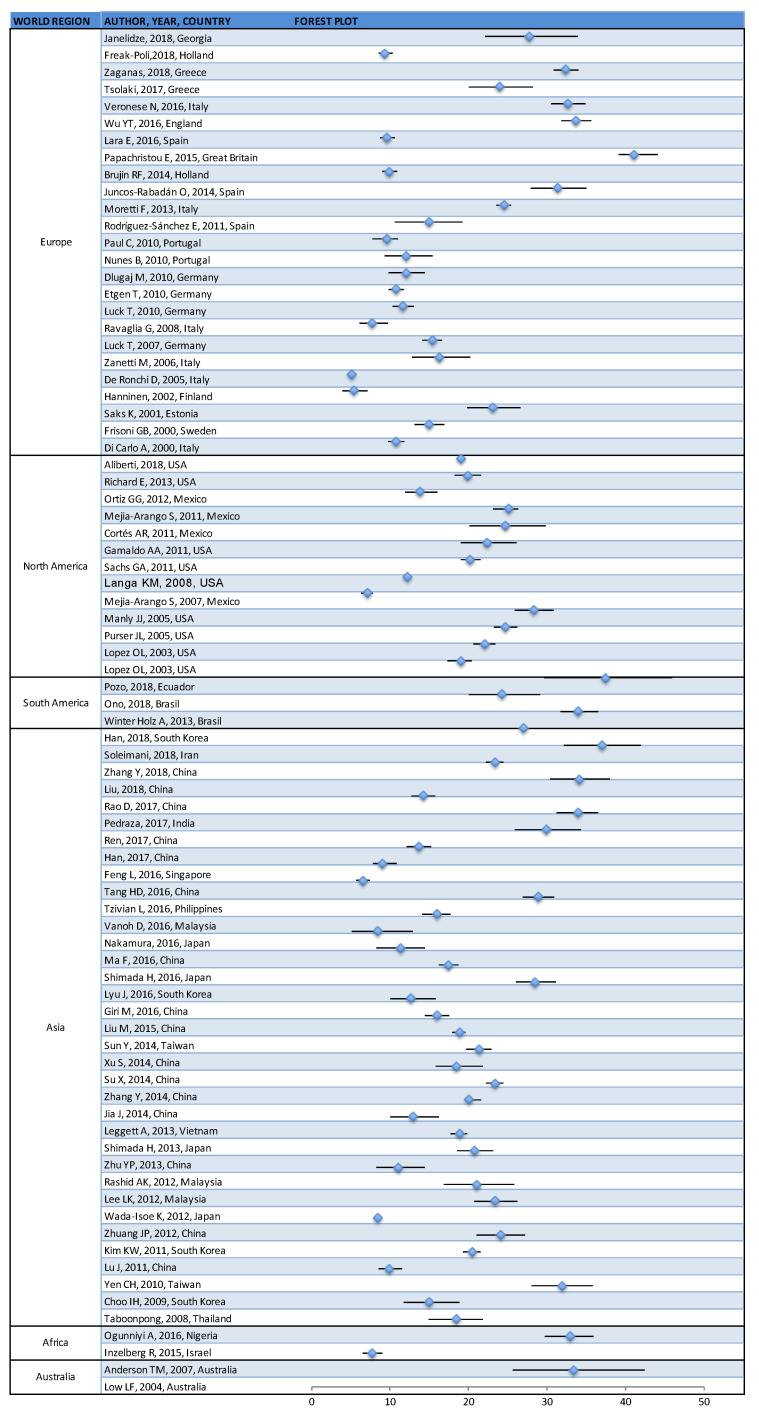
(1) Background: We proposed to review worldwide estimates of cognitive impairment prevalence and incidence in adults older than 50 years of age living in the community. (2) Methods: Systematic searches were performed in January 2019 using MEDLINE/PubMed. Articles were selected if they referred to cognitive impairment, prevalence, incidence, elders, and population or community-based studies. Analysis, aggregated by different methodologic features, was performed. (3) Results: Prevalence (80 studies) ranged between 5.1% and 41% with a median of 19.0% (25th percentile = 12.0%; 75th percentile = 24.90%). Incidence (11 studies) ranged from 22 to 76.8 per 1000 person-years with a median of 53.97 per 1000 person-years (25th percentile = 39.0; 75th percentile = 68.19). No statistically significant effects were found except for inclusion age. (4) Conclusion: We propose that the homogenization and clarification of the definition of what constitutes cognitive impairment are essential to refine the epidemiological understanding of this entity. The results of this review reinforce the importance of adherence to standardized cut-off scores for cognitive tests to promote study comparability.
(1) 背景:我们提议回顾全球范围内对社区中50岁以上成年人认知障碍患病率和发病率的估计。(2) 方法:2019年1月使用MEDLINE/PubMed进行系统检索。如果文章涉及认知障碍、患病率、发病率、老年人以及基于人群或社区的研究,则将其纳入。按不同方法学特征进行汇总分析。(3) 结果:患病率(80项研究)在5.1%至41%之间,中位数为19.0%(第25百分位数 = 12.0%;第75百分位数 = 24.90%)。发病率(11项研究)每1000人年为22至76.8,中位数为每1000人年53.97(第25百分位数 = 39.0;第75百分位数 = 68.19)。除纳入年龄外,未发现统计学上的显著影响。(4) 结论:我们认为,对认知障碍构成的定义进行同质化和澄清对于完善对该实体的流行病学理解至关重要。本综述结果强化了坚持认知测试标准化临界值以促进研究可比性的重要性。