Department of Medicine Division of Cardiology Weill Cornell Medicine - New York Presbyterian Hospital New York NY.
Department of Medicine Division of Cardiology New York Presbyterian Hospital-Queens Flushing NY.
J Am Heart Assoc. 2021 Mar 16;10(6):e018477. doi: 10.1161/JAHA.120.018477. Epub 2020 Oct 30.
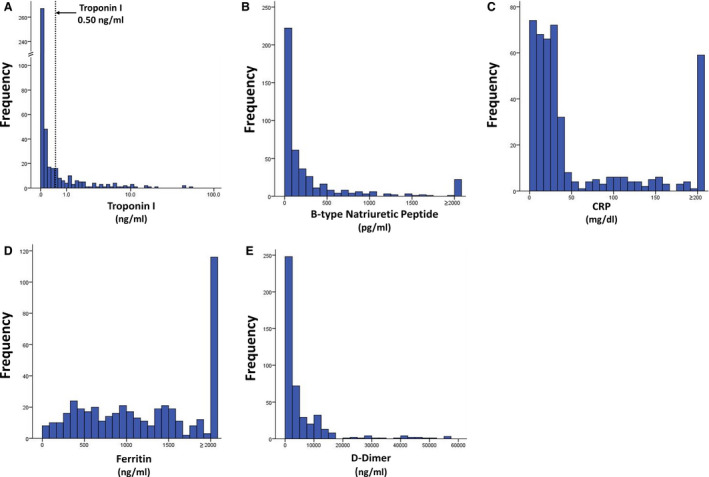
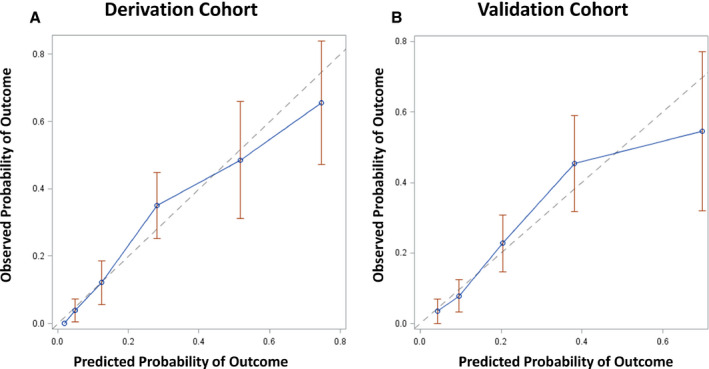
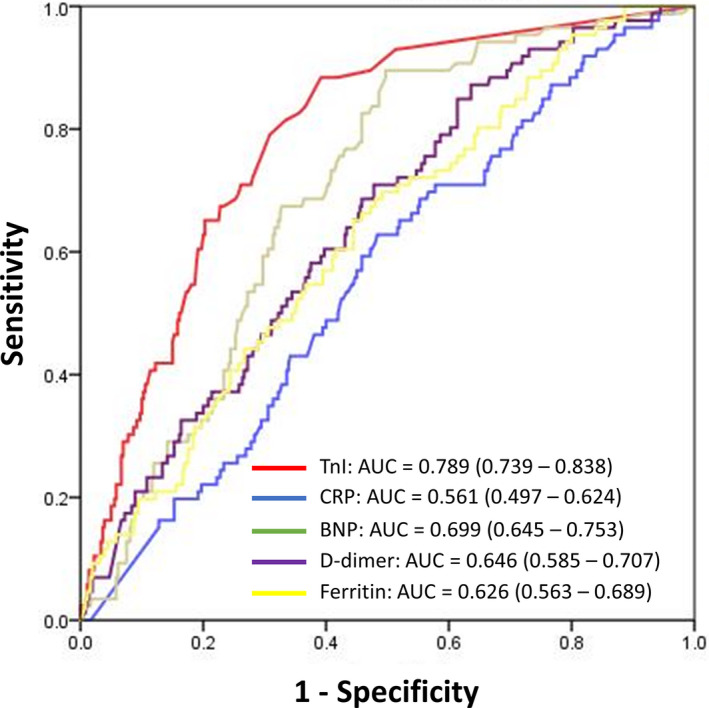
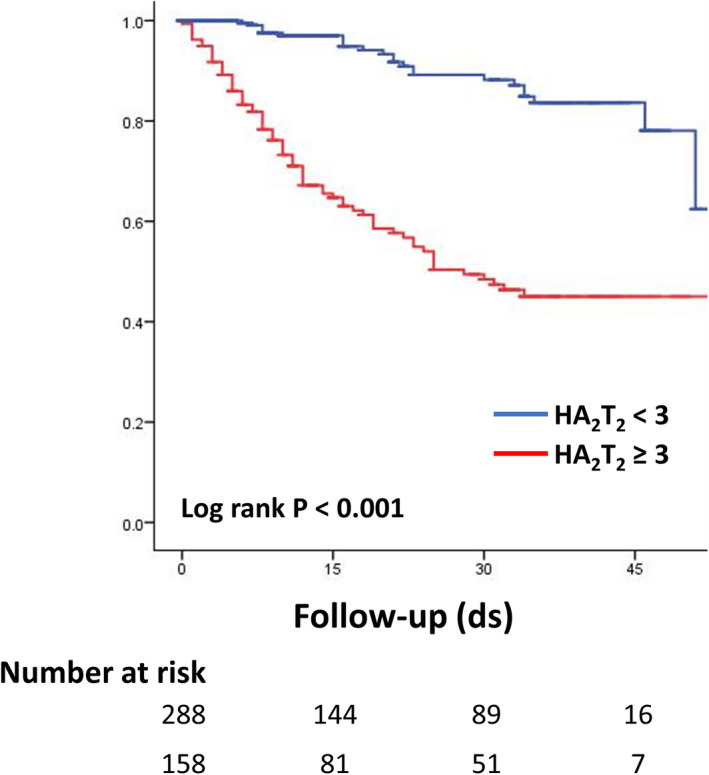
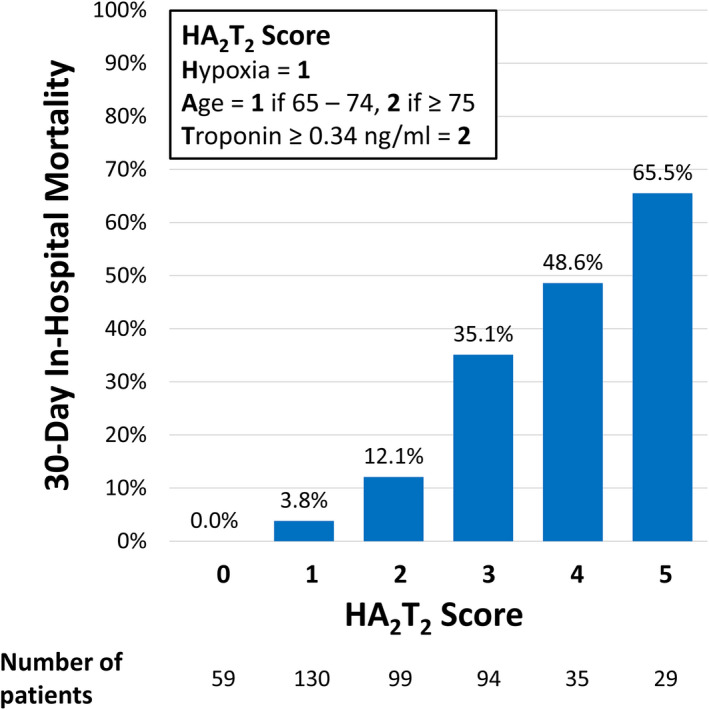
Background The independent prognostic value of troponin and other biomarker elevation among patients with coronavirus disease 2019 (COVID-19) are unclear. We sought to characterize biomarker levels in patients hospitalized with COVID-19 and develop and validate a mortality risk score. Methods and Results An observational cohort study of 1053 patients with COVID-19 was conducted. Patients with all of the following biomarkers measured-troponin-I, B-type natriuretic peptide, C-reactive protein, ferritin, and d-dimer (n=446) -were identified. Maximum levels for each biomarker were recorded. The primary end point was 30-day in-hospital mortality. Multivariable logistic regression was used to construct a mortality risk score. Validation of the risk score was performed using an independent patient cohort (n=440). Mean age of patients was 65.0±15.2 years and 65.3% were men. Overall, 444 (99.6%) had elevation of any biomarker. Among tested biomarkers, troponin-I ≥0.34 ng/mL was the only independent predictor of 30-day mortality (adjusted odds ratio, 4.38; <0.001). Patients with a mortality score using hypoxia on presentation, age, and troponin-I elevation, age (HAT) ≥3 had a 30-day mortality of 43.7% while those with a score <3 had mortality of 5.9%. Area under the receiver operating characteristic curve of the HAT score was 0.834 for the derivation cohort and 0.784 for the validation cohort. Conclusions Elevated troponin and other biomarker levels are commonly seen in patients hospitalized with COVID-19. High troponin levels are a potent predictor of 30-day in-hospital mortality. A simple risk score can stratify patients at risk for COVID-19-associated mortality.
新型冠状病毒病 2019(COVID-19)患者肌钙蛋白和其他生物标志物升高的独立预后价值尚不清楚。我们旨在描述因 COVID-19 住院患者的生物标志物水平,并开发和验证一种死亡率风险评分。
进行了一项针对 1053 例 COVID-19 患者的观察性队列研究。确定了所有以下标志物(肌钙蛋白 I、B 型利钠肽、C 反应蛋白、铁蛋白和 D-二聚体)均有测量值的患者(n=446)。记录了每个标志物的最高水平。主要终点为 30 天住院内死亡率。使用多变量逻辑回归构建死亡率风险评分。使用独立患者队列(n=440)对风险评分进行验证。患者的平均年龄为 65.0±15.2 岁,65.3%为男性。总体而言,444(99.6%)例患者存在任何标志物升高。在测试的生物标志物中,肌钙蛋白 I≥0.34ng/mL 是 30 天死亡率的唯一独立预测因子(调整后的优势比,4.38;<0.001)。使用入院时缺氧、年龄和肌钙蛋白 I 升高的死亡率评分(HAT)≥3 的患者 30 天死亡率为 43.7%,而评分<3 的患者死亡率为 5.9%。HAT 评分的受试者工作特征曲线下面积在推导队列中为 0.834,在验证队列中为 0.784。
因 COVID-19 住院的患者常出现肌钙蛋白和其他生物标志物升高。高肌钙蛋白水平是预测 30 天住院内死亡率的有力指标。简单的风险评分可以对 COVID-19 相关死亡率风险分层。