Li Xianghong, Cui Wanchang, Hull Lisa, Wang Li, Yu Tianzheng, Xiao Mang
Radiation Countermeasures Program, Armed Forces Radiobiology Research Institute, Uniformed Services University of the Health Sciences, 4555 South Palmer Road, Bethesda, MD, 20889-5648, USA.
Consortium for Health and Military Performance, Department of Military and Emergency Medicine, Uniformed Services University of the Health Sciences, Bethesda, MD, USA.
Sci Rep. 2020 Oct 29;10(1):18674. doi: 10.1038/s41598-020-75675-5.
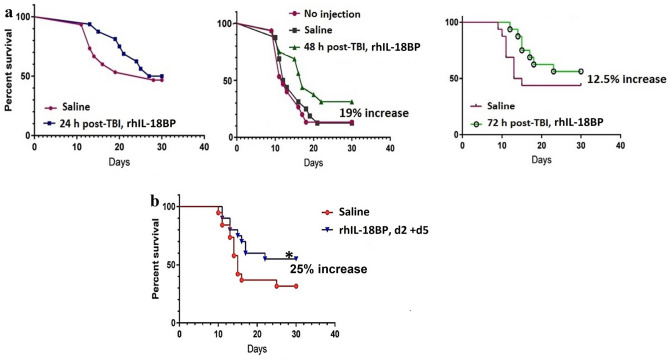
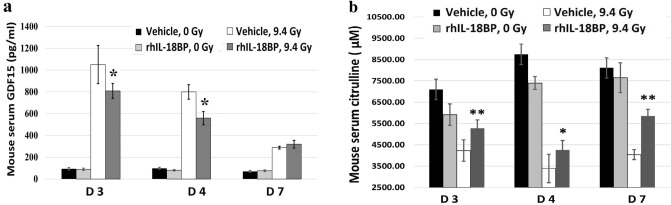
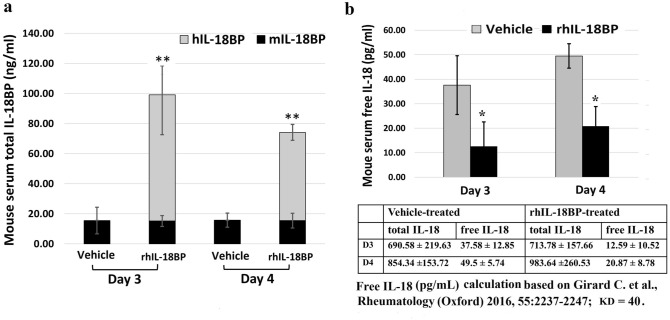
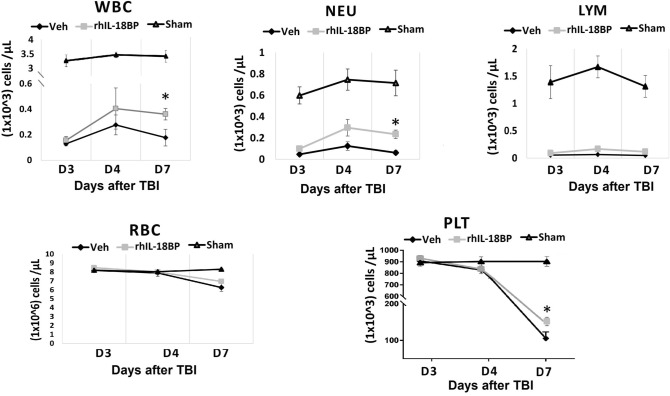
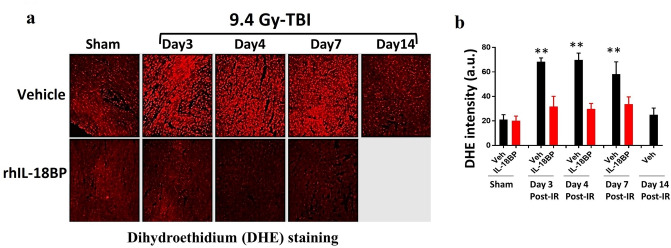
Recent studies suggested that radiation exposure causes local and systemic inflammatory responses and induces cell and tissue damage. We have reported that IL-18 plays an important role in radiation-induced injury. Here, we demonstrate that IL-18 binding protein (IL-18BP), a natural antagonist of IL-18, was significantly increased (1.7-63 fold) in mouse serum on day 1 after 0.5-10 Gy TBI. However, this high level of IL-18BP was not sufficient to neutralize the active IL-18 in irradiated mice, resulting in a radiation dose-dependent free IL-18 increase in these mice's serum which led to pathological alterations to the irradiated cells and tissues and finally caused animal death. Administration of recombinant human (rh) IL-18BP (1.5 mg/kg) with single (24, 48 or 72 h post-TBI) or double doses (48 h and 5 days post-TBI) subcutaneous (SC) injection increased 30-day survival of CD2F1 mice after 9 Gy TBI 12.5-25% compared with the vehicle control treated group, respectively. Furthermore, the mitigative effects of rhIL-18BP included balancing the ratio of IL-18/IL-18BP and decreasing the free IL-18 levels in irradiated mouse serum and significantly increasing blood cell counts, BM hematopoietic cellularity and stem and progenitor cell clonogenicity in mouse BM. Furthermore, IL-18BP treatment inhibited the IL-18 downstream target interferon (IFN)-γ expression in mouse BM, decreased reactive oxygen species (ROS) level in the irradiated mouse heart tissues, attenuated the stress responsive factor GDF-15 (growth differentiation factor-15) and increased the intestine protector citrulline level in total body irradiated mouse serum, implicating that IL-18BP may protect multiple organs from radiation-induced inflammation and oxidative stress. Our data suggest that IL-18 plays a key role in radiation-induced cell and tissue damage and dysfunction; and for the first time demonstrated that IL-18BP counters IL-18 activation and therefore may mitigate/treat radiation-induced multiple organ injuries and increase animal survival with a wider therapeutic window from 24 h and beyond after lethal doses of radiation exposure.
近期研究表明,辐射暴露会引发局部和全身炎症反应,并导致细胞和组织损伤。我们曾报道白细胞介素-18(IL-18)在辐射诱导的损伤中起重要作用。在此,我们证明,作为IL-18的天然拮抗剂,IL-18结合蛋白(IL-18BP)在0.5 - 10 Gy全身照射(TBI)后第1天,小鼠血清中显著升高(1.7 - 63倍)。然而,如此高水平的IL-18BP并不足以中和受照射小鼠体内的活性IL-18,导致这些小鼠血清中游离IL-18呈辐射剂量依赖性增加,进而导致受照射细胞和组织发生病理改变,最终致使动物死亡。单次(TBI后24、48或72小时)或双次剂量(TBI后48小时和5天)皮下注射重组人(rh)IL-18BP(1.5 mg/kg),与载体对照处理组相比,分别使9 Gy TBI后CD2F1小鼠的30天存活率提高了12.5% - 25%。此外,rhIL-18BP的缓解作用包括平衡IL-18/IL-18BP的比例,降低受照射小鼠血清中的游离IL-18水平,并显著增加小鼠骨髓中的血细胞计数、骨髓造血细胞数量以及干细胞和祖细胞的克隆形成能力。此外,IL-18BP治疗抑制了小鼠骨髓中IL-18下游靶点干扰素(IFN)-γ的表达,降低了受照射小鼠心脏组织中的活性氧(ROS)水平,减弱了应激反应因子生长分化因子-15(GDF-15),并提高了全身照射小鼠血清中肠道保护因子瓜氨酸的水平,这表明IL-18BP可能保护多个器官免受辐射诱导的炎症和氧化应激。我们的数据表明,IL-18在辐射诱导的细胞和组织损伤及功能障碍中起关键作用;并且首次证明IL-18BP可对抗IL-18的激活,因此可能减轻/治疗辐射诱导引起的多器官损伤,并在致死剂量辐射暴露后24小时及以后的更宽治疗窗内提高动物存活率。