Mason D Y, Gatter K C
Nuffield Department of Pathology, John Radcliffe Hospital, Oxford.
J Clin Pathol. 1987 Sep;40(9):1042-54. doi: 10.1136/jcp.40.9.1042.
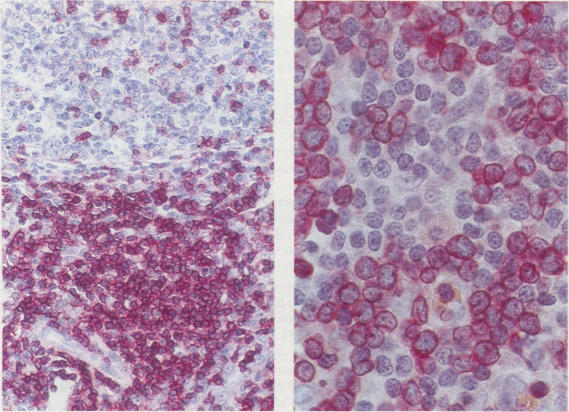
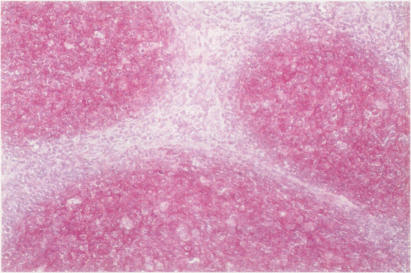
This review suggests that immunocytochemistry in diagnostic pathology can be performed using relatively small panels of antibodies and that it should be reserved for situations in which, for one reason or another, the pathologist cannot exert his or her conventional diagnostic skills. Examples include the diagnosis of tumours the true nature of which is uncertain because of anaplasia or poor morphological preservation; the demonstration of small numbers of cells which are otherwise too rare to be recognised in conventionally stained preparations; and the immunophenotyping of non-Hodgkin's lymphomas. Recently progress has been made in the context of non-Hodgkin's lymphomas by the development of monoclonal antibodies that detect T and B cell associated markers in paraffin wax sections. Most of these reagents, however, recognise either lineage associated (but not lineage specific) variants of the leucocyte common antigen CD45, or antigens that are poorly characterised. A recent promising development has therefore been the demonstration that polyclonal antisera raised against the CD3/T3 T cell specific marker (purified by affinity chromatography) are suitable for staining T cells in paraffin sections. This approach will hopefully enable antibodies to be produced which react with other well defined white cell associated markers in routine biopsy material.
本综述表明,诊断病理学中的免疫细胞化学可使用相对较小的抗体组合来进行,且应保留用于病理学家因某种原因无法运用其传统诊断技能的情况。例如,因间变或形态保存不佳而其真实性质不确定的肿瘤的诊断;少量细胞的显示,这些细胞在常规染色标本中因过于稀少而难以识别;以及非霍奇金淋巴瘤的免疫表型分析。最近,在非霍奇金淋巴瘤方面取得了进展,通过开发能在石蜡切片中检测T和B细胞相关标志物的单克隆抗体。然而,这些试剂大多识别白细胞共同抗原CD45的谱系相关(但非谱系特异性)变体,或特征不明确的抗原。因此,最近一个有前景的进展是证明针对CD3/T3 T细胞特异性标志物(通过亲和层析纯化)产生的多克隆抗血清适用于石蜡切片中T细胞的染色。这种方法有望能够生产出与常规活检材料中其他明确的白细胞相关标志物发生反应的抗体。