Mariano João, Marques Sibila, Ramos Miguel R, Gerardo Filomena, de Vries Hein
Instituto Universitário de Lisboa (ISCTE-IUL), CIS-IUL, Lisbon, Portugal.
Care and Public Health Research Institute (CAPHRI), Maastricht University, Maastricht, Netherlands.
Front Psychol. 2020 Oct 2;11:568972. doi: 10.3389/fpsyg.2020.568972. eCollection 2020.
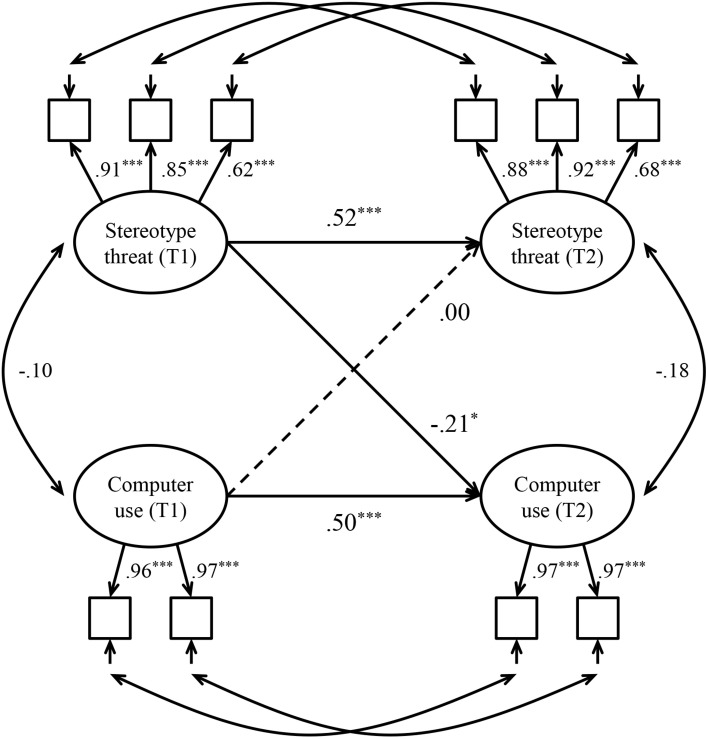
Besides having lower rates of technology adoption than the general population, older adults are commonly stereotyped as lacking technological ability. Stereotype threat, the fear of confirming negative stereotypes targeting their social group, may lead individuals to distance themselves from the stereotyped domain. This suggests that older adults may underuse computer technology due to stereotype threat. A sample of 86 community-dwelling older adults ( = 78.47, SD = 7.92) participated in a two-wave longitudinal study aiming to examine the relationship between stereotype threat and computer use in this age group. An autoregressive cross-lagged panel analysis was conducted using structural equation modeling. As expected, stereotype threat predicted lower levels of computer use a year and a half later. In turn, computer use was unrelated to the later experience of stereotype threat in this domain. These findings suggest that stereotype threat may undermine computer adoption in late adulthood, thus contributing to perpetuate the digital inequalities between younger and older generations.
除了技术采用率低于普通人群外,老年人通常被刻板地认为缺乏技术能力。刻板印象威胁,即害怕证实针对其社会群体的负面刻板印象,可能会导致个体远离被刻板化的领域。这表明老年人可能由于刻板印象威胁而未充分使用计算机技术。86名社区居住的老年人样本(平均年龄=78.47,标准差=7.92)参与了一项两波纵向研究,旨在检验该年龄组中刻板印象威胁与计算机使用之间的关系。使用结构方程模型进行了自回归交叉滞后面板分析。正如预期的那样,刻板印象威胁预测一年半后计算机使用水平较低。反过来,计算机使用与该领域后来的刻板印象威胁经历无关。这些发现表明,刻板印象威胁可能会破坏成年后期的计算机采用,从而导致年轻一代和老年一代之间的数字不平等长期存在。