Çalık Ali Nazmi, İnan Duygu, Karataş Mehmet Baran, Akdeniz Evliya, Genç Duygu, Çanga Yiğit, Çınar Tufan, Emre Ayşe
University of Health Sciences, Dr. Siyami Ersek Thoracic and Cardiovascular Surgery Training and Research Hospital, Istanbul, Turkey.
University of Health Sciences, Sultan Abdülhamid Han Training and Research Hospital, Istanbul, Turkey.
J Cardiovasc Thorac Res. 2020;12(3):179-184. doi: 10.34172/jcvtr.2020.31. Epub 2020 Aug 16.
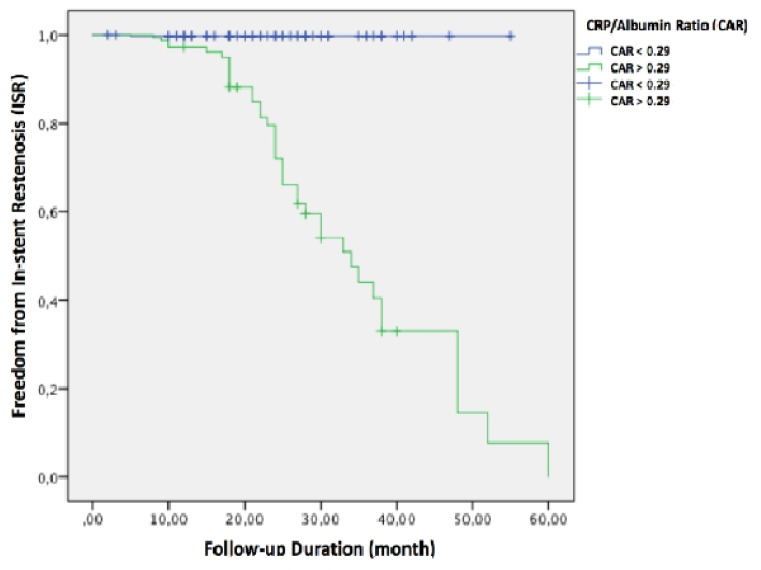
In-stent restenosis (ISR) still constitutes a major problem after percutaneous vascular interventions and the inflammation has a pivotal role in the pathogenesis of such event. The C-reactive protein/albumin ratio (CAR) is a newly identified inflammatory biomarker, and it may be used as an indicator to predict ISR in subjects with coronary artery stenting. In light of these data, our main objective was to investigate the relationship between the preprocedural CAR and ISR in patients undergoing successful iliac artery stent implantation. In total, 138 consecutive patients who had successful iliac artery stent implantation in a tertiary heart center between 2015 and 2018 were enrolled in the study. The study population was categorized into two groups; patients with ISR and those without ISR during follow-up. The CAR was determined by dividing CRP by serum albumin. In the multivariable regression analysis; the CAR (HR: 2.66, 95% CI: 1.66-4.25, < 0.01), stent length (HR: 1.01, 95% CI: 0.99-1.02, = 0.04), and HbA1c levels (HR: 1.22, 95% CI: 0.99-1.51, = 0.04) were independently related with ISR. A receiver operating curve analysis displayed that the CAR value of >0.29 predicted ISR with sensitivity of 97.5% and specificity of 88.8% (AUC 0.94, < 0.01). Our findings provide evidence that the CAR may be an applicable inflammatory biomarker in predicting ISR in subjects undergoing iliac artery stenting for the treatment of peripheral artery disease (PAD). Also, the stent length and poor glycemic control were found to be associated with ISR.
支架内再狭窄(ISR)仍是经皮血管介入治疗后的一个主要问题,炎症在这一事件的发病机制中起关键作用。C反应蛋白/白蛋白比值(CAR)是一种新发现的炎症生物标志物,它可作为预测冠状动脉支架置入患者发生ISR的指标。鉴于这些数据,我们的主要目的是研究成功进行髂动脉支架植入术患者术前CAR与ISR之间的关系。共有138例在2015年至2018年间于一家三级心脏中心成功进行髂动脉支架植入术的连续患者纳入本研究。研究人群分为两组:随访期间发生ISR的患者和未发生ISR的患者。CAR通过将CRP除以血清白蛋白来确定。在多变量回归分析中,CAR(风险比:2.66,95%置信区间:1.66 - 4.25,P < 0.01)、支架长度(风险比:1.01,95%置信区间:0.99 - 1.02,P = 0.04)和糖化血红蛋白水平(风险比:1.22,95%置信区间:0.99 - 1.51,P = 0.04)与ISR独立相关。受试者工作特征曲线分析显示,CAR值>0.29预测ISR的敏感性为97.5%,特异性为88.8%(曲线下面积0.94,P < 0.01)。我们的研究结果表明,CAR可能是预测接受髂动脉支架植入术治疗外周动脉疾病(PAD)患者发生ISR的一种适用的炎症生物标志物。此外,发现支架长度和血糖控制不佳与ISR有关。