Department of Clinical Nutrition, Instituto Nacional de Ciencias Médicas y Nutrición Salvador Zubirán, Vasco de Quiroga, 15, Col. Belisario Domínguez Sección XVI, Del. Tlalpan. CP, 14080, Mexico City, Mexico.
Department of Welfare and Sustainable Development, Centro Universitario del Norte, Universidad de Guadalajara, Colotlán, Jalisco, Mexico.
Curr Nutr Rep. 2020 Dec;9(4):309-315. doi: 10.1007/s13668-020-00337-x. Epub 2020 Oct 30.
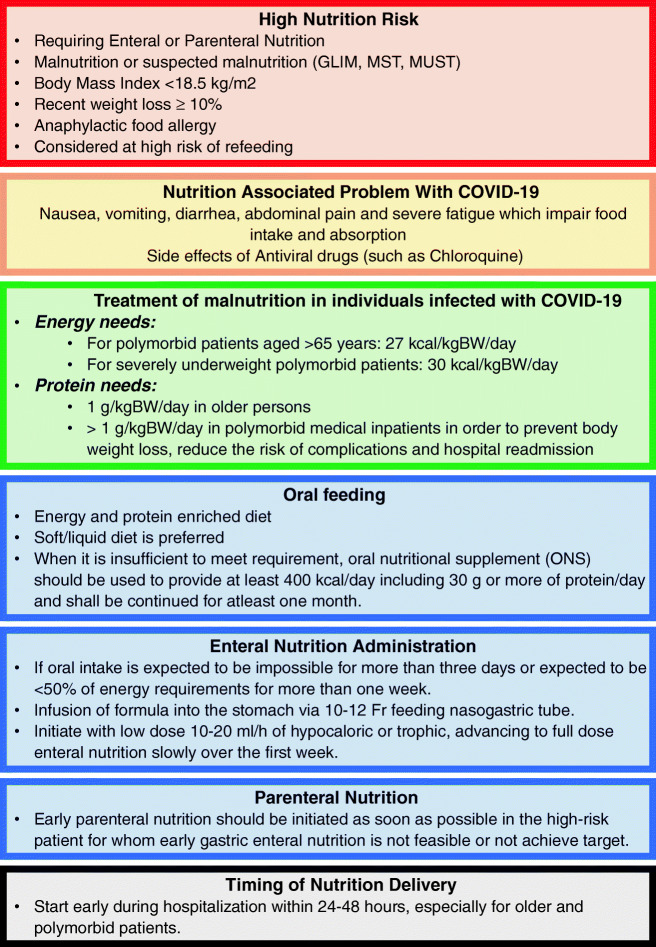
As of 13 September 2020, almost 28 million confirmed cases of COVID-19 including more than 920,000 deaths have been reported to the World Health Organization. The SARS-CoV-2 pandemic represents a potential threat to patients and healthcare systems worldwide. Patients with the worst outcomes and higher mortality are reported to include older adults, polymorbid individuals, and malnourished people in general. The purpose of this review is to provide concise guidance for the nutritional management of individuals with COVID-19 based on the current literature and focused on those in the non-ICU setting or with an older age and polymorbidity, which are independently associated with malnutrition and its negative impact on mortality.
Prolonged hospital stays are reported to be required for individuals with COVID-19, and longer acute setting stays may directly worsen or cause malnutrition, with severe loss of skeletal muscle mass and function, which may lead to poor quality of life and additional morbidity. Nutritional therapy is among the mainstay of therapeutic principles and one of the core contents of comprehensive treatment measures. The current COVID-19 pandemic is unprecedented. The prevention, diagnosis, and treatment of malnutrition should therefore be routinely included in the management of individuals with COVID-19.
截至 2020 年 9 月 13 日,世界卫生组织报告了近 2800 万例 COVID-19 确诊病例,包括超过 92 万例死亡。SARS-CoV-2 大流行对全球患者和医疗系统构成潜在威胁。据报道,预后最差和死亡率最高的患者包括老年人、多合并症患者和一般营养不良人群。本综述的目的是根据现有文献为 COVID-19 患者的营养管理提供简明指导,重点关注非 ICU 环境或年龄较大、合并症较多的患者,这些患者独立存在营养不良及其对死亡率的负面影响。
据报道,COVID-19 患者需要长时间住院,急性住院时间延长可能直接导致或引起营养不良,严重丧失骨骼肌质量和功能,导致生活质量下降和额外发病。营养治疗是治疗原则的主要内容之一,也是综合治疗措施的核心内容之一。目前的 COVID-19 大流行是前所未有的。因此,应常规将预防、诊断和治疗营养不良纳入 COVID-19 患者的管理中。