Park Hee-Soo, Kim Min-Ju, Yu Jae-Hyuk, Shin Kwang-Soo
School of Food Science and Biotechnology, Kyungpook National University, Daegu 41566, Korea.
Department of Integrative Biology, Kyungpook National University, Daegu 41566, Korea.
Pathogens. 2020 Oct 28;9(11):902. doi: 10.3390/pathogens9110902.
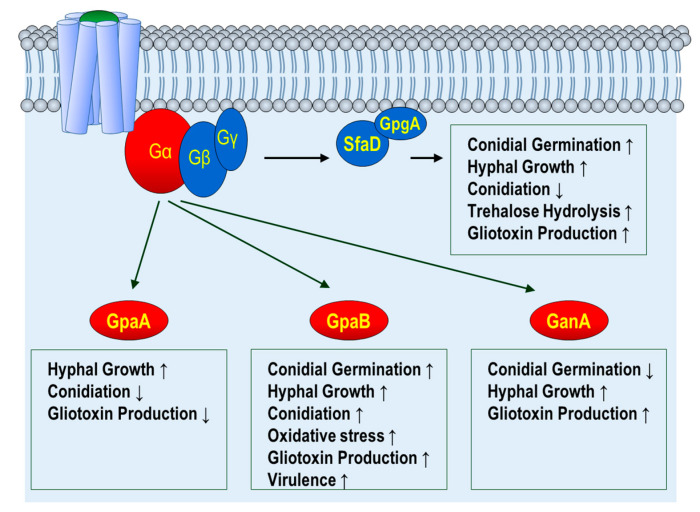
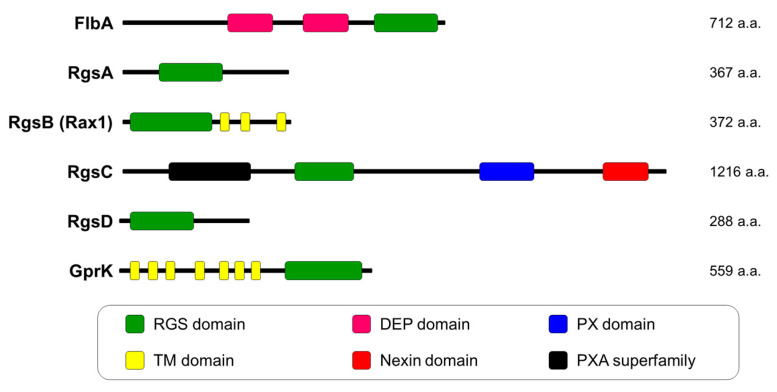
The heterotrimeric G-protein (G-protein) signaling pathway is one of the most important signaling pathways that transmit external signals into the inside of the cell, triggering appropriate biological responses. The external signals are sensed by various G-protein-coupled receptors (GPCRs) and transmitted into G-proteins consisting of the α, β, and γ subunits. Regulators of G-protein signaling (RGSs) are the key controllers of G-protein signaling pathways. GPCRs, G-proteins, and RGSs are the primary upstream components of the G-protein signaling pathway, and they are highly conserved in most filamentous fungi, playing diverse roles in biological processes. Recent studies characterized the G-protein signaling components in the opportunistic pathogenic fungus . In this review, we have summarized the characteristics and functions of GPCRs, G-proteins, and RGSs, and their regulatory roles in governing fungal growth, asexual development, germination, stress tolerance, and virulence in .
异源三聚体G蛋白(G蛋白)信号通路是将外部信号传递到细胞内部、触发适当生物学反应的最重要信号通路之一。外部信号由各种G蛋白偶联受体(GPCR)感知,并传递到由α、β和γ亚基组成的G蛋白中。G蛋白信号调节剂(RGS)是G蛋白信号通路的关键调控因子。GPCR、G蛋白和RGS是G蛋白信号通路的主要上游成分,它们在大多数丝状真菌中高度保守,在生物学过程中发挥着多种作用。最近的研究对机会致病性真菌中的G蛋白信号成分进行了表征。在这篇综述中,我们总结了GPCR、G蛋白和RGS的特征和功能,以及它们在控制真菌生长、无性发育、萌发、胁迫耐受性和毒力方面的调控作用。