The Clinical Hospital of Chengdu Brain Science Institute, School of Life Science and Technology, University of Electronic Science and Technology of China, Chengdu, 610054, People's Republic of China.
MOE Key Lab for Neuroinformation, High-Field Magnetic Resonance Brain Imaging Key Laboratory of Sichuan Province, University of Electronic Science and Technology of China, Chengdu, 610054, People's Republic of China.
Transl Psychiatry. 2020 Oct 30;10(1):365. doi: 10.1038/s41398-020-01053-4.
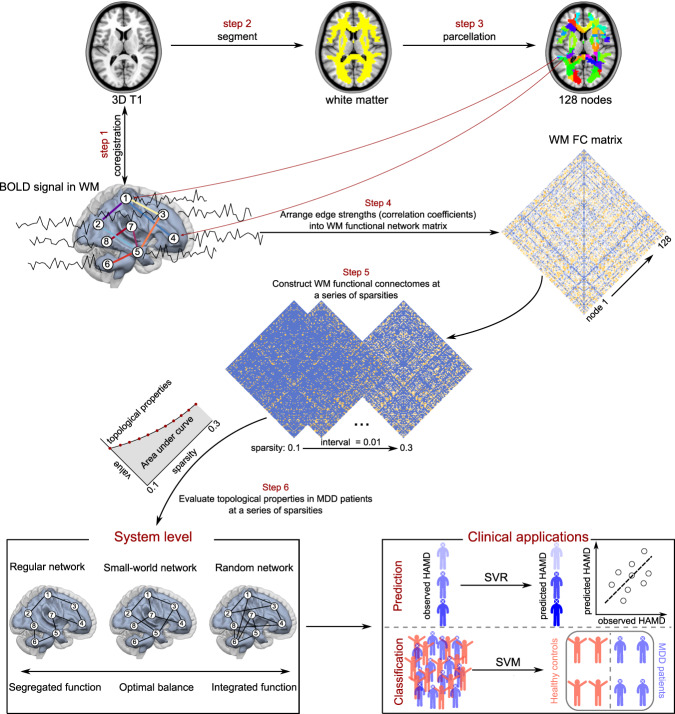
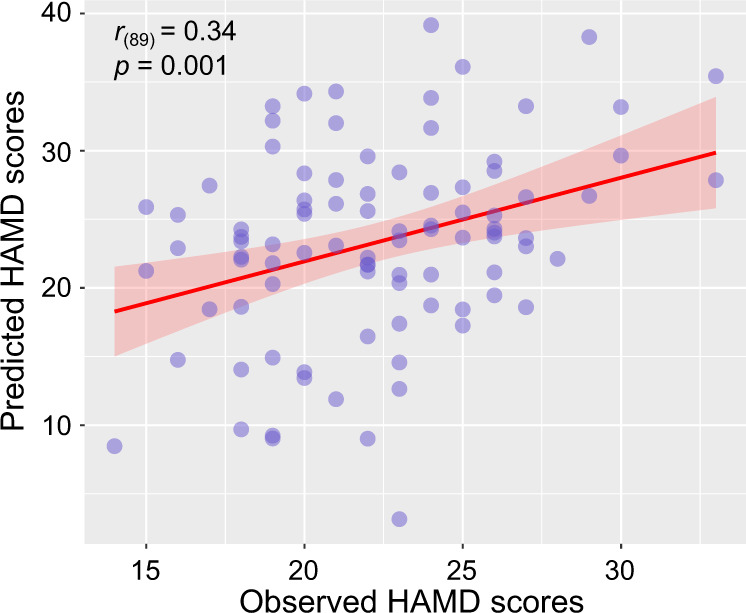
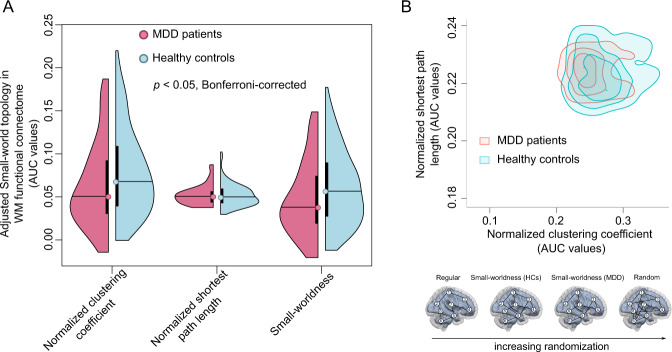
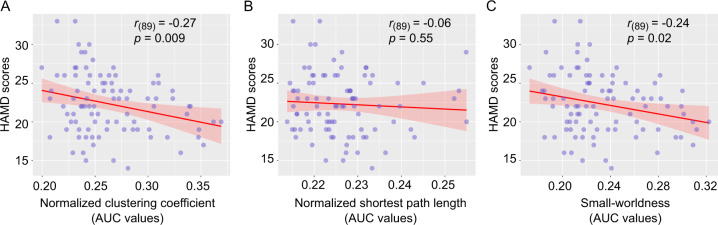
Aberrant topological organization of brain connectomes underlies pathological mechanisms in major depressive disorder (MDD). However, accumulating evidence has only focused on functional organization in brain gray-matter, ignoring functional information in white-matter (WM) that has been confirmed to have reliable and stable topological organizations. The present study aimed to characterize the functional pattern disruptions of MDD from a new perspective-WM functional connectome topological organization. A case-control, cross-sectional resting-state functional magnetic resonance imaging study was conducted on both discovery [91 unmedicated MDD patients, and 225 healthy controls (HCs)], and replication samples (34 unmedicated MDD patients, and 25 HCs). The WM functional networks were constructed in 128 anatomical regions, and their global topological properties (e.g., small-worldness) were analyzed using graph theory-based approaches. At the system-level, ubiquitous small-worldness architecture and local information-processing capacity were detectable in unmedicated MDD patients but were less salient than in HCs, implying a shift toward randomization in MDD WM functional connectomes. Consistent results were replicated in an independent sample. For clinical applications, small-world topology of WM functional connectome showed a predictive effect on disease severity (Hamilton Depression Rating Scale) in discovery sample (r = 0.34, p = 0.001). Furthermore, the topologically-based classification model could be generalized to discriminate MDD patients from HCs in replication sample (accuracy, 76%; sensitivity, 74%; specificity, 80%). Our results highlight a reproducible topologically shifted WM functional connectome structure and provide possible clinical applications involving an optimal small-world topology as a potential neuromarker for the classification and prediction of MDD patients.
异常的大脑连接组拓扑结构是重度抑郁症(MDD)病理机制的基础。然而,越来越多的证据仅集中在大脑灰质的功能组织上,而忽略了已被证实具有可靠和稳定拓扑结构的白质(WM)中的功能信息。本研究旨在从新的视角——WM 功能连接组拓扑组织,来描述 MDD 的功能模式紊乱。在发现组(91 名未经药物治疗的 MDD 患者和 225 名健康对照(HC))和复制组(34 名未经药物治疗的 MDD 患者和 25 名 HC)中进行了病例对照、横断面静息态功能磁共振成像研究。在 128 个解剖区域构建 WM 功能网络,并使用基于图论的方法分析其全局拓扑性质(例如,小世界特性)。在系统水平上,未用药 MDD 患者中可检测到普遍存在的小世界架构和局部信息处理能力,但不如 HC 明显,这表明 MDD WM 功能连接组向随机化转变。在独立样本中复制了一致的结果。对于临床应用,WM 功能连接组的小世界拓扑结构对发现样本中的疾病严重程度(汉密尔顿抑郁评定量表)具有预测作用(r=0.34,p=0.001)。此外,基于拓扑的分类模型可以推广到复制样本中区分 MDD 患者和 HC(准确率为 76%;敏感性为 74%;特异性为 80%)。我们的研究结果突出了可重复的拓扑转移 WM 功能连接组结构,并提供了可能的临床应用,涉及到最佳小世界拓扑作为 MDD 患者分类和预测的潜在神经标志物。