Department of Psychology, Faculty of Education and Psychology, University of Jyväskylä, P.O. Box 35, 40014, Jyväskylä, Finland.
Department of Teacher Education, Faculty of Education and Psychology, University of Jyväskylä, P.O. Box 35, 40014, Jyväskylä, Finland.
J Youth Adolesc. 2021 Feb;50(2):231-245. doi: 10.1007/s10964-020-01331-w. Epub 2020 Oct 30.
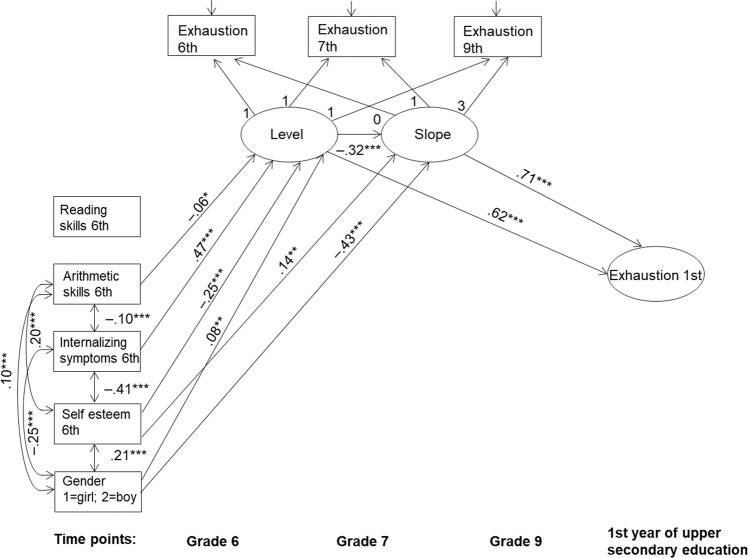
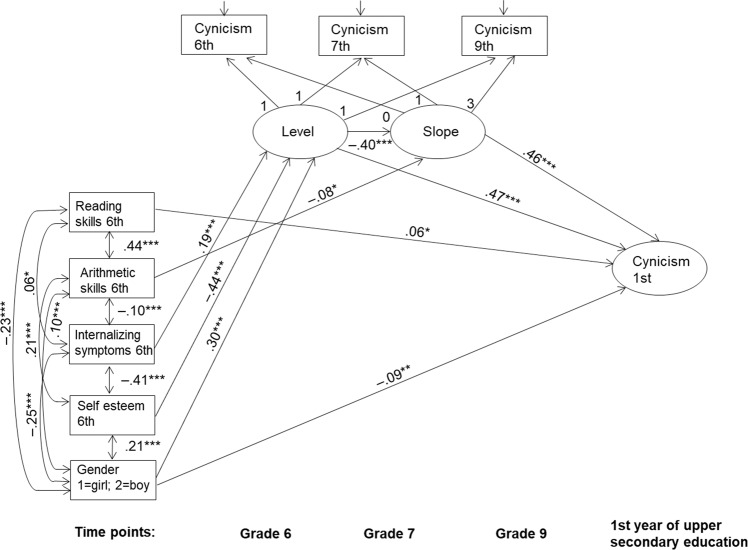
School burnout symptoms are prevalent among upper secondary education students, but thus far, very little is known about the background of these symptoms. The present study examined the extent to which school burnout symptoms (i.e., exhaustion and cynicism) among upper secondary education students have their roots in primary and lower secondary school and whether early antecedents of school burnout symptoms could be identified. The sample consisted of 1544 Finnish students followed up four times (Time1-Time 4) from the end of primary school (T1; mean age 12.74 and range 11.71-14.20) to the first year of upper secondary education (T4; mean age 16.66 and range 15.55-18.39). The results of latent growth curve modeling showed that school burnout symptoms in upper secondary education were predicted by the level of school burnout symptoms at the end of primary school and by an increase in these symptoms across the transition from primary school through lower secondary school. In addition, psychological well-being, academic skills, and gender were found to contribute to the prediction of school burnout symptoms. Overall, the present study suggest that potential warning signs of school burnout should not be ignored and attention should be directed to earlier education phases.
中学生中普遍存在学业倦怠症状,但到目前为止,对于这些症状的背景了解甚少。本研究旨在探讨中学生学业倦怠症状(即疲惫和玩世不恭)在多大程度上源于小学和初中,并确定是否可以识别学业倦怠症状的早期前兆。该样本由 1544 名芬兰学生组成,从小学结束时(T1;平均年龄为 12.74 岁,范围为 11.71-14.20)到高中第一年(T4;平均年龄为 16.66 岁,范围为 15.55-18.39)进行了四次随访(T1-T4)。潜增长曲线模型的结果表明,中学的学业倦怠症状可以通过小学结束时的学业倦怠症状水平以及从小学到初中过渡期间这些症状的增加来预测。此外,心理健康、学业技能和性别也被发现对学业倦怠症状的预测有贡献。总体而言,本研究表明,不应忽视学业倦怠的潜在预警信号,应关注早期教育阶段。