Department of Molecular Systems Biology, Cell Science Research Center, Royan Institute for Stem Cell Biology and Technology, Banihashem St., ACECR, Tehran 16635-148, Iran.
Department of Stem Cells and Developmental Biology, Cell Science Research Center, Royan Institute for Stem Cell Biology and Technology, Banihashem St., ACECR, Tehran 16635-148, Iran.
Gigascience. 2020 Oct 31;9(11). doi: 10.1093/gigascience/giaa116.
Generation of oligodendrocytes is a sophisticated multistep process, the mechanistic underpinnings of which are not fully understood and demand further investigation. To systematically profile proteome dynamics during human embryonic stem cell differentiation into oligodendrocytes, we applied in-depth quantitative proteomics at different developmental stages and monitored changes in protein abundance using a multiplexed tandem mass tag-based proteomics approach.
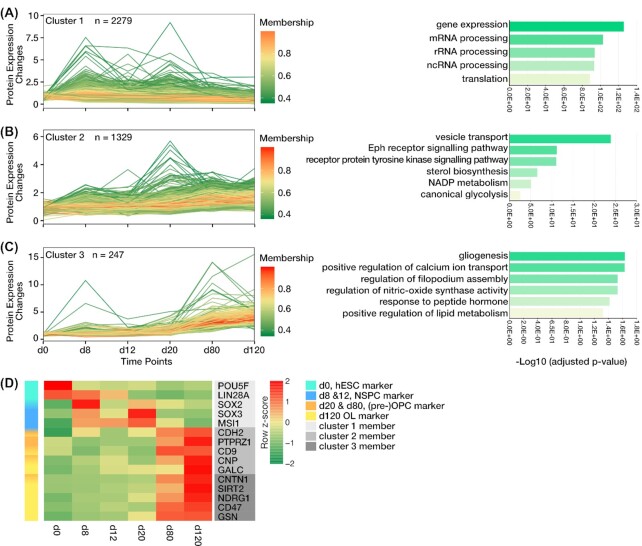
Our proteome data provided a comprehensive protein expression profile that highlighted specific expression clusters based on the protein abundances over the course of human oligodendrocyte lineage differentiation. We identified the eminence of the planar cell polarity signalling and autophagy (particularly macroautophagy) in the progression of oligodendrocyte lineage differentiation-the cooperation of which is assisted by 106 and 77 proteins, respectively, that showed significant expression changes in this differentiation process. Furthermore, differentially expressed protein analysis of the proteome profile of oligodendrocyte lineage cells revealed 378 proteins that were specifically upregulated only in 1 differentiation stage. In addition, comparative pairwise analysis of differentiation stages demonstrated that abundances of 352 proteins differentially changed between consecutive differentiation time points.
Our study provides a comprehensive systematic proteomics profile of oligodendrocyte lineage cells that can serve as a resource for identifying novel biomarkers from these cells and for indicating numerous proteins that may contribute to regulating the development of myelinating oligodendrocytes and other cells of oligodendrocyte lineage. We showed the importance of planar cell polarity signalling in oligodendrocyte lineage differentiation and revealed the autophagy-related proteins that participate in oligodendrocyte lineage differentiation.
少突胶质细胞的生成是一个复杂的多步骤过程,其机制基础尚未完全阐明,需要进一步研究。为了系统地描绘人胚胎干细胞向少突胶质细胞分化过程中的蛋白质组动态,我们在不同的发育阶段应用了深度定量蛋白质组学,并使用多重串联质量标签蛋白质组学方法监测蛋白质丰度的变化。
我们的蛋白质组数据提供了一个全面的蛋白质表达谱,根据人少突胶质细胞谱系分化过程中的蛋白质丰度,突出了特定的表达簇。我们发现平面细胞极性信号和自噬(特别是巨自噬)在少突胶质细胞谱系分化过程中的重要性——这两种信号的合作分别由分别在这个分化过程中表现出显著表达变化的 106 个和 77 个蛋白质协助。此外,对少突胶质细胞谱系细胞蛋白质组谱的差异表达蛋白分析显示,有 378 个蛋白质仅在 1 个分化阶段特异性上调。此外,分化阶段的比较性两两分析表明,352 个蛋白质的丰度在连续的分化时间点之间发生了差异变化。
我们的研究提供了一个全面的少突胶质细胞谱系细胞的系统蛋白质组学图谱,可作为从这些细胞中识别新的生物标志物的资源,并指示许多可能有助于调节髓鞘形成少突胶质细胞和其他少突胶质细胞谱系细胞发育的蛋白质。我们表明了平面细胞极性信号在少突胶质细胞谱系分化中的重要性,并揭示了参与少突胶质细胞谱系分化的自噬相关蛋白质。