Lab for Autonomic Neuroscience, Imaging and Cognition (LANIC), Department of Psychosomatic Medicine and Psychotherapy, Jena University Hospital, Germany.
Department of Psychiatry and Psychotherapy, Jena University Hospital, Germany.
Hum Brain Mapp. 2021 Feb 15;42(3):811-823. doi: 10.1002/hbm.25264. Epub 2020 Oct 31.
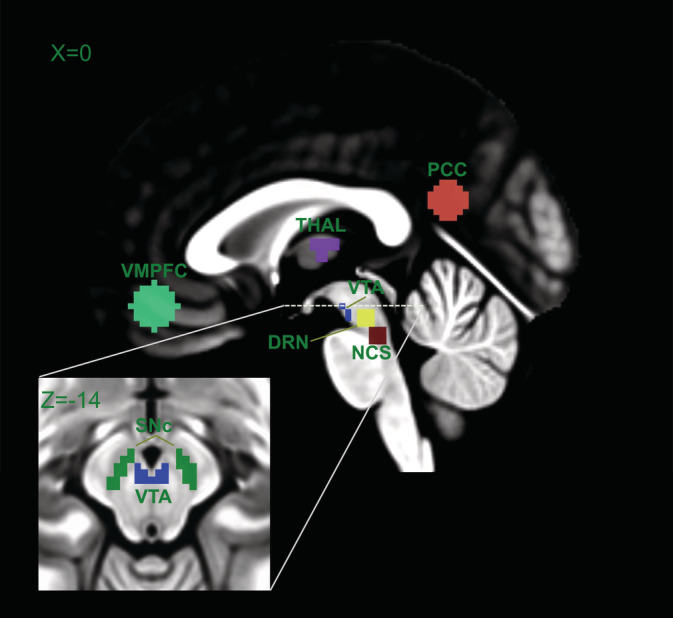
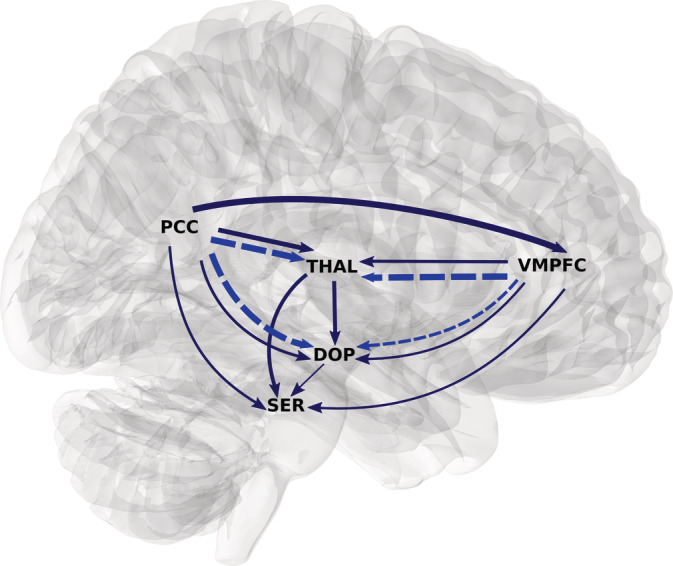
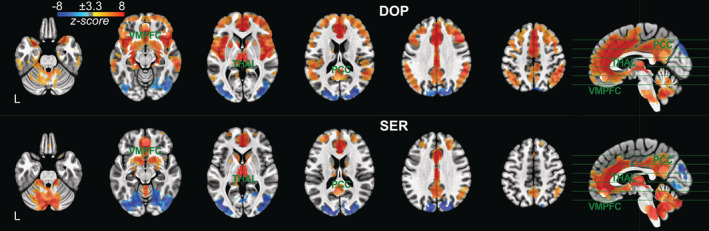
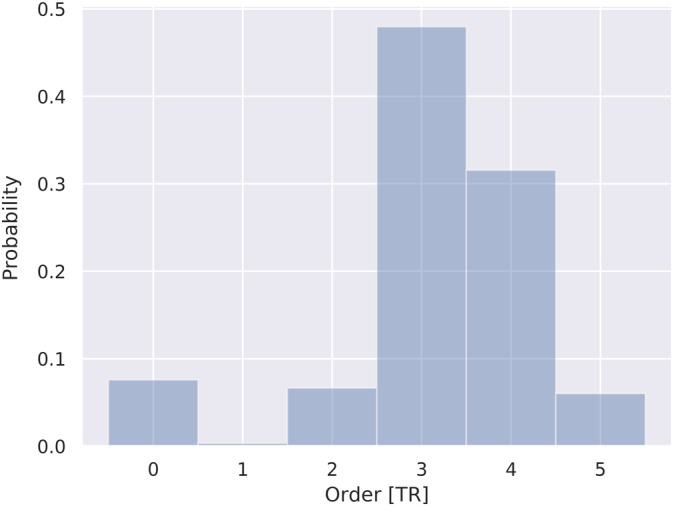
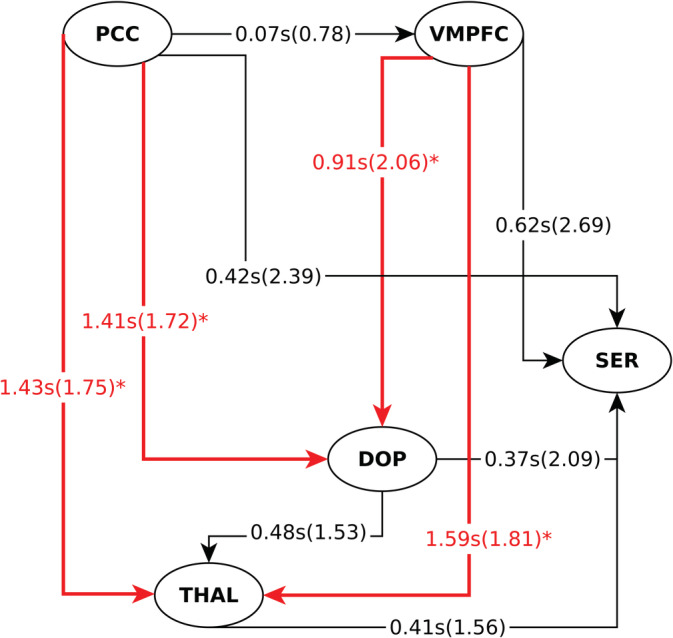
Recent functional magnetic resonance imaging (fMRI) studies showed that blood oxygenation level-dependent (BOLD) signal fluctuations in the default mode network (DMN) are functionally tightly connected to those in monoaminergic nuclei, producing dopamine (DA), and serotonin (5-HT) transmitters, in the midbrain/brainstem. We combined accelerated fMRI acquisition with spectral Granger causality and coherence analysis to investigate causal relationships between these areas. Both methods independently lead to similar results and confirm the existence of a top-down information flow in the resting-state condition, where activity in core DMN areas influences activity in the neuromodulatory centers producing DA/5-HT. We found that latencies range from milliseconds to seconds with high inter-subject variability, likely attributable to the resting condition. Our novel findings provide new insights into the functional organization of the human brain.
最近的功能磁共振成像 (fMRI) 研究表明,默认模式网络 (DMN) 中的血氧水平依赖 (BOLD) 信号波动与中脑/脑干中单胺能核中的多巴胺 (DA) 和 5-羟色胺 (5-HT) 递质的功能紧密相连。我们结合加速 fMRI 采集和频谱 Granger 因果关系和相干性分析来研究这些区域之间的因果关系。这两种方法独立地得出相似的结果,并证实了在静息状态下存在自上而下的信息流,其中核心 DMN 区域的活动影响产生 DA/5-HT 的神经调质中心的活动。我们发现潜伏期范围从毫秒到秒,具有很高的个体间可变性,可能归因于静息状态。我们的新发现为人类大脑的功能组织提供了新的见解。