Clinical Trial Service Unit and Epidemiological Studies Unit, Nuffield Department of Population Health, University of Oxford, UK.
Jockey Club School of Public Health and Primary Care, The Chinese University of Hong Kong, Hong Kong Special Administrative Region.
Environ Int. 2021 Jan;146:106217. doi: 10.1016/j.envint.2020.106217. Epub 2020 Oct 28.
Previous studies of the health impact of ambient and household air pollution (AAP/HAP) have chiefly relied on self-reported and/or address-based exposure modelling data. We assessed the feasibility of collecting and integrating detailed personal exposure data in different settings and seasons.
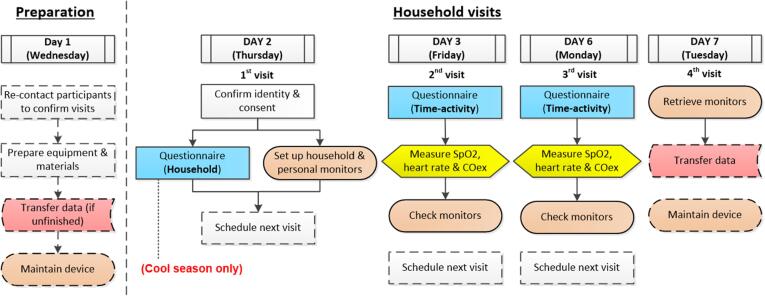
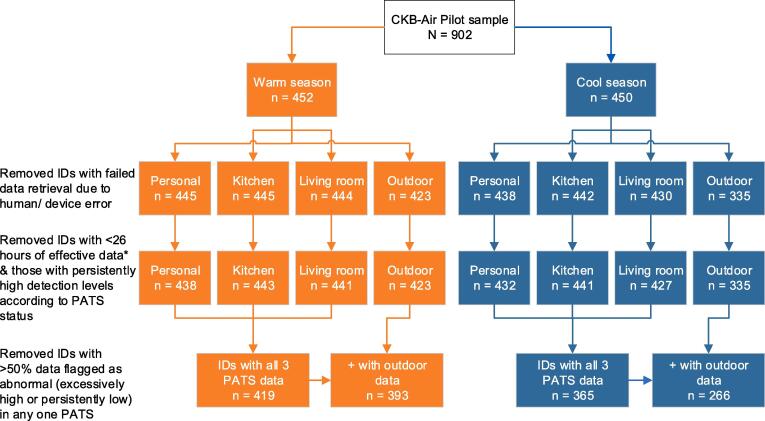
METHODS/DESIGN: We recruited 477 participants (mean age 58 years, 72% women) from three (two rural [Gansu/Henan] and one urban [Suzhou]) study areas in the China Kadoorie Biobank, based on their previously reported fuel use patterns. A time-resolved monitor (PATS+CO) was used to measure continuously for 120-hour the concentration of fine particulate matter (PM) at personal and household (kitchen and living room) levels in warm (May-September 2017) and cool (November 2017-January 2018) seasons, along with questionnaires on participants' characteristics (e.g. socio-demographic, and fuel use) and time-activity (48-hour). Parallel local ambient monitoring of particulate matter (PM, PM and PM) and gaseous pollutants (CO, ozone, nitrogen oxides) was conducted using regularly-calibrated devices. The air pollution exposure data were compared by study sites and seasons.
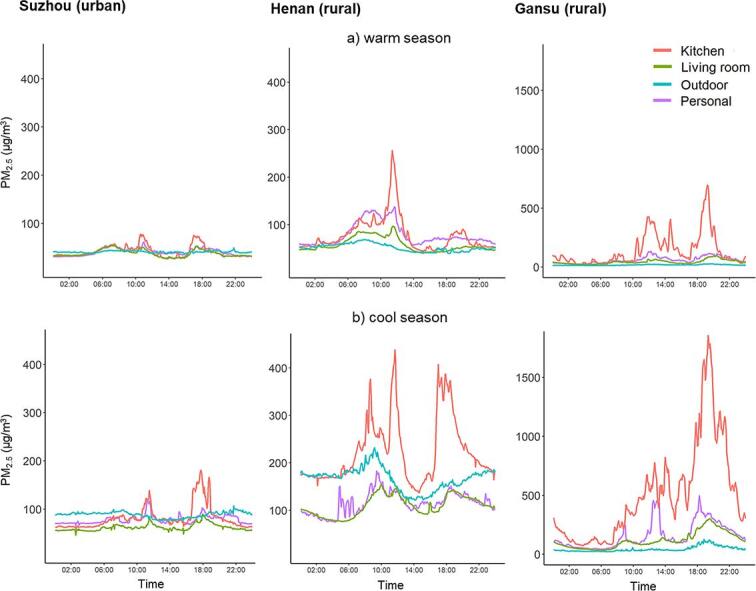
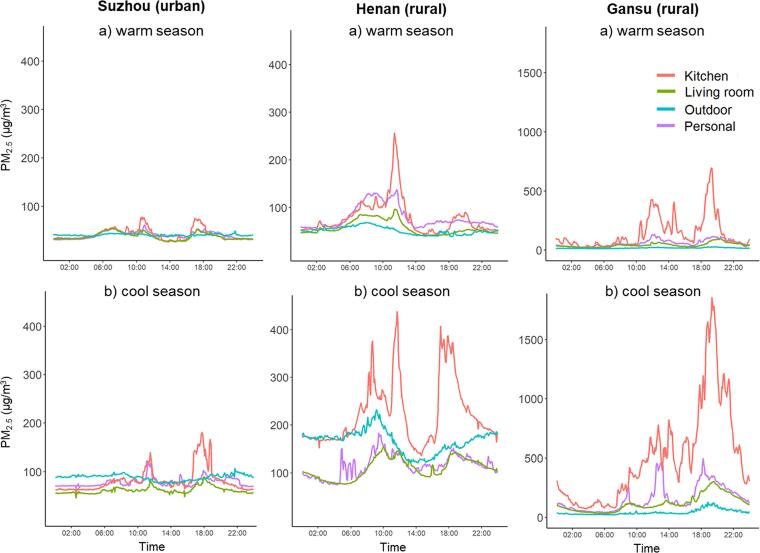
Overall 76% reported cooking at least weekly (regular-cooks), and 48% (urban 1%, rural 65%) used solid fuels (wood/coal) for cooking. Winter heating was more common in rural sites than in urban site (74-91% vs 17% daily), and mainly involved solid fuels. Mixed use of clean and solid fuels was common for cooking in rural areas (38%) but not for heating (0%). Overall, the measured mean PM levels were 2-3 fold higher in the cool than warm season, and in rural (e.g. kitchen: Gansu = 142.3 µg/m; Gansu = 508.1 µg/m; Henan = 77.5 µg/m; Henan = 222.3 µg/m) than urban sites (Suzhou = 41.6 µg/m; Suzhou = 81.6 µg/m). The levels recorded tended to be the highest in kitchens, followed by personal, living room and outdoor. Time-resolved data show prominent peaks consistently recorded in the kitchen at typical cooking times, and sustained elevated PM levels (> 100 µg/m) were observed in rural areas where use of solid fuels for heating was common.
Personal air pollution exposure can be readily assessed using a low-cost time-resolved monitor in different settings, which, in combination with other personal and health outcome data, will enable reliable assessment of the long-term health effects of HAP/AAP exposures in general populations.
先前有关环境和家庭空气污染(AAP/HAP)对健康影响的研究主要依赖于自我报告和/或基于地址的暴露建模数据。我们评估了在不同环境和季节中收集和整合详细个人暴露数据的可行性。
方法/设计:我们根据之前报告的燃料使用模式,从中国慢性病前瞻性研究(CKB)的三个研究区域(两个农村地区[甘肃、河南]和一个城市地区[苏州])招募了 477 名参与者(平均年龄 58 岁,72%为女性)。使用时间分辨监测仪(PATS+CO)在温暖季节(2017 年 5 月至 9 月)和凉爽季节(2017 年 11 月至 2018 年 1 月),在个人和家庭(厨房和客厅)水平上连续 120 小时测量细颗粒物(PM)的浓度,同时还对参与者的特征(如社会人口统计学和燃料使用情况)和 48 小时的时间活动情况进行了问卷调查。使用定期校准的设备平行进行了对颗粒物(PM、PM和 PM)和气态污染物(CO、臭氧、氮氧化物)的当地环境监测。根据研究地点和季节比较了空气污染暴露数据。
总体而言,76%的人每周至少烹饪一次(常规厨师),48%(城市 1%,农村 65%)使用固体燃料(木材/煤炭)烹饪。农村地区比城市地区更常见冬季取暖(农村 74-91%,城市 17%),主要涉及固体燃料。农村地区烹饪时经常混合使用清洁燃料和固体燃料(38%),但冬季取暖时没有(0%)。总体而言,凉爽季节的 PM 平均水平比温暖季节高 2-3 倍,农村地区(例如,厨房:甘肃=142.3μg/m;甘肃=508.1μg/m;河南=77.5μg/m;河南=222.3μg/m)比城市地区(苏州=41.6μg/m;苏州=81.6μg/m)高。记录到的水平在厨房中最高,其次是个人、客厅和户外。时间分辨数据显示,在典型的烹饪时间,厨房中持续记录到明显的峰值,在农村地区,固体燃料取暖很常见,持续存在的高水平 PM(>100μg/m)。
使用低成本的时间分辨监测仪可以轻松评估个人空气污染暴露情况,结合其他个人和健康结果数据,可以可靠地评估一般人群中家庭和环境空气污染暴露对健康的长期影响。