Jiang Ruoting, Bell Michelle L
Department of Civil and Environmental Engineering, Stanford University, Stanford, California, USA.
Environ Health Perspect. 2008 Jul;116(7):907-14. doi: 10.1289/ehp.10622.
Biomass fuel is the primary source of domestic fuel in much of rural China. Previous studies have not characterized particle exposure through time-activity diaries or personal monitoring in mainland China.
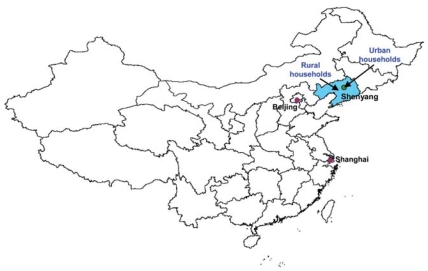
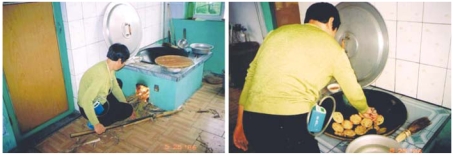
In this study we characterized indoor and personal particle exposure in six households in northeastern China (three urban, three rural) and explored differences by location, cooking status, activity, and fuel type. Rural homes used biomass. Urban homes used a combination of electricity and natural gas.
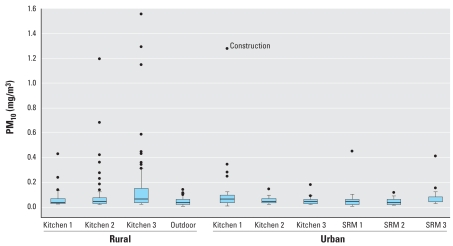
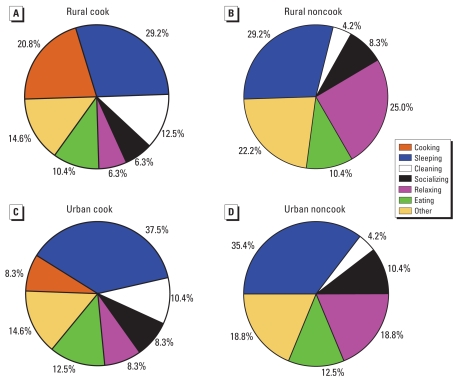
Stationary monitors measured hourly indoor particulate matter (PM) with an aerodynamic diameter < or = 10 microm (PM10) for rural and urban kitchens, urban sitting rooms, and outdoors. Personal monitors for PM with an aerodynamic diameter < or = 2.5 microm (PM2.5) were employed for 10 participants. Time-activity patterns in 30-min intervals were recorded by researchers for each participant.
Stationary monitoring results indicate that rural kitchen PM10 levels are three times higher than those in urban kitchens during cooking. PM10 was 6.1 times higher during cooking periods than during noncooking periods for rural kitchens. Personal PM2.5 levels for rural cooks were 2.8-3.6 times higher than for all other participant categories. The highest PM2.5 exposures occurred during cooking periods for urban and rural cooks. However, rural cooks had 5.4 times higher PM2.5 levels during cooking than did urban cooks. Rural cooks spent 2.5 times more hours per day cooking than did their urban counterparts.
These findings indicate that biomass burning for cooking contributes substantially to indoor particulate levels and that this exposure is particularly elevated for cooks. Second-by-second personal PM2.5 exposures revealed differences in exposures by population group and strong temporal heterogeneity that would be obscured by aggregate metrics.
生物质燃料是中国大部分农村地区家庭燃料的主要来源。此前在中国内地尚未有研究通过时间-活动日记或个人监测来描述颗粒物暴露情况。
在本研究中,我们对中国东北地区六户家庭(三户城市家庭、三户农村家庭)的室内和个人颗粒物暴露情况进行了描述,并探讨了不同地点、烹饪状态、活动和燃料类型之间的差异。农村家庭使用生物质燃料。城市家庭使用电力和天然气的组合。
固定监测仪每小时测量农村和城市厨房、城市客厅及户外空气动力学直径小于或等于10微米的室内颗粒物(PM10)。对10名参与者使用了空气动力学直径小于或等于2.5微米的个人颗粒物(PM2.5)监测仪。研究人员为每位参与者记录30分钟间隔的时间-活动模式。
固定监测结果表明,烹饪期间农村厨房的PM10水平比城市厨房高3倍。农村厨房烹饪期间的PM10比非烹饪期间高6.1倍。农村厨师的个人PM2.5水平比所有其他参与者类别高2.8 - 3.6倍。城市和农村厨师在烹饪期间的PM2.5暴露最高。然而,农村厨师在烹饪期间的PM2.5水平比城市厨师高5.4倍。农村厨师每天做饭的时间比城市厨师多2.5倍。
这些发现表明,烹饪用生物质燃烧对室内颗粒物水平有很大贡献,而且这种暴露对厨师来说尤其高。逐秒的个人PM2.5暴露揭示了不同人群组之间的暴露差异以及强烈的时间异质性,而这些会被总体指标所掩盖。