Sydney Brenner Institute for Molecular Bioscience, University of the Witwatersrand, Johannesburg, South Africa.
Division of Human Genetics, National Health Laboratory Service, and School of Pathology, Faculty of Health Sciences, University of the Witwatersrand, Johannesburg, South Africa.
BMC Microbiol. 2020 Oct 31;20(1):330. doi: 10.1186/s12866-020-02017-w.
Comparisons of traditional hunter-gatherers and pre-agricultural communities in Africa with urban and suburban Western North American and European cohorts have clearly shown that diet, lifestyle and environment are associated with gut microbiome composition. Yet, little is known about the gut microbiome composition of most communities in the very diverse African continent. South Africa comprises a richly diverse ethnolinguistic population that is experiencing an ongoing epidemiological transition and concurrent spike in the prevalence of obesity, largely attributed to a shift towards more Westernized diets and increasingly inactive lifestyle practices. To characterize the microbiome of African adults living in more mainstream lifestyle settings and investigate associations between the microbiome and obesity, we conducted a pilot study, designed collaboratively with community leaders, in two South African cohorts representative of urban and transitioning rural populations. As the rate of overweight and obesity is particularly high in women, we collected single time-point stool samples from 170 HIV-negative women (51 at Soweto; 119 at Bushbuckridge), performed 16S rRNA gene sequencing on these samples and compared the data to concurrently collected anthropometric data.
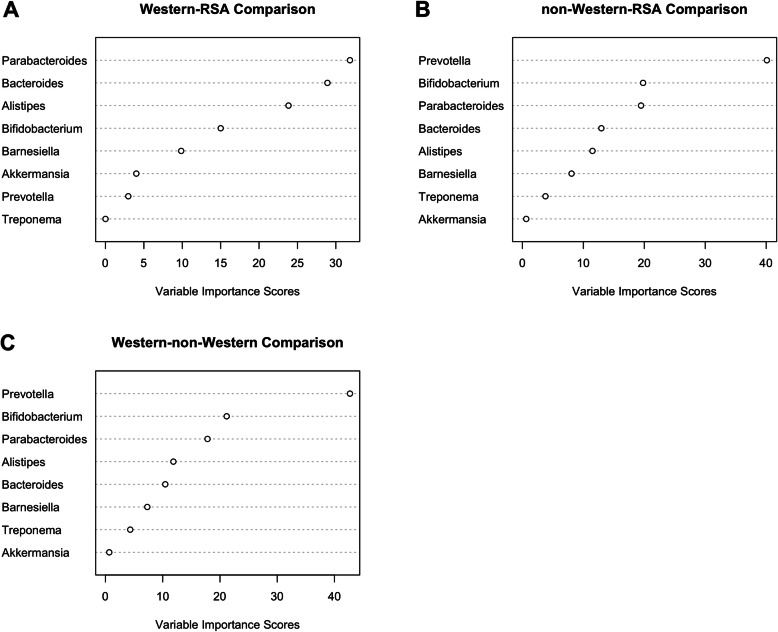
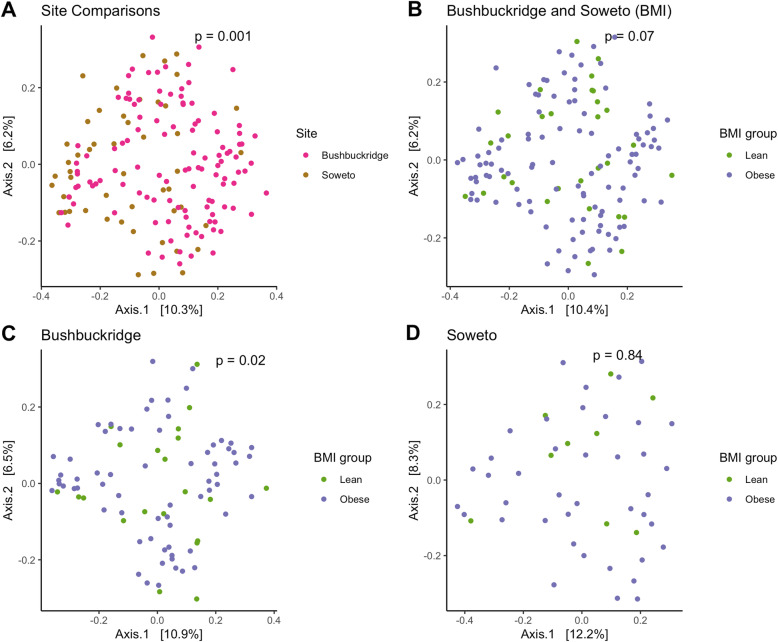
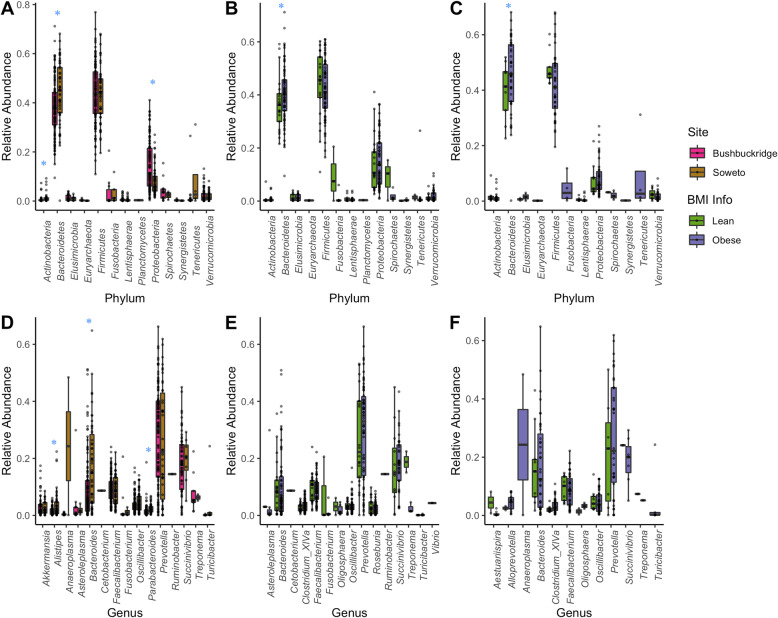
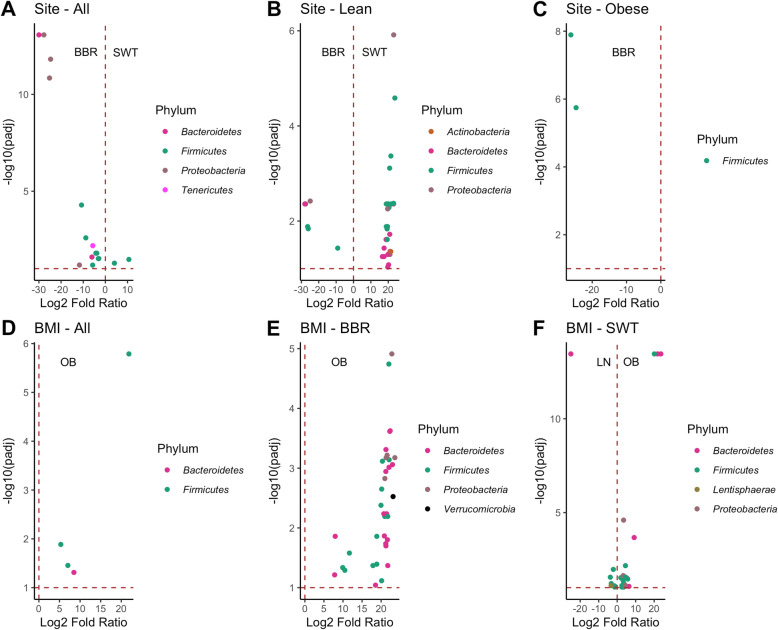
We found the overall gut microbiome of our cohorts to be reflective of their ongoing epidemiological transition. Specifically, we find that geographical location was more important for sample clustering than lean/obese status and observed a relatively higher abundance of the Melainabacteria, Vampirovibrio, a predatory bacterium, in Bushbuckridge. Also, Prevotella, despite its generally high prevalence in the cohorts, showed an association with obesity. In comparisons with benchmarked datasets representative of non-Western populations, relatively higher abundance values were observed in our dataset for Barnesiella (logfold change (FC) = 4.5), Alistipes (logFC = 3.9), Bacteroides (logFC = 4.2), Parabacteroides (logFC = 3.1) and Treponema (logFC = 1.6), with the exception of Prevotella (logFC = - 4.7).
Altogether, this work identifies putative microbial features associated with host health in a historically understudied community undergoing an epidemiological transition. Furthermore, we note the crucial role of community engagement to the success of a study in an African setting, the importance of more population-specific studies to inform targeted interventions as well as present a basic foundation for future research.
与北美西部和欧洲的城市和郊区人群相比,对非洲的传统狩猎采集者和前农业社区进行的比较清楚地表明,饮食、生活方式和环境与肠道微生物群组成有关。然而,对于非洲大陆大多数社区的肠道微生物群组成,我们知之甚少。南非拥有丰富多样的民族语言人口,目前正经历着持续的流行病学转变和肥胖患病率的同时上升,这主要归因于向更西化的饮食和越来越不活跃的生活方式的转变。为了描述生活在更主流生活方式环境中的非洲成年人的微生物组,并研究微生物组与肥胖之间的关联,我们与社区领导人合作开展了一项试点研究,该研究在两个具有代表性的城市和过渡农村人群的南非队列中进行。由于超重和肥胖的比率在女性中尤其高,我们从 170 名 HIV 阴性女性(51 名来自索韦托;119 名来自布什巴克利德)中收集了单次粪便样本,对这些样本进行了 16S rRNA 基因测序,并将数据与同时收集的人体测量数据进行了比较。
我们发现,我们的队列的整体肠道微生物组反映了他们正在进行的流行病学转变。具体而言,我们发现地理位置对样本聚类的重要性大于瘦/肥胖状态,并且在布什巴克利德观察到相对较高丰度的 Melainabacteria、Vampirovibrio(一种捕食性细菌)。此外,尽管普雷沃特菌在队列中普遍存在,但它与肥胖有关。与代表非西方人群的基准数据集进行比较时,我们的数据集中 Barnesiella(logfold change (FC) = 4.5)、Alistipes(logFC = 3.9)、Bacteroides(logFC = 4.2)、Parabacteroides(logFC = 3.1)和 Treponema(logFC = 1.6)的相对丰度值较高,而 Prevotella(logFC = -4.7)除外。
总的来说,这项工作确定了与历史上研究不足的正在经历流行病学转变的社区中的宿主健康相关的潜在微生物特征。此外,我们注意到社区参与对于在非洲环境中成功开展研究的至关重要性,以及开展更多针对特定人群的研究以提供信息来指导有针对性的干预措施的重要性,以及为未来的研究提供了一个基本的基础。