Liu Yu-Pu, Luo Zhi-Rong, Wang Chang, Cai Hao, Zhao Tian-Tian, Li Han, Shao Shui-Jin, Guo Hai-Dong
Department of Anatomy, School of Basic Medicine, Shanghai University of Traditional Chinese Medicine, Shanghai, China.
Front Neurosci. 2020 Sep 29;14:525144. doi: 10.3389/fnins.2020.525144. eCollection 2020.
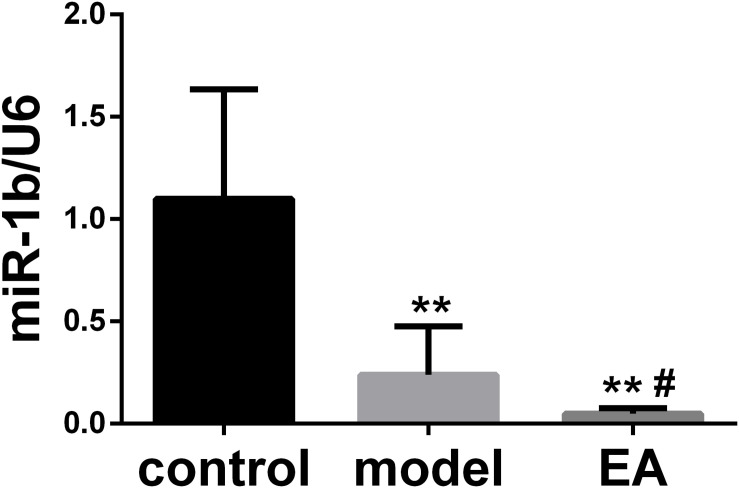
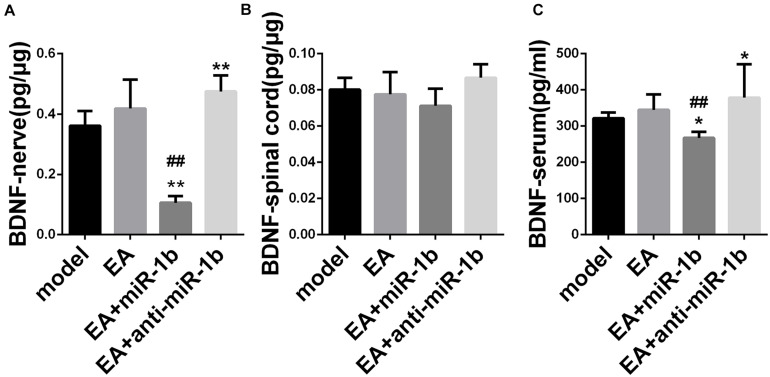
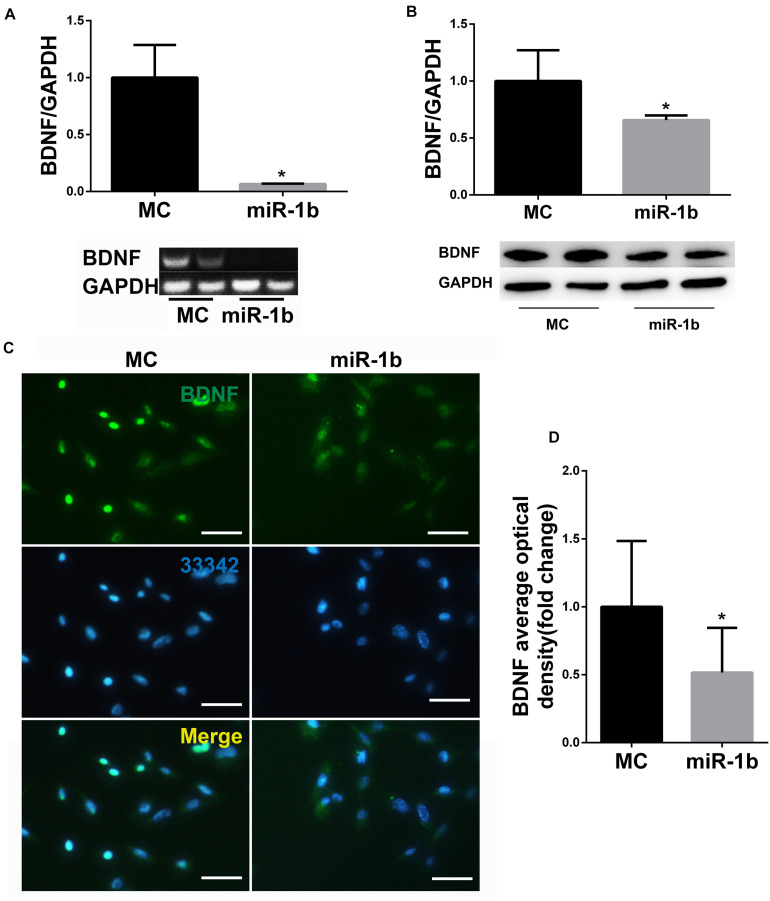
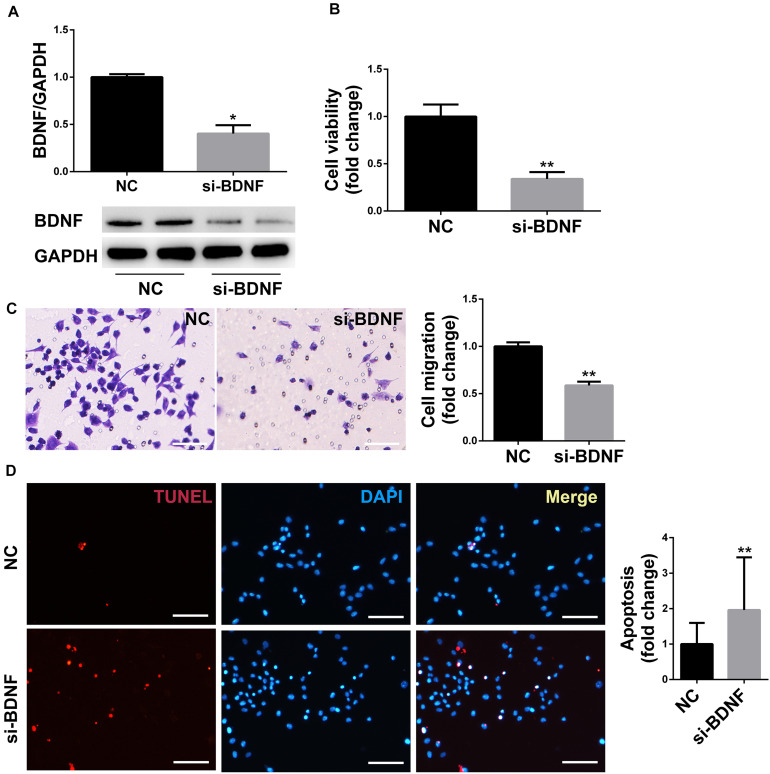
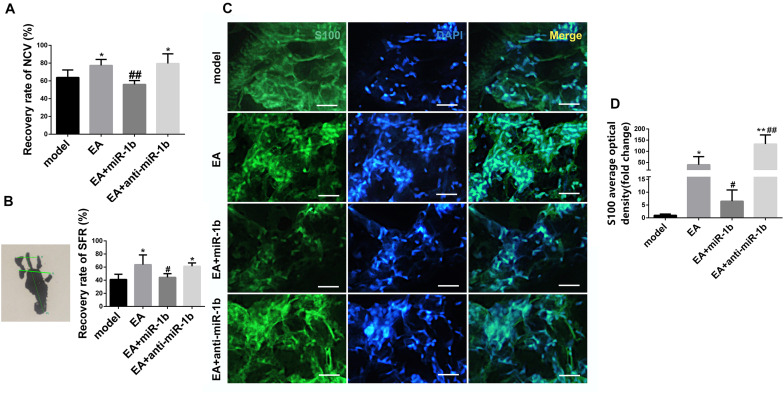
Growing evidence indicates that electroacupuncture (EA) has a definite effect on the treatment of peripheral nerve injury (PNI), but its mechanism is not completely clear. MicroRNAs (miRNAs) are involved in the regulation of a variety of biological processes, and EA may enhance PNI repair by regulating miRNAs. In this study, the rat sciatic nerve injury model was treated with EA for 4 weeks. Acupoints Huantiao (GB30) and Zusanli (ST36) were stimulated by EA 20 min once a day, 6 days a week for 4 weeks. We found that EA treatment downregulated the expression of miR-1b in the local injured nerve. experiments showed that overexpression of miR-1b inhibited the expression of brain-derived neurotrophic factor (BDNF) in rat Schwann cell (SC) line, while BDNF knockdown inhibited the proliferation, migration, and promoted apoptosis of SCs. Subsequently, the rat model of sciatic nerve injury was treated by EA treatment and injection of agomir-1b or antagomir-1b. The nerve conduction velocity ratio (NCV), sciatic functional index (SFI), and S100 immunofluorescence staining were examined and showed that compared with the model group, NCV, SFI, proliferation of SC, and expression of BDNF in the injured nerves of rats treated with EA or EA + anti-miR-1b were elevated, while EA + miR-1b was reduced, indicating that EA promoted sciatic nerve function recovery and SC proliferation through downregulating miR-1b. To summarize, EA may promote the proliferation, migration of SC, and nerve repair after PNI by regulating miR-1b, which targets BDNF.
越来越多的证据表明,电针(EA)对周围神经损伤(PNI)的治疗有确切疗效,但其机制尚不完全清楚。微小RNA(miRNA)参与多种生物学过程的调控,电针可能通过调控miRNA促进周围神经损伤的修复。在本研究中,对大鼠坐骨神经损伤模型进行4周的电针治疗。每天一次,每次20分钟,每周6天,共4周,针刺环跳穴(GB30)和足三里穴(ST36)。我们发现电针治疗下调了局部损伤神经中miR-1b的表达。实验表明,miR-1b过表达抑制大鼠雪旺细胞(SC)系中脑源性神经营养因子(BDNF)的表达,而BDNF敲低则抑制雪旺细胞的增殖、迁移并促进其凋亡。随后,对大鼠坐骨神经损伤模型进行电针治疗并注射miR-1b激动剂或拮抗剂。检测神经传导速度比值(NCV)、坐骨神经功能指数(SFI)和S100免疫荧光染色,结果显示,与模型组相比,电针组或电针+抗miR-1b组大鼠损伤神经的NCV、SFI、雪旺细胞增殖及BDNF表达升高,而电针+miR-1b组降低,表明电针通过下调miR-1b促进坐骨神经功能恢复和雪旺细胞增殖。综上所述,电针可能通过调控靶向BDNF的miR-1b促进雪旺细胞的增殖、迁移及周围神经损伤后的神经修复。