Tittelmeier Jessica, Nachman Eliana, Nussbaum-Krammer Carmen
German Cancer Research Center (DKFZ), Center for Molecular Biology of Heidelberg University (ZMBH), DKFZ-ZMBH Alliance, Heidelberg, Germany.
Front Aging Neurosci. 2020 Oct 6;12:581374. doi: 10.3389/fnagi.2020.581374. eCollection 2020.
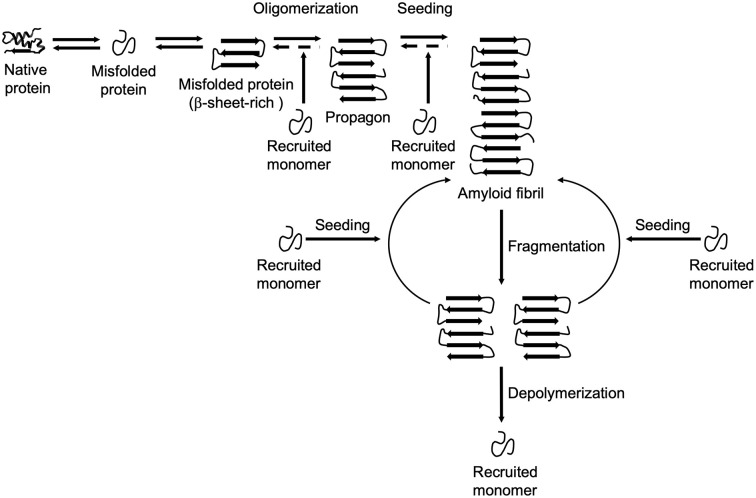
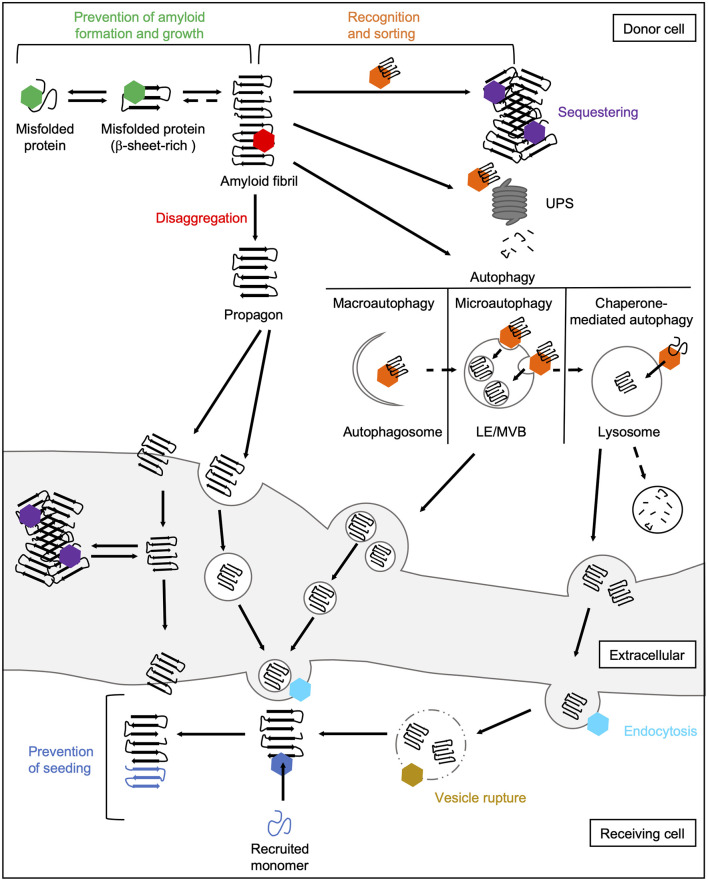
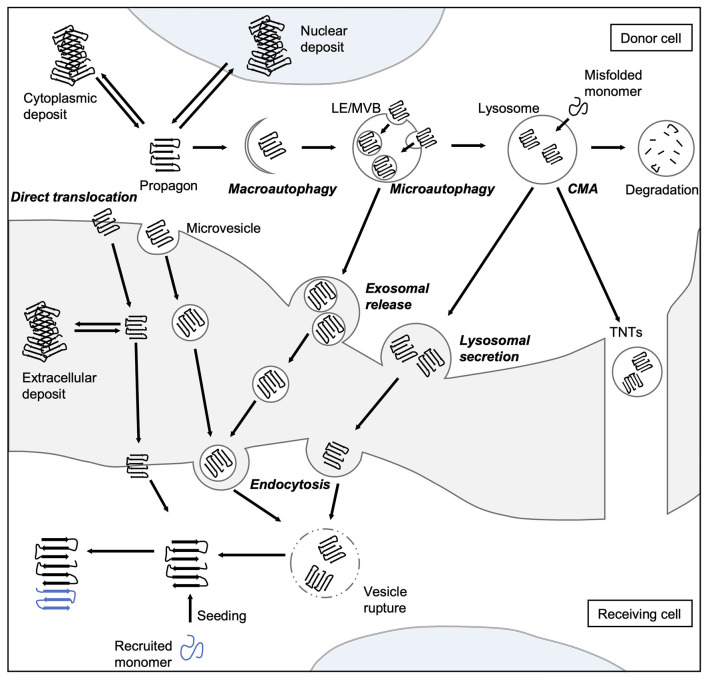
Aberrant accumulation of misfolded proteins into amyloid deposits is a hallmark in many age-related neurodegenerative diseases, including Alzheimer's disease (AD), Parkinson's disease (PD), Huntington's disease (HD), and amyotrophic lateral sclerosis (ALS). Pathological inclusions and the associated toxicity appear to spread through the nervous system in a characteristic pattern during the disease. This has been attributed to a prion-like behavior of amyloid-type aggregates, which involves self-replication of the pathological conformation, intercellular transfer, and the subsequent seeding of native forms of the same protein in the neighboring cell. Molecular chaperones play a major role in maintaining cellular proteostasis by assisting the (re)-folding of cellular proteins to ensure their function or by promoting the degradation of terminally misfolded proteins to prevent damage. With increasing age, however, the capacity of this proteostasis network tends to decrease, which enables the manifestation of neurodegenerative diseases. Recently, there has been a plethora of studies investigating how and when chaperones interact with disease-related proteins, which have advanced our understanding of the role of chaperones in protein misfolding diseases. This review article focuses on the steps of prion-like propagation from initial misfolding and self-templated replication to intercellular spreading and discusses the influence that chaperones have on these various steps, highlighting both the positive and adverse consequences chaperone action can have. Understanding how chaperones alleviate and aggravate disease progression is vital for the development of therapeutic strategies to combat these debilitating diseases.
错误折叠的蛋白质异常积聚形成淀粉样沉积物是许多与年龄相关的神经退行性疾病的标志,包括阿尔茨海默病(AD)、帕金森病(PD)、亨廷顿病(HD)和肌萎缩侧索硬化症(ALS)。在疾病过程中,病理性包涵体及其相关毒性似乎以一种特征性模式在神经系统中传播。这被归因于淀粉样蛋白聚集体的朊病毒样行为,其中涉及病理构象的自我复制、细胞间转移以及随后在相邻细胞中播种相同蛋白质的天然形式。分子伴侣通过协助细胞蛋白质的(重新)折叠以确保其功能,或通过促进最终错误折叠蛋白质的降解以防止损伤,在维持细胞蛋白质稳态中发挥主要作用。然而,随着年龄的增长,这种蛋白质稳态网络的能力往往会下降,这使得神经退行性疾病得以显现。最近,有大量研究调查了分子伴侣如何以及何时与疾病相关蛋白质相互作用,这加深了我们对分子伴侣在蛋白质错误折叠疾病中作用的理解。这篇综述文章重点关注了从最初的错误折叠和自我模板复制到细胞间传播的朊病毒样传播步骤,并讨论了分子伴侣对这些不同步骤的影响,强调了分子伴侣作用可能产生的积极和不利后果。了解分子伴侣如何减轻和加重疾病进展对于开发对抗这些使人衰弱疾病的治疗策略至关重要。