Bakirtzis Christos, Grigoriadou Eleni, Boziki Marina Kleopatra, Kesidou Evangelia, Siafis Spyridon, Moysiadis Theodoros, Tsakona Dimitra, Thireos Eleftherios, Nikolaidis Ioannis, Pourzitaki Chrysa, Kouvelas Dimitrios, Papazisis Georgios, Tsalikakis Dimitrios, Grigoriadis Nikolaos
Multiple Sclerosis Center, B' Department of Neurology, Aristotle University of Thessaloniki, Thessaloniki, Greece.
Department of Clinical Pharmacology, Aristotle University of Thessaloniki, Thessaloniki, Greece.
Front Neurol. 2020 Sep 29;11:1012. doi: 10.3389/fneur.2020.01012. eCollection 2020.
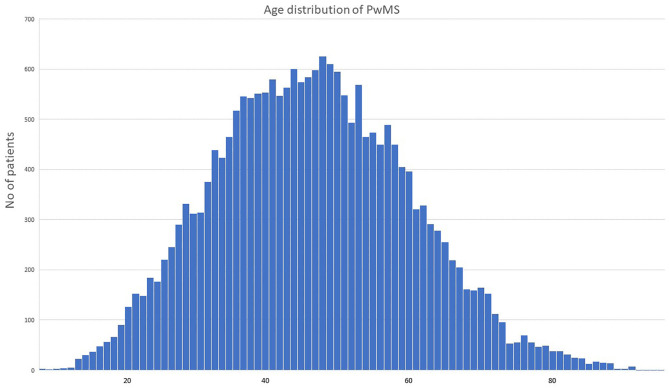
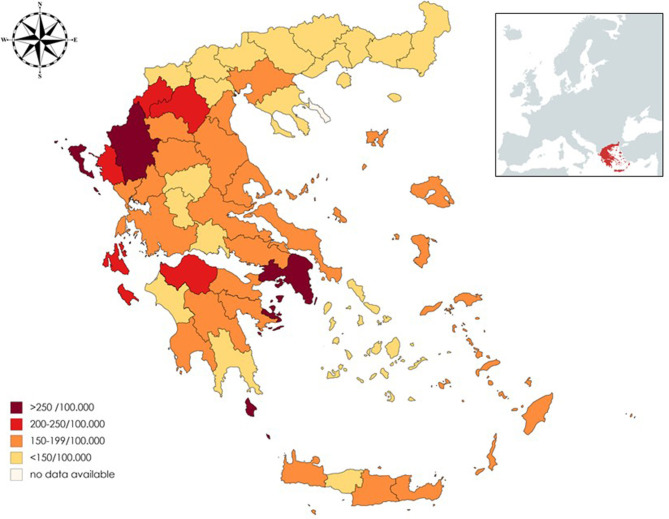
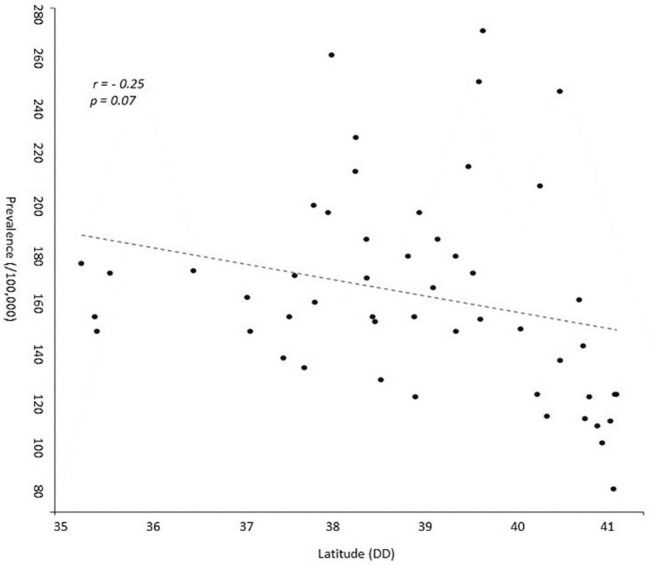
To estimate current prevalence of multiple sclerosis (MS) in Greece using administrative data from the nationwide medicine prescription database. Prescription records of a 24-month period (June 2017-May 2019) were analyzed in order to identify cases of MS. Sex, age, and place of residence were recorded for each identified case. Prevalence of MS was calculated based on the updated records of the Greek population according to Hellenic Statistical Authority. The 2-year cumulative period prevalence of MS was estimated to 197.8 per 100,000 (95% CI 197.6-198.0). In total, 21,218 patients (65.8% female) were identified. During this period, the prevalence of MS was 138.7 per 100,000 (95% CI 138.4-139.0) in men and 253.6 per 100,000 (95% CI 253.3-254.1) in women. Prevalence was higher in the 45-49 age group in both sexes. Analysis of the place of residence revealed higher prevalence in the Attica region and Western Greece while lower prevalence was observed in Northern Greece. No north-south latitude gradient was detected. Point prevalence on 1 January 2019 was calculated to 188.9 per 100,000 (95% CI 188.7-189.1). Regarding treatment, 73.1% of the identified cases received at least once a Disease Modifying Drug. According to this national-level study conducted in Greece, estimated prevalence of MS was found to be similar to those of other European countries. Heterogeneity of MS prevalence across the country was observed and needs further investigation.
利用全国药品处方数据库中的管理数据估算希腊目前多发性硬化症(MS)的患病率。分析了24个月期间(2017年6月至2019年5月)的处方记录,以确定MS病例。记录每个确诊病例的性别、年龄和居住地点。根据希腊统计局更新的希腊人口记录计算MS的患病率。MS的2年累积期间患病率估计为每10万人197.8例(95%置信区间197.6 - 198.0)。总共确定了21218名患者(女性占65.8%)。在此期间,男性MS患病率为每10万人138.7例(95%置信区间138.4 - 139.0),女性为每10万人253.6例(95%置信区间253.3 - 254.1)。45 - 49岁年龄组的两性患病率均较高。对居住地点的分析显示,阿提卡地区和希腊西部患病率较高,而希腊北部患病率较低。未检测到南北纬度梯度。2019年1月1日的点患病率计算为每10万人188.9例(95%置信区间188.7 - 189.1)。关于治疗,73.1%的确诊病例至少接受过一次疾病修正药物治疗。根据在希腊进行的这项国家级研究,发现MS的估计患病率与其他欧洲国家相似。观察到全国MS患病率存在异质性,需要进一步调查。