Touchstone Diabetes Center, Department of Internal Medicine, University of Texas Southwestern Medical Center, Dallas, TX, United States.
Department of Cell Biology, University of Texas Southwestern Medical Center, Dallas, TX, United States.
Front Endocrinol (Lausanne). 2020 Oct 2;11:569250. doi: 10.3389/fendo.2020.569250. eCollection 2020.
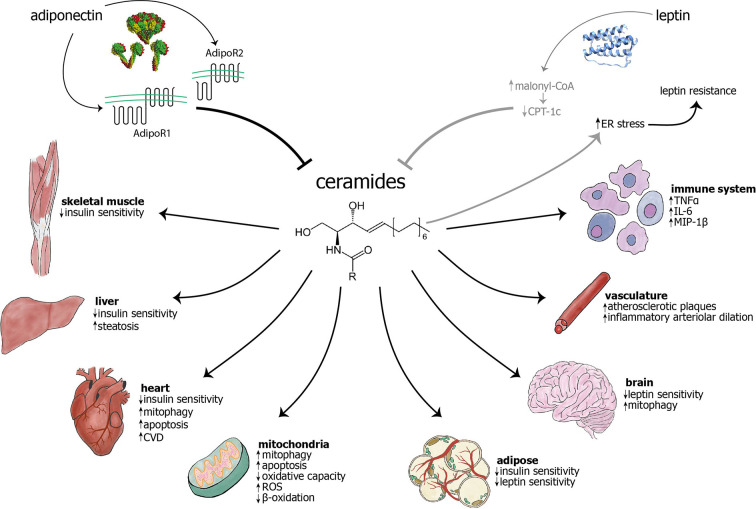
Metabolic dysfunction is intertwined with the pathophysiology of both diabetes and cardiovascular disease. Recently, one particular lipid class has been shown to influence the development and sustainment of these diseases: ceramides. As a subtype of sphingolipids, these species are particularly central to many sphingolipid pathways. Increased levels of ceramides are known to correlate with impaired cardiovascular and metabolic health. Furthermore, the interaction between ceramides and adipokines, most notably adiponectin and leptin, appears to play a role in the pathophysiology of these conditions. Adiponectin appears to counteract the detrimental effects of elevated ceramides, largely through activation of the ceramidase activity of its receptors. Elevated ceramides appear to worsen leptin resistance, which is an important phenomenon in the pathophysiology of obesity and metabolic syndrome.
代谢功能障碍与糖尿病和心血管疾病的病理生理学密切相关。最近,一类特定的脂质被证明会影响这些疾病的发展和持续:神经酰胺。作为鞘脂的一种亚型,这些物质在许多鞘脂途径中起着特别重要的作用。神经酰胺水平升高与心血管和代谢健康受损有关。此外,神经酰胺与脂肪细胞因子(尤其是脂联素和瘦素)之间的相互作用似乎在这些疾病的病理生理学中发挥作用。脂联素似乎通过激活其受体的神经酰胺酶活性来抵消升高的神经酰胺的有害影响。神经酰胺水平升高似乎会加重瘦素抵抗,这是肥胖和代谢综合征病理生理学中的一个重要现象。