Erfanparast Amir, Tamaddonfard Esmaeal, Henareh-Chareh Farzin
Department of Basic Sciences, Faculty of Veterinary Medicine, Urmia University, Urmia, Iran.
DVM Graduate, Faculty of Veterinary Medicine, Urmia University, Urmia, Iran.
Vet Res Forum. 2020 Summer;11(3):229-234. doi: 10.30466/vrf.2018.83779.2101. Epub 2020 Sep 15.
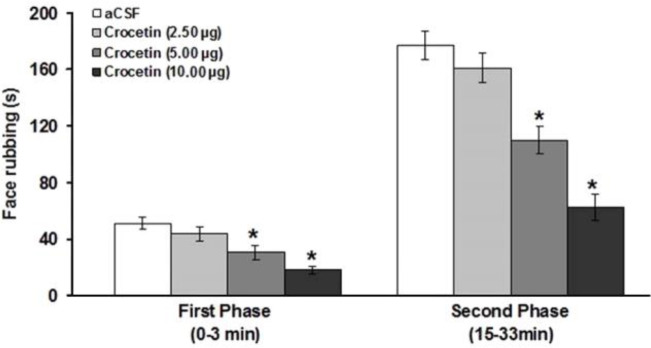
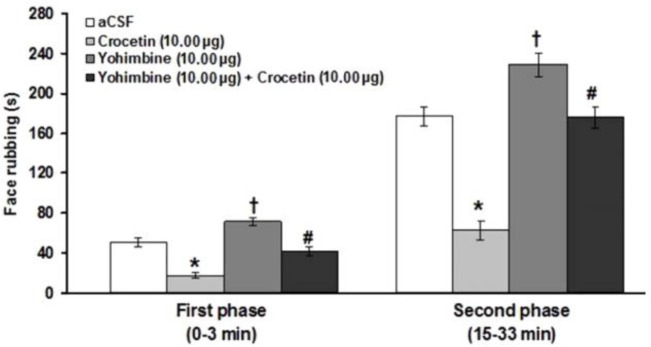
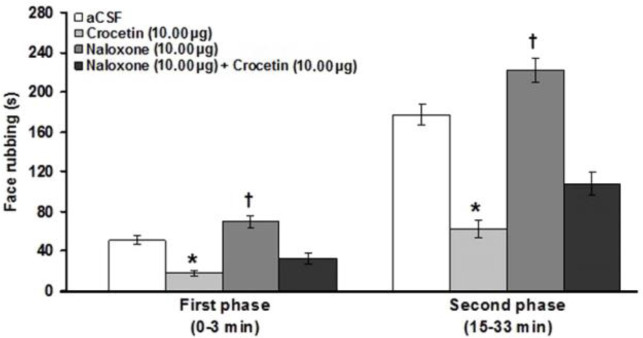
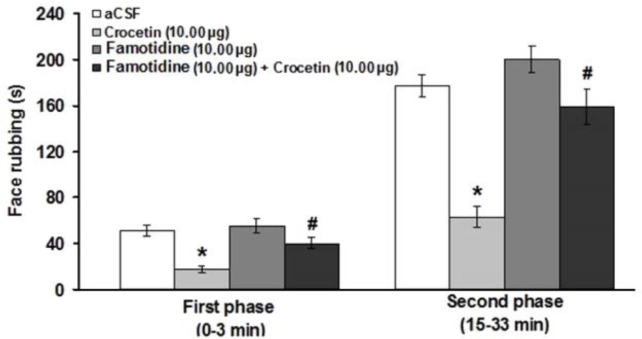
Previous findings have shown that saffron ( L.) extract and its active constituents produce antinociceptive effects in the rat models of orofacial pain. In the present study, the central H histaminergic and alpha-2 adrenergic receptors involvement in crocetin-induced antinociception in orofacial formalin pain in rats was evaluated. The guide cannula was implanted into the fourth ventricle in ketamine-xylazine anesthetized rats. Subcutaneous injection of a diluted formalin solution (1.50%; 50.00 µL) into a vibrissae pad was used as a model of orofacial pain. Face rubbing behavior durations were recorded at 3 min blocks for 45 min. Formalin produced a biphasic pain response (first phase: 0-3 min and second phase: 15-33 min). Intra-fourth ventricle injections of crocetin (5.00 and 10.00 μg μL) suppressed, whereas yohimbine (10.00 μg μL) and naloxone (10.00 μg μL) increased the intensity of both phases of pain. Crocetin-induced antinociception was not prevented by central pretreatment with naloxone. However, the antinociceptive effect of crocetin (5.00 μg μL) was inhibited by prior administration of famotidine (10.00 μg μL) and yohimbine (10.00 μg μL). Our study showed that injection of crocetin into the cerebral fourth ventricle attenuated formalin-induced orofacial pain in rats. Central H histaminergic and alpha-2 adrenergic receptors, but not opioid receptors, might be involved in crocetin-induced antinociception.
先前的研究结果表明,藏红花提取物及其活性成分在口面部疼痛的大鼠模型中产生抗伤害感受作用。在本研究中,评估了中枢H组胺能和α-2肾上腺素能受体在大鼠口面部福尔马林疼痛中藏红花素诱导的抗伤害感受中的作用。将引导套管植入氯胺酮-赛拉嗪麻醉大鼠的第四脑室。将稀释的福尔马林溶液(1.50%;50.00μL)皮下注射到触须垫中作为口面部疼痛模型。以3分钟为间隔记录45分钟的擦脸行为持续时间。福尔马林产生双相疼痛反应(第一阶段:0-3分钟,第二阶段:15-33分钟)。第四脑室内注射藏红花素(5.00和10.00μg/μL)可抑制疼痛,而育亨宾(10.00μg/μL)和纳洛酮(10.00μg/μL)可增加两个疼痛阶段的强度。纳洛酮中枢预处理不能阻止藏红花素诱导的抗伤害感受。然而,法莫替丁(10.00μg/μL)和育亨宾(10.00μg/μL)预先给药可抑制藏红花素(5.00μg/μL)的抗伤害感受作用。我们的研究表明,向脑第四脑室注射藏红花素可减轻大鼠福尔马林诱导的口面部疼痛。中枢H组胺能和α-2肾上腺素能受体而非阿片受体可能参与藏红花素诱导的抗伤害感受。