Zhang Yanfang, Feng Bin, Xie Zhixun, Deng Xianwen, Zhang Minxiu, Xie Zhiqin, Xie Liji, Fan Qing, Luo Sisi, Zeng Tingting, Huang Jiaoling, Wang Sheng
Guangxi Key Laboratory of Veterinary Biotechnology, Guangxi Veterinary Research Institute, Nanning, China.
Front Vet Sci. 2020 Oct 8;7:561371. doi: 10.3389/fvets.2020.561371. eCollection 2020.
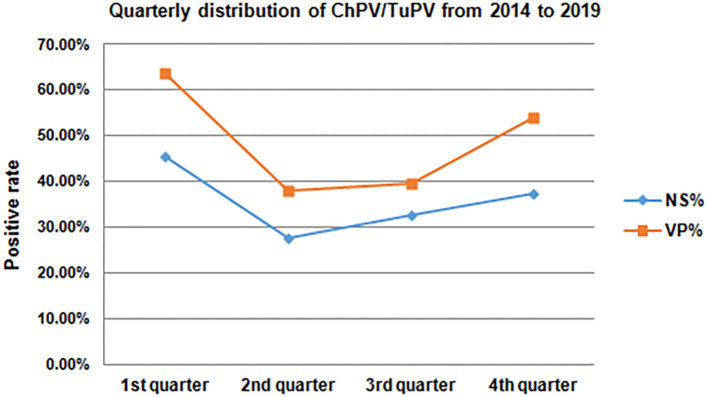
A previously unidentified chicken parvovirus (ChPV) and turkey parvovirus (TuPV) strain, associated with runting-stunting syndrome (RSS) and poultry enteritis and mortality syndrome (PEMS) in turkeys, is now prevalent among chickens in China. In this study, a large-scale surveillance of parvoviruses in chickens and turkeys using conserved PCR assays was performed. We assessed the prevalence of ChPV/TuPV in commercial chicken and turkey farms in China between 2014 and 2019. Parvoviruses were prevalent in 51.73% (1,795/3,470) of commercial chicken and turkey farms in Guangxi, China. The highest frequency of ChPV positive samples tested by PCR occurred in chickens that were broiler chickens 64.18% (1,041/1,622) compared with breeder chickens 38.75% (572/1,476) and layer hens 38.89% (112/288), and TuPV was detected in 70/84 (83.33%). Native and exotic chicken species were both prevalent in commercial farms in southern China, and exotic broiler chickens had a higher positive rate with 88.10% (148/168), while native chickens were 50.00% (1,465/2,930). The environmental samples from poultry houses tested positive for ChPV and TuPV were 47.05% (415/874). Samples from open house flocks had higher prevalence rates of ChPV than those of closed house flocks (), among which those from the open house showed 84.16% (85/101) positivity, those from litter showed 62.86% (44/70) positivity, and those from drinking water showed 50.00% (56/112) positivity, whereas those from the closed house litter were 53.57% (60/112), those from swabs were 50.18% (138/275), and those from drinking water were 15.69% (32/204). Samples collected during spring were more frequently ChPV/ TuPV positive than those collected during other seasons. This study is the first report regarding the epidemiological surveillance of ChPV and TuPV in chicken/turkey flocks in Guangxi, China. Our results suggest that ChPV and TuPV are widely distributed in commercial fowl in Guangxi. These findings highlight the need for further epidemiological and genetic research on ChPV and TuPV in this area.
一种先前未被识别的鸡细小病毒(ChPV)和火鸡细小病毒(TuPV)毒株,与火鸡的生长迟缓综合征(RSS)以及家禽肠炎和死亡综合征(PEMS)相关,目前在中国的鸡群中普遍存在。在本研究中,使用保守PCR检测法对鸡和火鸡中的细小病毒进行了大规模监测。我们评估了2014年至2019年间中国商业性鸡场和火鸡场中ChPV/TuPV的流行情况。在中国广西,51.73%(1795/3470)的商业性鸡场和火鸡场中存在细小病毒。通过PCR检测,ChPV阳性样本频率最高的是肉鸡,占64.18%(1041/1622),相比之下,种鸡为38.75%(572/1476),蛋鸡为38.89%(112/288),并且在84个样本中的70个(83.33%)中检测到了TuPV。在中国南方的商业性养殖场中,本地鸡种和外来鸡种都很普遍,外来肉鸡的阳性率更高,为88.10%(148/168),而本地鸡为50.00%(1465/2930)。家禽舍的环境样本中ChPV和TuPV检测呈阳性的比例为47.05%(415/874)。开放式鸡舍鸡群的样本中ChPV的流行率高于封闭式鸡舍鸡群(),其中开放式鸡舍样本的阳性率为84.16%(85/101),垫料样本为62.86%(44/70),饮用水样本为50.00%(56/112),而封闭式鸡舍垫料样本为53.57%(60/112),拭子样本为50.18%(138/275),饮用水样本为15.69%(32/204)。春季采集的样本中ChPV/TuPV呈阳性的频率高于其他季节采集的样本。本研究是关于中国广西鸡/火鸡群中ChPV和TuPV流行病学监测的首次报告。我们的结果表明,ChPV和TuPV在中国广西的商业家禽中广泛分布。这些发现凸显了对该地区ChPV和TuPV进行进一步流行病学和遗传学研究的必要性。