
经皮骨活检用于糖尿病足骨髓炎:一项系统评价和Meta分析
Percutaneous Bone Biopsy for Diabetic Foot Osteomyelitis: A Systematic Review and Meta-Analysis.
作者信息
Schechter Marcos C, Ali Mohammed K, Risk Benjamin B, Singer Adam D, Santamarina Gabriel, Rogers Hannah K, Rajani Ravi R, Umpierrez Guillermo, Fayfman Maya, Kempker Russell R
机构信息
Emory University School of Medicine, Grady Memorial Hospital, Department of Medicine, Division of Infectious Diseases, Atlanta, Georgia, USA.
Emory University, Rollins School of Public Health, Department of Global Health and Epidemiology, Atlanta, Georgia, USA.
出版信息
Open Forum Infect Dis. 2020 Aug 29;7(10):ofaa393. doi: 10.1093/ofid/ofaa393. eCollection 2020 Oct.
BACKGROUND
Diabetes is the leading cause of lower extremity nontraumatic amputation globally, and diabetic foot osteomyelitis (DFO) is usually the terminal event before limb loss. Although guidelines recommend percutaneous bone biopsy (PBB) for microbiological diagnosis of DFO in several common scenarios, it is unclear how frequently PBBs yield positive cultures and whether they cause harm or improve outcomes.
METHODS
We searched the PubMed, EMBASE, and Cochrane Trials databases for articles in any language published up to December 31, 2019, reporting the frequency of culture-positive PBBs. We calculated the pooled proportion of culture-positive PBBs using a random-effects meta-analysis model and reported on PBB-related adverse events, DFO outcomes, and antibiotic adjustment based on PBB culture results where available.
RESULTS
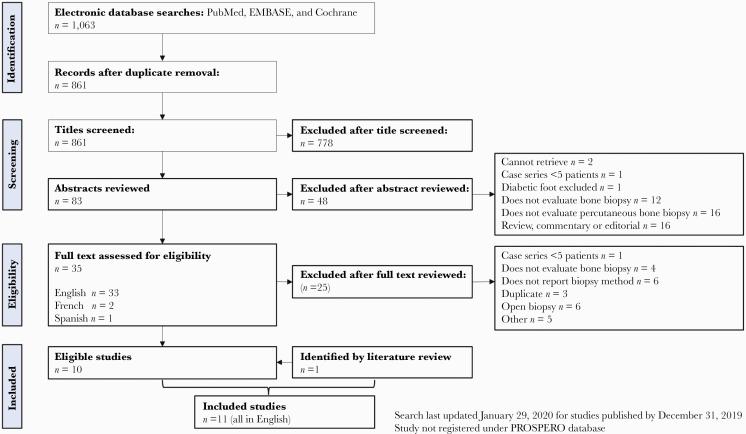
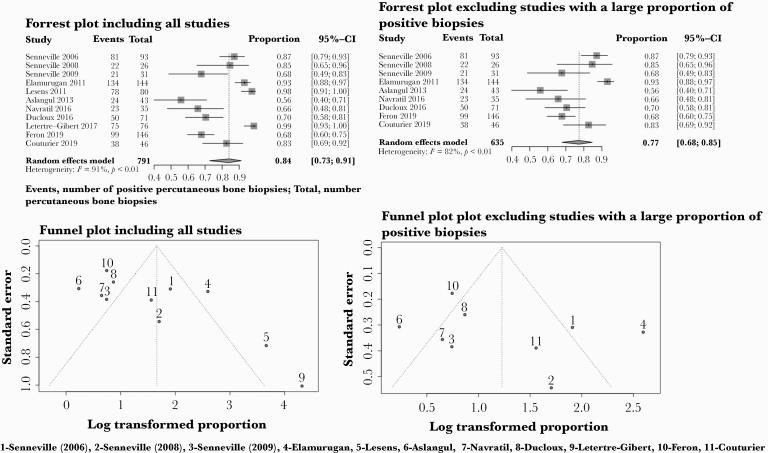
Among 861 articles, 11 studies met inclusion criteria and included 780 patients with 837 PBBs. Mean age ranged between 56.6 and 71.0 years old. The proportion of males ranged from 62% to 86%. All studies were longitudinal observational cohorts, and 10 were from Europe. The range of culture-positive PBBs was 56%-99%, and the pooled proportion of PBBs with a positive culture was 84% (95% confidence interval, 73%-91%). There was heterogeneity between studies and no consistency in definitions used to define adverse events. Impact of PBB on DFO outcomes or antibiotic management were seldom reported.
CONCLUSIONS
This meta-analysis suggests PBBs have a high yield of culture-positive results. However, this is an understudied topic, especially in low- and middle-income countries, and the current literature provides very limited data regarding procedure safety and impact on clinical outcomes or antibiotic management.
背景
糖尿病是全球下肢非创伤性截肢的主要原因,糖尿病足骨髓炎(DFO)通常是肢体丧失前的终末事件。尽管指南推荐在几种常见情况下采用经皮骨活检(PBB)对DFO进行微生物学诊断,但尚不清楚PBB获得阳性培养结果的频率,以及其是否会造成伤害或改善预后。
方法
我们检索了PubMed、EMBASE和Cochrane试验数据库,以查找截至2019年12月31日发表的任何语言的文章,这些文章报告了培养阳性PBB的频率。我们使用随机效应荟萃分析模型计算了培养阳性PBB的合并比例,并报告了与PBB相关的不良事件、DFO预后以及根据PBB培养结果进行的抗生素调整(如有)。
结果
在861篇文章中,11项研究符合纳入标准,包括780例患者,共进行了837次PBB。平均年龄在56.6岁至71.0岁之间。男性比例在62%至86%之间。所有研究均为纵向观察性队列研究,其中10项来自欧洲。培养阳性PBB的比例范围为56%至99%,培养阳性PBB的合并比例为84%(95%置信区间,73%至91%)。各研究之间存在异质性,且在定义不良事件时使用的定义不一致。很少有研究报告PBB对DFO预后或抗生素管理的影响。
结论
这项荟萃分析表明,PBB获得培养阳性结果的比例很高。然而,这是一个研究不足的主题,尤其是在低收入和中等收入国家中;当前文献提供的关于该操作安全性以及对临床结局或抗生素管理影响的数据非常有限。


 Zotero 插件