Ramos Beatriz, Pereira André C, Reis Ana C, Cunha Mónica V
Centre for Ecology, Evolution and Environmental Changes (cE3c), Faculdade de Ciências, Universidade de Lisboa, 1749-016 Lisboa, Portugal.
Biosystems & Integrative Sciences Institute (BioISI), Faculdade de Ciências, Universidade de Lisboa, 1749-016 Lisboa, Portugal.
One Health. 2020 Sep 20;10:100169. doi: 10.1016/j.onehlt.2020.100169. eCollection 2020 Dec.
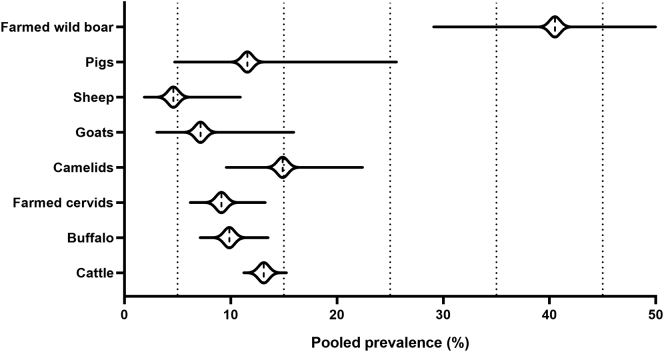
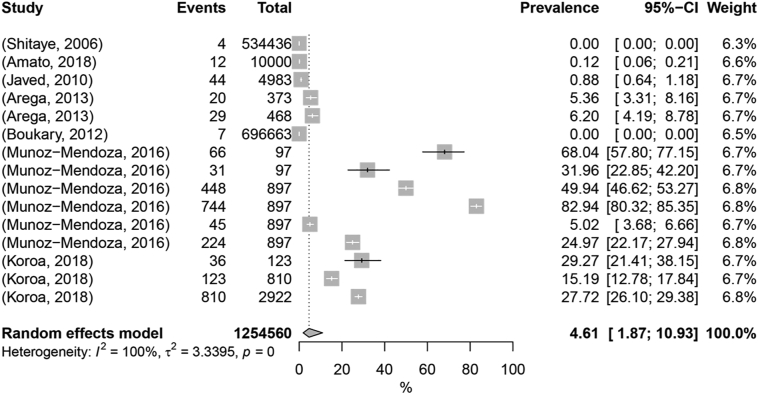
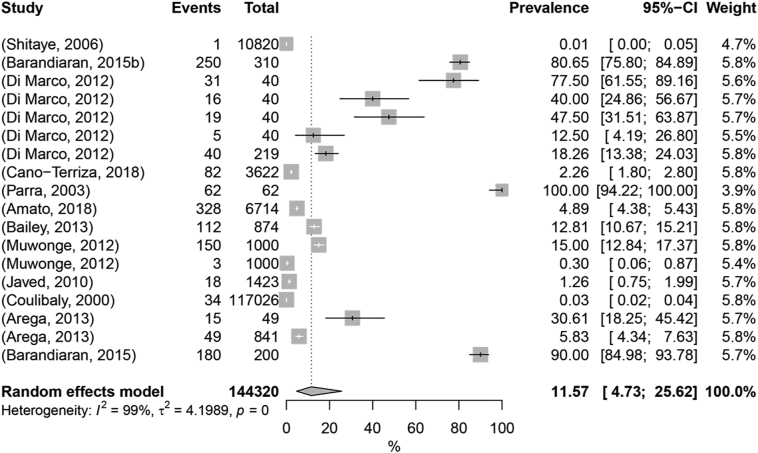
Zoonotic animal tuberculosis (TB) is a One Health paradigm infectious disease, caused by complex bacteria, that affects different host species with varying levels of management. In most developed countries, official surveillance and control strategies support the longitudinal reporting of herd and/or animal prevalence. However, for under resourced countries without surveillance plans, this information may be obtained from cross-sectional studies only. The objective of this meta-analysis was to perform a worldwide estimate of the overall prevalence of animal TB in different livestock species whose importance in production systems varies according to the region of the world. The ISI's Web of Science and Google Scholar were searched combining keywords and related database-specific subject terms to identify relevant cohort or cross-sectional work published in this topic. A total of 443 articles were retrieved, screened, and a final set of 182 references included. Potential sources of variation were investigated using subgroup analyses and meta-regression. Prevalence estimates in five mammalian host groups were stratified according to host species, host characteristics, anatomical localization of lesions, sample size, geographical location, and diagnostic tests. The multivariable meta-regression analysis accounted for a range between 0% (farmed wild boar) and 68.71% (camelids) of the overall observed heterogeneity, indicating that the pondered predictors partially explain the observed variability. Differences in the overall prevalence of TB across hosts were small, with most groups showing values around 10%, except farmed wild boar (41%). The sample size emerged as an important moderator, with small size studies leading to the overestimation of prevalence. TB prevalence rates were very heterogeneous across continents and depended on the host, with lower values (below 10%) in Africa and Asia, while North America (33.6%, cattle), Europe (51%, goats), and South America (85.7%, pigs) exhibited higher rates, possibly related to greater densities of specific host groups managed on more intensive production systems. Stratification by diagnostic tests evidenced heterogeneous prevalence rates depending on the host group, possibly reflecting differences in test performance across different hosts. Results from this study highlight different TB burden scenarios, pinpointing host groups and diagnostics that should be prioritized in surveillance systems in different regions, thus providing policy-relevant information to catalyse TB control in settings with lower installed capacity and better resource allocation at the human-animal-environment interface.
人畜共患动物结核病是一种遵循“同一健康”范式的传染病,由复杂细菌引起,影响不同管理水平的不同宿主物种。在大多数发达国家,官方监测和控制策略支持对畜群和/或动物患病率进行纵向报告。然而,对于没有监测计划的资源匮乏国家,这些信息可能只能从横断面研究中获得。本荟萃分析的目的是对不同家畜物种的动物结核病总体患病率进行全球估计,这些家畜物种在生产系统中的重要性因世界区域而异。在科学网(ISI's Web of Science)和谷歌学术(Google Scholar)中进行搜索,结合关键词和特定数据库的相关主题词,以识别该主题下发表的相关队列研究或横断面研究。共检索到443篇文章,经过筛选,最终纳入182篇参考文献。使用亚组分析和meta回归研究潜在的变异来源。根据宿主物种、宿主特征、病变的解剖定位、样本量、地理位置和诊断测试,对五个哺乳动物宿主组的患病率估计进行分层。多变量meta回归分析解释了总体观察到的异质性的0%(养殖野猪)至68.71%(骆驼科动物)之间的范围,表明加权预测因子部分解释了观察到的变异性。不同宿主的结核病总体患病率差异较小,除养殖野猪(41%)外,大多数组的患病率约为10%。样本量是一个重要的调节因素,小规模研究导致患病率估计值偏高。结核病患病率在各大洲之间差异很大,并且取决于宿主,非洲和亚洲的患病率较低(低于10%),而北美洲(牛为33.6%)、欧洲(山羊为51%)和南美洲(猪为85.7%)的患病率较高,这可能与在更集约化生产系统中管理的特定宿主群体密度较高有关。按诊断测试分层显示,患病率因宿主组而异,这可能反映了不同宿主的检测性能差异。本研究结果突出了不同的结核病负担情况,确定了不同地区监测系统中应优先考虑的宿主群体和诊断方法,从而提供与政策相关的信息,以促进在能力建设较低的环境中进行结核病控制,并在人-动物-环境界面实现更好的资源分配。