Li Honggang, Xiao Xingyuan, Zhang Jie, Zafar Mohammad Ishraq, Wu Chunlin, Long Yuting, Lu Wei, Pan Feng, Meng Tianqing, Zhao Kai, Zhou Liquan, Shen Shiliang, Liu Liang, Liu Qian, Xiong Chengliang
Institute of Reproductive Health/Center of Reproductive Medicine, Tongji Medical College, Huazhong University of Science and Technology, Hangkong Road 13, Wuhan 430030, China.
Wuhan Tongji Reproductive Medicine Hospital, Sanyang Road 128, Wuhan 430013, China.
EClinicalMedicine. 2020 Nov;28:100604. doi: 10.1016/j.eclinm.2020.100604. Epub 2020 Oct 23.
The current study aimed to determine the impact of SARS-CoV-2 infection on male fertility.
This is a single-center, hospital-based observational study that included autopsied testicular and epididymal specimens of deceased COVID-19 male patients (=6) and recruited recovering COVID-19 inpatients (=23) with an equal number of age-matched controls, respectively. We performed histopathological examinations on testicular and epididymal specimens, and also performed TUNEL assay and immunohistochemistry. Whereas, we investigated the semen specimen for sperm parameters and immune factors.
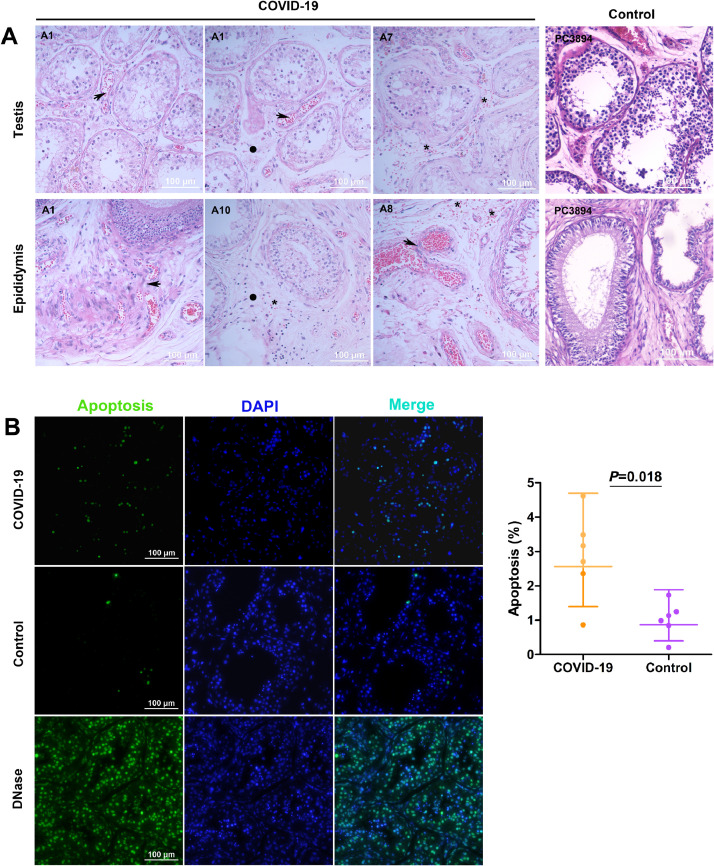
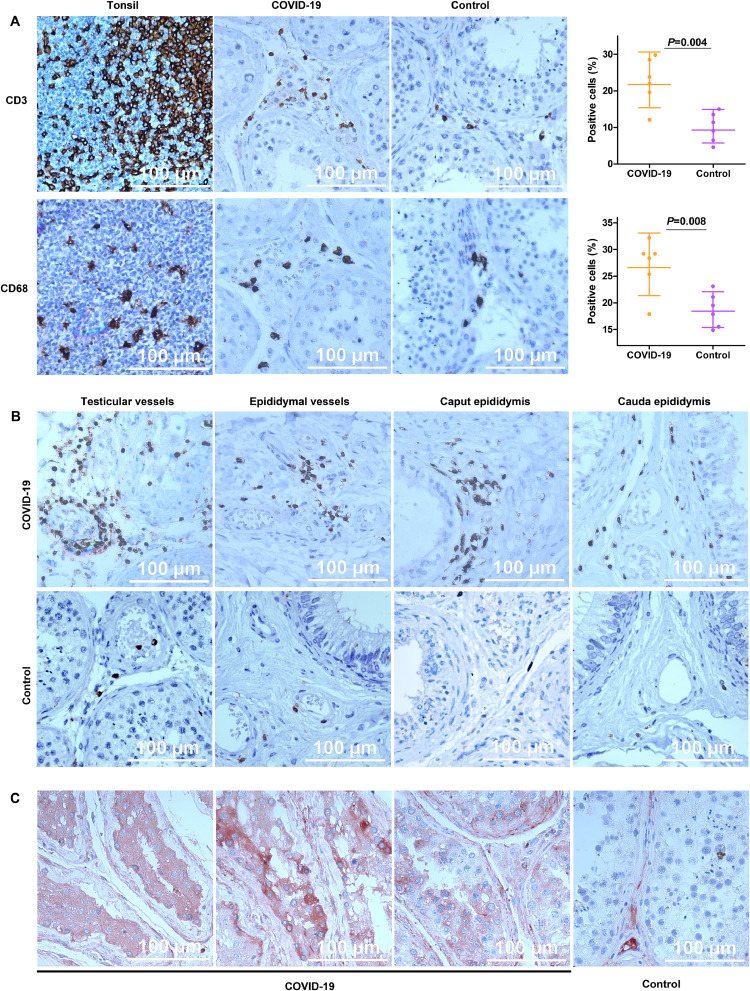
Autopsied testicular and epididymal specimens of COVID-19 showed the presence of interstitial edema, congestion, red blood cell exudation in testes, and epididymides. Thinning of seminiferous tubules was observed. The number of apoptotic cells within seminiferous tubules was significantly higher in COVID-19 compared to control cases. It also showed an increased concentration of CD3+ and CD68+ in the interstitial cells of testicular tissue and the presence of IgG within seminiferous tubules. Semen from COVID-19 inpatients showed that 39.1% (=9) of them have oligozoospermia, and 60.9% (=14) showed a significant increase in leucocytes in semen. Decreased sperm concentration, and increased seminal levels of IL-6, TNF-α, and MCP-1 compared to control males were observed.
Impairment of spermatogenesis was observed in COVID-19 patients, which could be partially explained as a result of an elevated immune response in testis. Additionally, autoimmune orchitis occurred in some COVID-19 patients. Further research on the reversibility of impairment and developing treatment are warranted.
This study was supported by Ministry of Science and Technology of China Plan, Hubei Science and Technology Plan, National Key Research and Development Program of China, HUST COVID-19 Rapid Response Call, China and National Natural Science Foundation of China; these funding bodies are public institutions, and they had no role in study conception, design, interpretation of results, and manuscript preparation.
本研究旨在确定严重急性呼吸综合征冠状病毒2(SARS-CoV-2)感染对男性生育能力的影响。
这是一项基于医院的单中心观察性研究,分别纳入了6例死亡的新冠肺炎男性患者的睾丸和附睾尸检标本,以及23例康复期新冠肺炎住院患者,并设置了同等数量的年龄匹配对照。我们对睾丸和附睾标本进行了组织病理学检查,还进行了TUNEL检测和免疫组织化学检测。此外,我们对精液标本进行了精子参数和免疫因子检测。
新冠肺炎患者的睾丸和附睾尸检标本显示存在间质水肿、充血,睾丸和附睾中有红细胞渗出。观察到生精小管变薄。与对照病例相比,新冠肺炎患者生精小管内的凋亡细胞数量显著增加。还显示睾丸组织间质细胞中CD3+和CD68+浓度增加,生精小管内存在IgG。新冠肺炎住院患者的精液显示,其中39.1%(9例)少精子症,60.9%(14例)精液中白细胞显著增加。与对照男性相比,观察到精子浓度降低,精液中白细胞介素-6、肿瘤坏死因子-α和单核细胞趋化蛋白-1水平升高。
新冠肺炎患者存在生精功能受损,这可能部分归因于睾丸免疫反应增强。此外,一些新冠肺炎患者发生了自身免疫性睾丸炎。有必要对损伤的可逆性和治疗方法开展进一步研究。
本研究得到了中国科学技术部计划、湖北省科技计划、国家重点研发计划、华中科技大学新冠肺炎快速响应项目以及国家自然科学基金的支持;这些资助机构均为公共机构,在研究的概念形成、设计、结果解读及论文撰写过程中未发挥任何作用。