Synergy A.I. Co.Ltd., Chuncheon, Korea.
Department of Urology, Hallym University Chuncheon Sacred Heart Hospital, Hallym University College of Medicine, Chuncheon, Korea.
Investig Clin Urol. 2020 Nov;61(6):555-564. doi: 10.4111/icu.20200086.
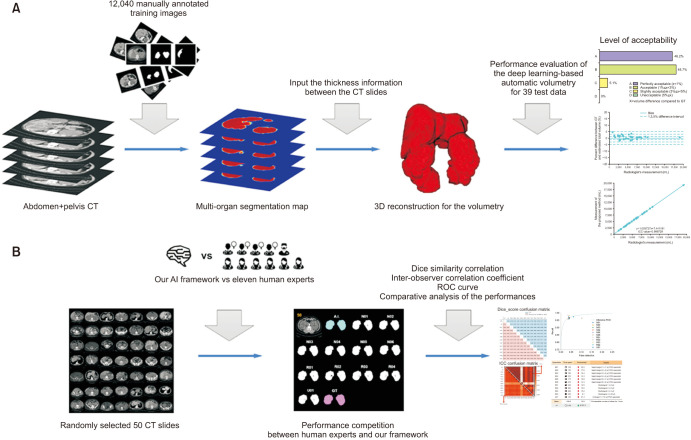
Volumetry is used in polycystic kidney and liver diseases (PKLDs), including autosomal dominant polycystic kidney disease (ADPKD), to assess disease progression and drug efficiency. However, since no rapid and accurate method for volumetry has been developed, volumetry has not yet been established in clinical practice, hindering the development of therapies for PKLD. This study presents an artificial intelligence (AI)-based volumetry method for PKLD.
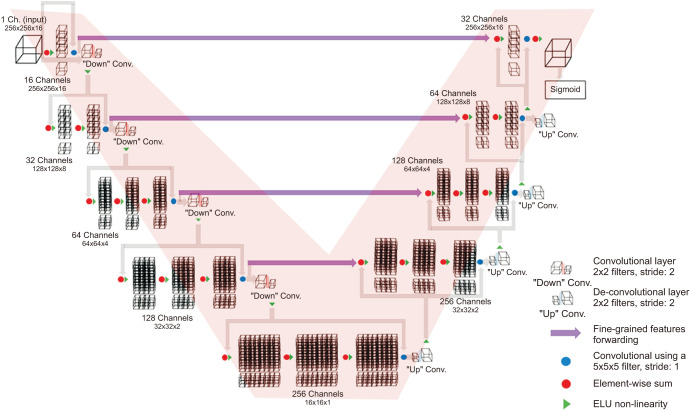
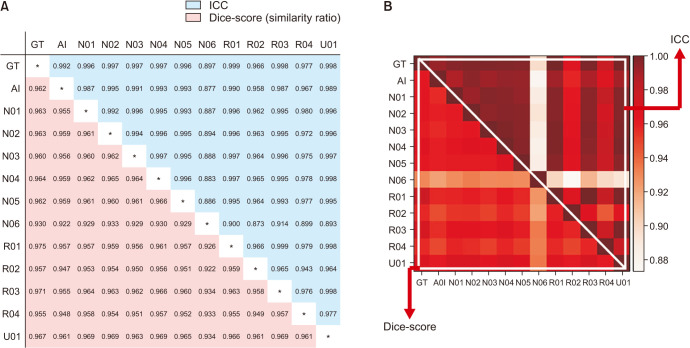
The performance of AI was first evaluated in comparison with ground-truth (GT). We trained a V-net-based convolutional neural network on 175 ADPKD computed tomography (CT) segmentations, which served as the GT and were agreed upon by 3 experts using images from 214 patients analyzed with volumetry. The dice similarity coefficient (DSC), interobserver correlation coefficient (ICC), and Bland-Altman plots of 39 GT and AI segmentations in the validation set were compared. Next, the performance of AI on the segmentation of 50 random CT images was compared with that of 11 PKLD specialists based on the resulting DSC and ICC.
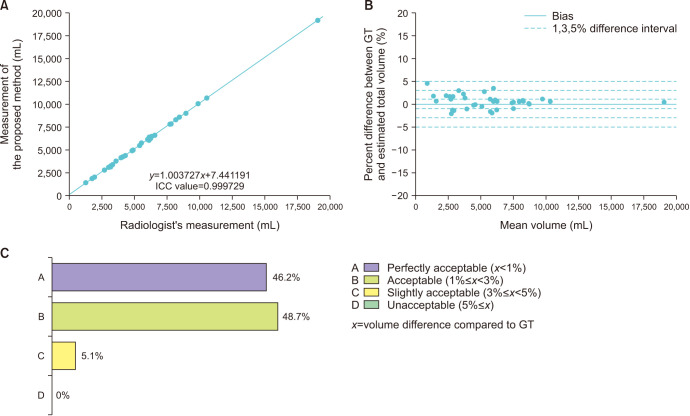
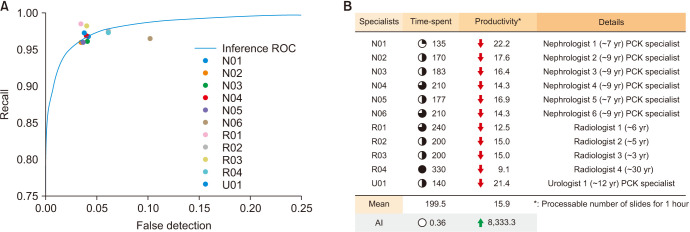
The DSC and ICC of the AI were 0.961 and 0.999729, respectively. The error rate was within 3% for approximately 95% of the CT scans (error<1%, 46.2%; 1%≤error<3%, 48.7%). Compared with the specialists, AI showed moderate performance. Furthermore, an outlier in our results confirmed that even PKLD specialists can make mistakes in volumetry.
PKLD volumetry using AI was fast and accurate. AI performed comparably to human specialists, suggesting its use may be practical in clinical settings.
体积测量用于多囊肾病和肝病(PKLDs),包括常染色体显性多囊肾病(ADPKD),以评估疾病进展和药物疗效。然而,由于尚未开发出快速准确的体积测量方法,因此体积测量尚未在临床实践中得到建立,这阻碍了 PKLD 治疗方法的发展。本研究提出了一种用于 PKLD 的基于人工智能(AI)的体积测量方法。
首先评估 AI 的性能与真实值(GT)进行比较。我们在 175 个 ADPKD CT 分割上训练了一个基于 V-net 的卷积神经网络,这些分割用作 GT,并由 3 位专家使用来自 214 位患者的图像进行体积测量来达成一致。比较了验证集中 39 个 GT 和 AI 分割的骰子相似系数(DSC)、观察者间相关系数(ICC)和 Bland-Altman 图。接下来,根据所得的 DSC 和 ICC,比较了 AI 在 50 张随机 CT 图像分割上的性能与 11 位 PKLD 专家的性能。
AI 的 DSC 和 ICC 分别为 0.961 和 0.999729。对于大约 95%的 CT 扫描,误差率在 3%以内(误差<1%,46.2%;1%≤误差<3%,48.7%)。与专家相比,AI 表现出中等性能。此外,我们结果中的一个异常值证实,即使是 PKLD 专家也可能在体积测量中出错。
使用 AI 的 PKLD 体积测量快速准确。AI 的性能与人类专家相当,表明其在临床环境中的应用可能是实用的。