University of Florida, Institute of Food and Agricultural Sciences, Florida Medical Entomology Laboratory, Vero Beach, FL.
J Insect Sci. 2020 Nov 1;20(6). doi: 10.1093/jisesa/ieaa059.
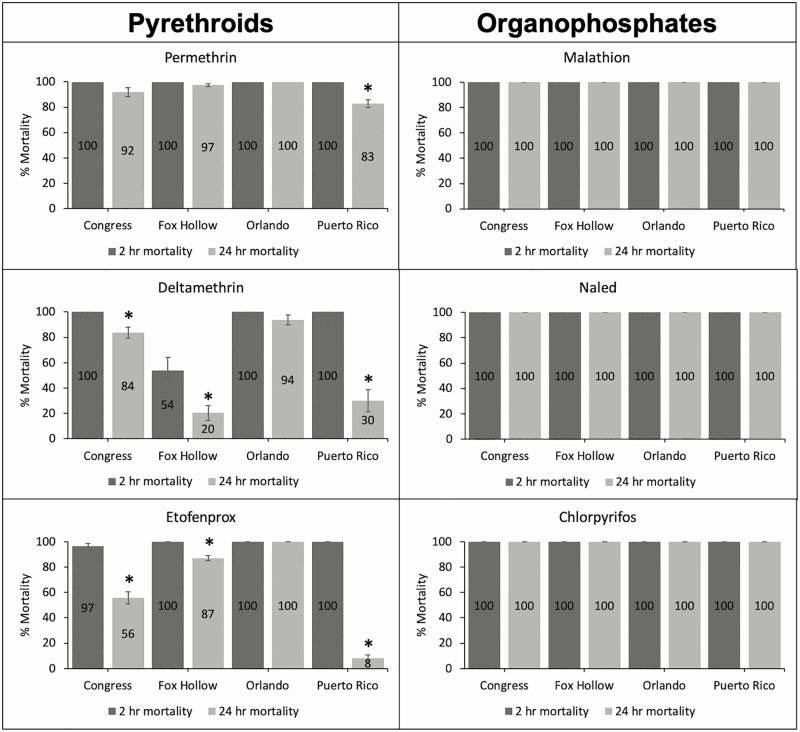
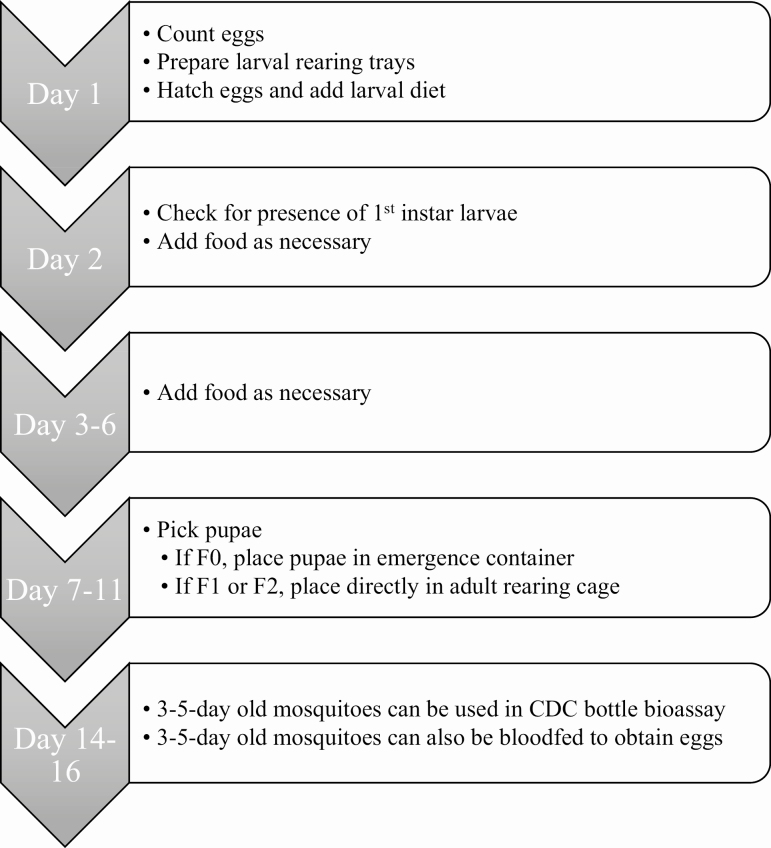
Container mosquitoes (Diptera: Culicidae) oviposit their eggs in both natural and artificial containers. Many container mosquito species also serve as important vectors of disease-causing pathogens including Aedes aegypti, Ae. albopictus, and Ae. triseriatus. Control of these species can be done through the use of adulticide sprays. The efficacy of these treatments is highly dependent on the insecticide susceptibility status of the local mosquito populations. This paper provides protocols on collecting and rearing container mosquitoes for use in the Centers for Disease Control and Prevention (CDC) bottle bioassay. A brief description of the CDC bottle bioassay is provided as well as a standardized protocol for the incorporation of a 24-h mortality to the CDC bottle bioassay. Results from this 24-h holding addition to the CDC bottle bioassay reveal that some forms of resistance may be missed without the incorporation of the additional mortality reading. These protocols provide a foundation for new laboratories to establish rearing protocols and begin conducting resistance monitoring.
容器蚊(双翅目:蚊科)将卵产在自然和人工容器中。许多容器蚊种也是包括埃及伊蚊、白纹伊蚊和三带喙库蚊在内的致病病原体的重要传播媒介。这些物种的控制可以通过使用杀虫剂喷雾来实现。这些处理的效果高度依赖于当地蚊虫种群的杀虫剂敏感性状况。本文提供了用于疾病预防控制中心(CDC)瓶生物测定的容器蚊收集和饲养的方案。简要描述了 CDC 瓶生物测定,以及将 24 小时死亡率纳入 CDC 瓶生物测定的标准化方案。从将 24 小时保存期添加到 CDC 瓶生物测定中获得的结果表明,如果不进行额外死亡率读数,可能会错过某些形式的抗药性。这些方案为新实验室建立饲养方案并开始进行抗药性监测提供了基础。