Department of Psychology, The Hebrew University.
Department of Experimental and Applied Psychology, Vrije Universiteit Amsterdam.
Perspect Psychol Sci. 2021 Mar;16(2):319-337. doi: 10.1177/1745691620953082. Epub 2020 Nov 2.
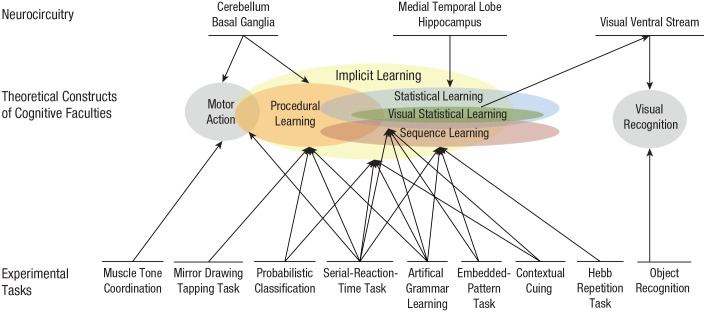
Statistical-learning (SL) theory offers an experience-based account of typical and atypical spoken and written language acquisition. Recent work has provided initial support for this view, tying individual differences in SL abilities to linguistic skills, including language impairments. In the current article, we provide a critical review of studies testing SL abilities in participants with and without developmental dyslexia and specific language impairment and discuss the directions that this field of research has taken so far. We identify substantial vagueness in the demarcation lines between different theoretical constructs (e.g., "statistical learning," "implicit learning," and "procedural learning") as well as in the mappings between experimental tasks and these theoretical constructs. Moreover, we argue that current studies are not designed to contrast different theoretical approaches but rather test singular confirmatory predictions without including control tasks showing normal performance. We end by providing concrete suggestions for how to advance research on SL deficits in language impairments.
统计学习(SL)理论为典型和非典型口语和书面语习得提供了一种基于经验的解释。最近的研究为这一观点提供了初步支持,将 SL 能力的个体差异与语言技能联系起来,包括语言障碍。在本文中,我们对测试有和没有发育性阅读障碍和特定语言障碍的参与者的 SL 能力的研究进行了批判性回顾,并讨论了该研究领域迄今为止的发展方向。我们发现,不同理论结构(例如“统计学习”、“内隐学习”和“程序性学习”)之间以及实验任务与这些理论结构之间的映射存在很大的模糊性。此外,我们认为,目前的研究不是为了对比不同的理论方法,而是在不包括显示正常表现的控制任务的情况下,对单一的验证性预测进行测试。最后,我们提供了具体的建议,说明如何推进语言障碍中的 SL 缺陷研究。