
猕猴大脑 ONPRC18 模板,具有灰质和白质联合标记图,用于非人类灵长类动物的多模态神经影像学研究。
The macaque brain ONPRC18 template with combined gray and white matter labelmap for multimodal neuroimaging studies of Nonhuman Primates.
机构信息
Division of Neuroscience, Oregon National Primate Research Center, Beaverton, OR, USA, 97006.
Division of Neuroscience, Oregon National Primate Research Center, Beaverton, OR, USA, 97006; Advanced Imaging Research Center, Oregon Health and Science University, Portland, OR, USA, 97239.
出版信息
Neuroimage. 2021 Jan 15;225:117517. doi: 10.1016/j.neuroimage.2020.117517. Epub 2020 Nov 1.
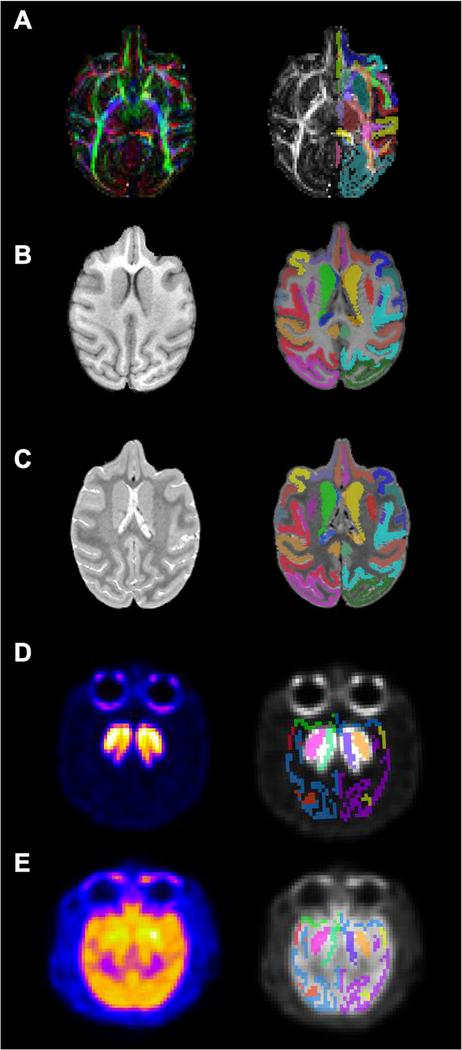
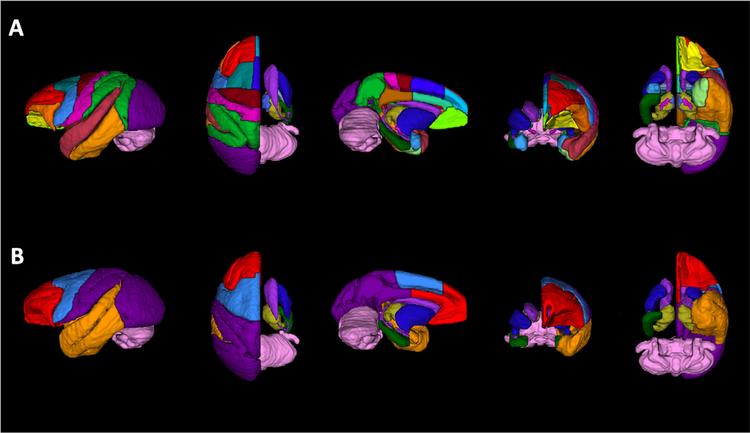
Macaques are the most common nonhuman primate (NHP) species used in neuroscience research. With the advancement of many neuroimaging techniques, new studies are beginning to apply multiple types of in vivo magnetic resonance imaging (MRI), such as structural imaging (sMRI) with T1 and T2 weighted contrasts alongside diffusion weighed (DW) imaging. In studies involving rhesus macaques, this approach can be used to better understand micro-structural changes that occur during development, in various disease states or with normative aging. However, many of the available rhesus brain atlases have been designed for only one imaging modality, making it difficult to consistently define the same brain regions across multiple imaging modalities in the same subject. To address this, we created a brain atlas from 18 adult rhesus macaques that includes co-registered templates constructed from images frequently used to characterize macroscopic brain structure (T2/SPACE and T1/MP-RAGE), and a diffusion tensor imaging (DTI) template. The DTI template was up-sampled from 1 mm isotropic resolution to resolution match to the T1 and T2-weighted images (0.5 mm isotropic), and the parameter maps were derived for FA, AD, RD and MD.The labelmap volumes delineate 57 gray matter regions of interest (ROIs; 36 cortical regions and 21 subcortical structures), as well as 74 white matter tracts. Importantly, the labelmap overlays both the structural and diffusion templates, enabling the same regions to be consistently identified across imaging modalities. A specialized condensed version of the labelmap ROIs are also included to further extend the usefulness of this tool for imaging data with lower spatial resolution, such as functional MRI (fMRI) or positron emission tomography (PET).
猕猴是神经科学研究中最常用的非人类灵长类动物(NHP)物种。随着许多神经影像学技术的进步,新的研究开始应用多种类型的活体磁共振成像(MRI),例如 T1 和 T2 加权对比结构成像(sMRI)以及扩散加权(DW)成像。在涉及恒河猴的研究中,这种方法可用于更好地了解发育过程中、各种疾病状态下或正常衰老过程中发生的微观结构变化。然而,许多现有的恒河猴脑图谱仅针对一种成像方式设计,因此难以在同一研究对象的多种成像方式中始终如一地定义相同的脑区。为了解决这个问题,我们创建了一个来自 18 只成年恒河猴的脑图谱,其中包括来自经常用于描绘宏观大脑结构的图像(T2/SPACE 和 T1/MP-RAGE)的配准模板,以及一个弥散张量成像(DTI)模板。DTI 模板从 1 毫米各向同性分辨率上采样到与 T1 和 T2 加权图像(0.5 毫米各向同性)匹配的分辨率,并为 FA、AD、RD 和 MD 导出了参数图。标签图体积描绘了 57 个灰质感兴趣区(ROI;36 个皮质区和 21 个皮质下结构)以及 74 个白质束。重要的是,标签图叠加在结构和弥散模板上,使得相同的区域可以在不同的成像方式中始终如一地识别。还包括标签图 ROI 的专门浓缩版本,以进一步扩展该工具对具有较低空间分辨率的成像数据(如功能磁共振成像(fMRI)或正电子发射断层扫描(PET))的有用性。


 Zotero 插件