Department of Neurosurgery, Kwong Wah Hospital, Room CS11-01, 11th Floor, 25 Waterloo Road, Yaumatei, Hong Kong, China.
BMC Neurol. 2020 Nov 3;20(1):401. doi: 10.1186/s12883-020-01908-9.
BACKGROUND: There are limited neuroprotective treatment options for patients with aneurysmal subarachnoid hemorrhage (SAH). Cerebrolysin, a brain-specific proposed pleiotropic neuroprotective agent, has been suggested to improve global functional outcomes in ischemic stroke. We investigated the efficacy, safety and feasibility of administering Cerebrolysin for SAH patients.
This was a prospective, randomized, double-blind, placebo-controlled, single-center, parallel-group pilot study. Fifty patients received either daily Cerebrolysin (30 ml/day) or a placebo (saline) for 14 days (25 patients per study group). The primary endpoint was a favorable Extended Glasgow Outcome Scale (GOSE) of 5 to 8 (moderate disability to good recovery) at six-months. Secondary endpoints included the modified Ranking Scale (mRS), the Montreal Cognitive Assessment (MOCA) score, occurrence of adverse effects and the occurrence of delayed cerebral ischemia (DCI).
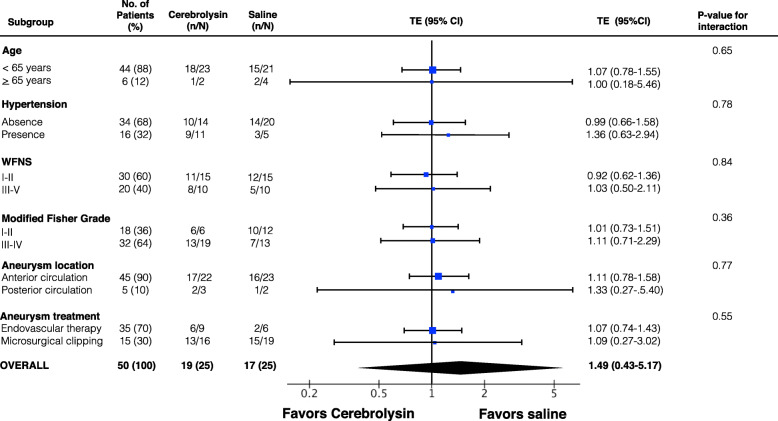
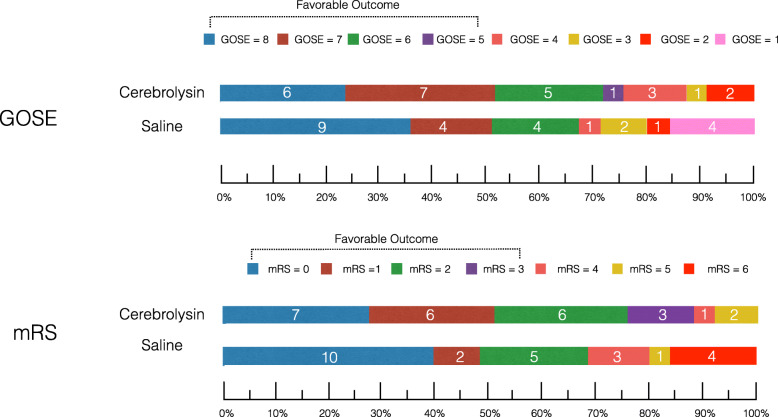
No severe adverse effects or mortality attributable to Cerebrolysin were observed. No significant difference was detected in the proportion of patients with favorable six-month GOSE in either study group (odds ratio (OR): 1.49; 95% confidence interval (CI): 0.43-5.17). Secondary functional outcome measures for favorable six-month recovery i.e. a mRS of 0 to 3 (OR: 3.45; 95% CI 0.79-15.01) were comparable for both groups. Similarly, there was no difference in MOCA neurocognitive performance (p-value: 0.75) and in the incidence of DCI (OR: 0.85 95% CI: 0.28-2.59).
Use of Cerebrolysin in addition to standard-of-care management of aneurysmal SAH is safe, well tolerated and feasible. However, the neutral results of this trial suggest that it does not improve the six-month global functional performance of patients.
Name of Registry: ClinicalTrials.gov Trial Registration Number: NCT01787123 . Date of Registration: 8th February 2013.
背景:对于患有蛛网膜下腔出血(SAH)的患者,神经保护治疗的选择有限。Cerebrolysin 是一种特定于大脑的、拟议的多效神经保护剂,已被证明可改善缺血性中风患者的整体功能预后。我们研究了给 SAH 患者使用 Cerebrolysin 的疗效、安全性和可行性。
这是一项前瞻性、随机、双盲、安慰剂对照、单中心、平行组的初步研究。50 名患者每天接受 Cerebrolysin(30ml/天)或安慰剂(生理盐水)治疗 14 天(每组 25 名患者)。主要终点是 6 个月时格拉斯哥预后量表(GOSE)的良好结果为 5-8 分(中度残疾到良好恢复)。次要终点包括改良 Rankin 量表(mRS)、蒙特利尔认知评估(MOCA)评分、不良事件发生情况和迟发性脑缺血(DCI)的发生情况。
未观察到与 Cerebrolysin 相关的严重不良事件或死亡。两组患者在 6 个月时具有良好 GOSE 的比例无显著差异(优势比(OR):1.49;95%置信区间(CI):0.43-5.17)。两组患者 6 个月时恢复良好的次要功能测量指标(mRS 为 0-3)的结果相似(OR:3.45;95%CI 0.79-15.01)。同样,MOCA 神经认知表现无差异(p 值:0.75),DCI 的发生率也无差异(OR:0.85 95%CI:0.28-2.59)。
在标准治疗方案的基础上,使用 Cerebrolysin 治疗动脉瘤性蛛网膜下腔出血是安全的、耐受良好且可行的。然而,这项试验的中性结果表明,它并不能改善患者的 6 个月整体功能预后。
注册机构名称:ClinicalTrials.gov 试验注册编号:NCT01787123。注册日期:2013 年 2 月 8 日。