Malik Shipra, Slack Frank J, Bahal Raman
Department of Pharmaceutical Sciences, University of Connecticut, Storrs, CT, 06269, USA.
Department of Pathology, BIDMC Cancer Center, Harvard Medical School, 330, Brookline Ave, Boston, MA 02215, USA.
MethodsX. 2020 Oct 22;7:101115. doi: 10.1016/j.mex.2020.101115. eCollection 2020.
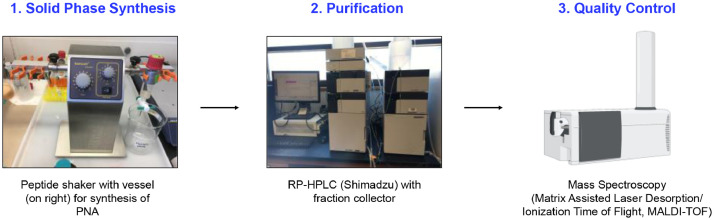
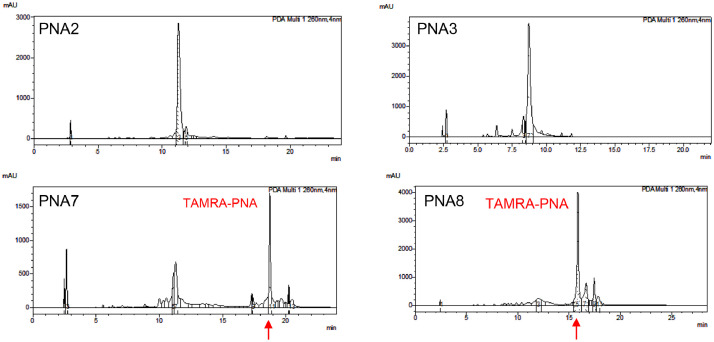
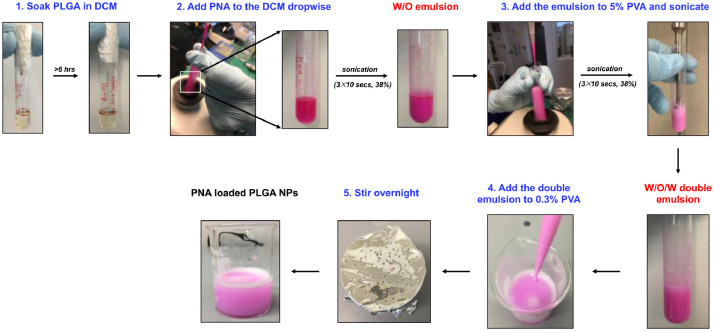
Peptide nucleic acids (PNAs) have emerged as one of the most versatile tools with a wide range of biomedical applications including antisense, antimiR, antigene, as well as site-specific gene editing. The application and potential of PNAs has been limited due to low solubility and poor cellular uptake. Several strategies have been employed to overcome the aforementioned challenges like conjugation to cationic peptides or nanotechnology to achieve superior transfection efficiency ex vivo and in vivo. Here, we report a detailed procedure optimized in our lab for synthesis of short cationic PNA probes, which exhibit high purity and yield in comparison to full-length PNA oligomers. We also provide step-by-step details of encapsulating short cationic PNA probes in poly (lactic-co-glycolic acid) nanoparticles by double emulsion solvent evaporation technique. 1.Detailed procedure for synthesis of short cationic PNAs with or without fluorophore (dye) conjugation while ensuring high yield and purity.2.Step-by-step details for encapsulation of short cationic PNAs in PLGA nanoparticles via double emulsion solvent evaporation technique.
肽核酸(PNA)已成为用途最为广泛的工具之一,具有广泛的生物医学应用,包括反义、抗miR、反基因以及位点特异性基因编辑。由于溶解度低和细胞摄取性差,PNA的应用和潜力受到了限制。人们采用了多种策略来克服上述挑战,如与阳离子肽偶联或利用纳米技术,以在体外和体内实现卓越的转染效率。在此,我们报告了我们实验室优化的用于合成短阳离子PNA探针的详细程序,与全长PNA寡聚物相比,该探针具有高纯度和高产量。我们还提供了通过双乳液溶剂蒸发技术将短阳离子PNA探针封装在聚(乳酸-乙醇酸)纳米颗粒中的详细步骤。1.合成带有或不带有荧光团(染料)偶联的短阳离子PNA的详细程序,同时确保高产量和高纯度。2.通过双乳液溶剂蒸发技术将短阳离子PNA封装在PLGA纳米颗粒中的详细步骤。