Huang Cibo, Zhang Zhiyi, Chen Yaolong, Zhang Yue, Xing Dan, Zhao Like, Lin Jianhao, Mei Yifang, Lin Hsiao-Yi, Zheng Yi, Tsai Wei-Chung, Liu Shengyun, Jiang Quan, Liu Yi, Chen Jinwei, Ye Zhizhong, Chen Min, Chen Yingjuan, Chu Cong-Qiu, Gao Ming, He Lan, Lin Jin, Wu Lijun, Xu Jianhua, Yang Pinting, Zhang Xuewu, Jiang Qing, Lei Guanghua, Li Mengtao, Yang Wanling, Gu Xin, Zhou Yixin, He Dongyi, Liu Wei, Zhang Weiya, Ding Changhai, Zeng Xiaofeng
Department of Rheumatology, Beijing Hospital, National Center of Gerontology, Institute of Geriatric Medicine, Chinese Academy of Medical Sciences, Beijing, China.
Department of Rheumatology, The First Affiliated Hospital, Harbin Medical University, Harbin, China.
Ann Transl Med. 2020 Sep;8(17):1068. doi: 10.21037/atm-20-4673.
The classification criteria of osteoarthritis (OA) is lack of the support of relevant research evidence and there is no standardized protocol for detailed steps of the development or clinical verification of classification criteria has yet been established. This study aims to describe the development process of the Categorization of Osteoarthritis CHecklist (COACH), which is designed to choose the precise treatment option for patients with OA.
A multidisciplinary panel was established to gather opinions. We conducted questionnaire survey and literature review to generate and COACH Panel members were invited to review the drafted classification criteria and optimize classification criteria. The final list of items was discussed and reached the agreement by the core group of the panel.
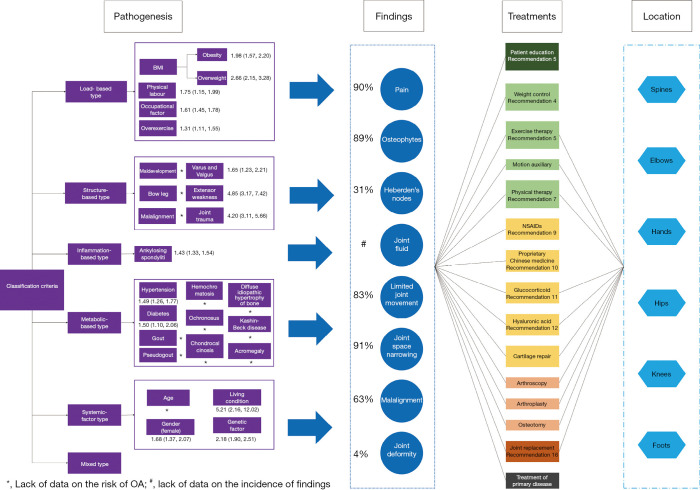
Thirty-six experts participated in COACH Panel including rheumatologist (80.6%; 29/36), orthopedist (13.9%; 5/36), methodologist (2.8%; 1/36) and rehabilitation physician (2.8%; 1/36) for classification factors generating and optimizing. The main body of the final classification criteria consists of six types of OA pathogenesis, eight types of medical findings (which can be grouped into two categories), and six types of the location. The final criteria include load-based type, structure-based type, inflammation-based type, metabolic-based type, systemic factor based type and mixed type.
COACH can better help clinicians quickly classify OA patients and help to choose the best treatment option from the aspects of types, findings and locations. What's more, the classification criteria are also helpful to promote the basic medical research and targeted prevention of OA.
骨关节炎(OA)的分类标准缺乏相关研究证据的支持,且尚未建立关于分类标准制定或临床验证详细步骤的标准化方案。本研究旨在描述骨关节炎检查表分类法(COACH)的制定过程,该方法旨在为OA患者选择精确的治疗方案。
成立了一个多学科小组来收集意见。我们进行了问卷调查和文献综述以生成内容,并且邀请COACH小组成员审查起草的分类标准并优化分类标准。最终项目清单由小组的核心成员进行讨论并达成一致。
36名专家参与了COACH小组,其中包括用于分类因素生成和优化的风湿病学家(80.6%;29/36)、骨科医生(13.9%;5/36)、方法学家(2.8%;1/36)和康复医师(2.8%;1/36)。最终分类标准的主体包括六种OA发病机制类型、八种医学发现类型(可分为两类)和六种发病部位类型。最终标准包括基于负荷型、基于结构型、基于炎症型、基于代谢型、基于全身因素型和混合型。
COACH能够更好地帮助临床医生快速对OA患者进行分类,并有助于从类型、发现和部位等方面选择最佳治疗方案。此外,该分类标准也有助于推动OA的基础医学研究和针对性预防。