Sverrisdottir Yrsa B, Martin Sean C, Hadjipavlou George, Kent Alexander R, Paterson David J, FitzGerald James J, Green Alexander L
Nuffield Department of Surgical Sciences, University of Oxford, Oxford, United Kingdom.
Department of Physiology, Anatomy and Genetics, University of Oxford, Oxford, United Kingdom.
JACC Basic Transl Sci. 2020 Sep 16;5(10):973-985. doi: 10.1016/j.jacbts.2020.07.010. eCollection 2020 Oct.
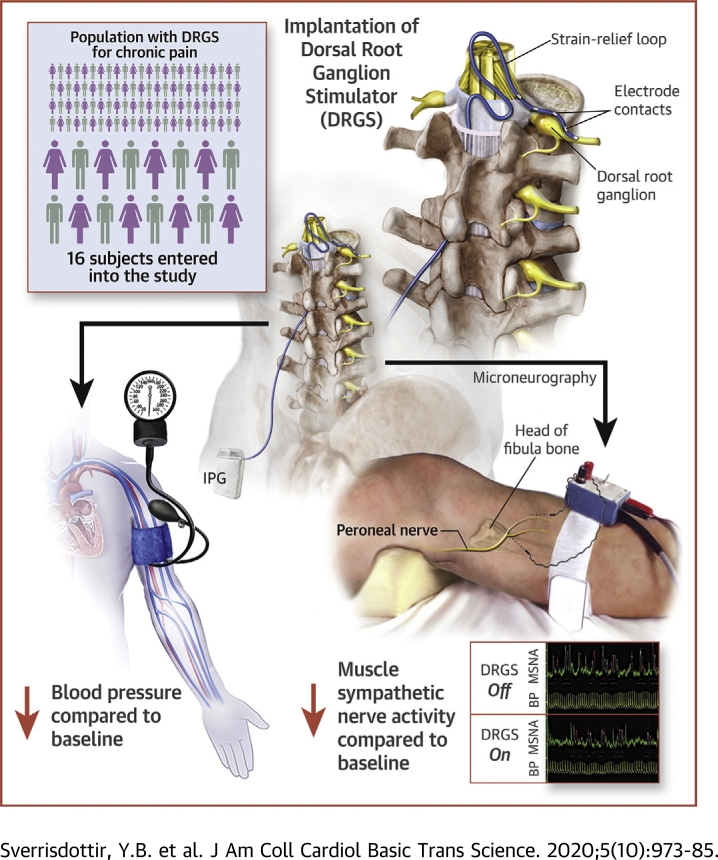
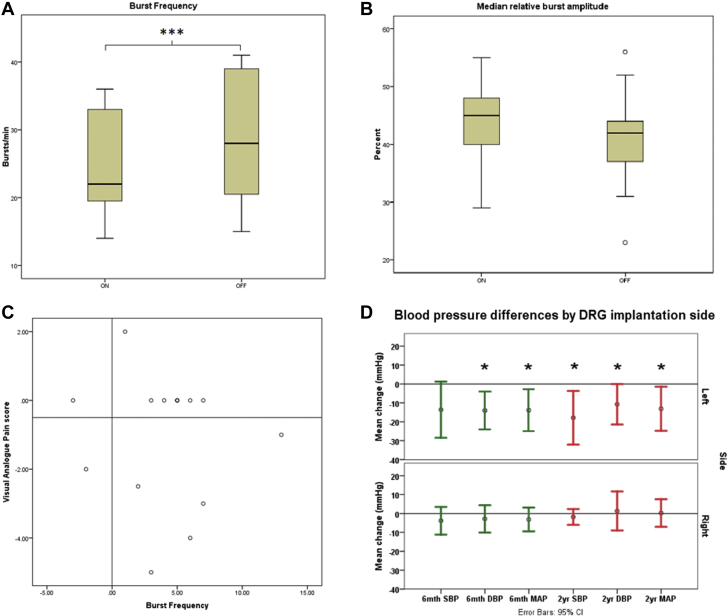
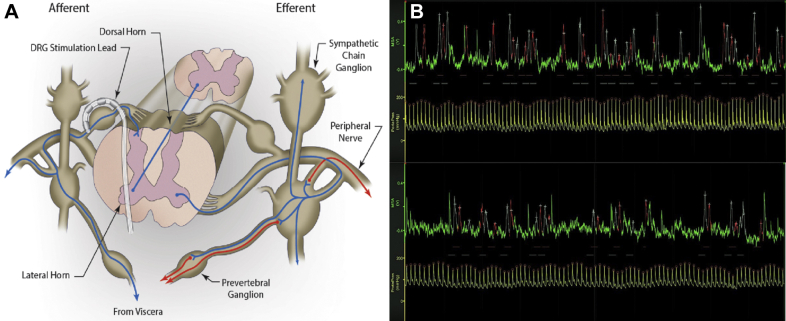
This study hypothesized that dorsal root ganglion (DRG) stimulation would reduce sympathetic nerve activity and would alter hemodynamic variables. This study directly recorded muscle sympathetic nerve activity during ON and OFF stimulation of the DRG while measuring hemodynamic parameters. DRG stimulation significantly reduced the firing frequency of sympathetic nerves, as well as significantly reducing blood pressure, with greater reductions evident when stimulation was left-sided. Left-sided DRG stimulation lowers sympathetic nerve activity, leading to long-term phenotypic changes. This raises the potential of DRG stimulation being used to treat de novo autonomic disorders such as hypertension or heart failure.
本研究假设,背根神经节(DRG)刺激会降低交感神经活动,并改变血流动力学变量。本研究在测量血流动力学参数的同时,直接记录了DRG开启和关闭刺激期间的肌肉交感神经活动。DRG刺激显著降低了交感神经的放电频率,同时也显著降低了血压,左侧刺激时降低幅度更大。左侧DRG刺激可降低交感神经活动,导致长期的表型变化。这增加了DRG刺激用于治疗诸如高血压或心力衰竭等原发性自主神经障碍的可能性。