Department of Computer Science & Engineering, Indian Institute of Technology Kanpur, Kanpur, Uttar Pradesh, India.
Deputy Chief Integrated Defence Staff (Medical), HQ Integrated Defense Staff, Ministry of Defence, Government of India, New Delhi, India.
Indian J Med Res. 2021;153(1 & 2):175-181. doi: 10.4103/ijmr.IJMR_4051_20.
BACKGROUND & OBJECTIVES: To handle the current COVID-19 pandemic in India, multiple strategies have been applied and implemented to slow down the virus transmission. These included clinical management of active cases, rapid development of treatment strategies, vaccines computational modelling and statistical tools to name a few. This article presents a mathematical model for a time series prediction and analyzes the impact of the lockdown.
Several existing mathematical models were not able to account for asymptomatic patients, with limited testing capability at onset and no data on serosurveillance. In this study, a new model was used which was developed on lines of susceptible-asymptomatic-infected-recovered (SAIR) to assess the impact of the lockdown and make predictions on its future course. Four parameters were used, namely β, γ, η and ε. β measures the likelihood of the susceptible person getting infected, and γ denotes recovery rate of patients. The ratio β/γ is denoted by R (basic reproduction number).
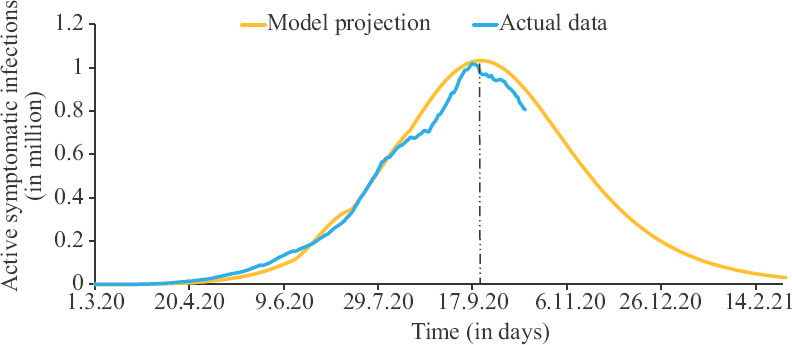
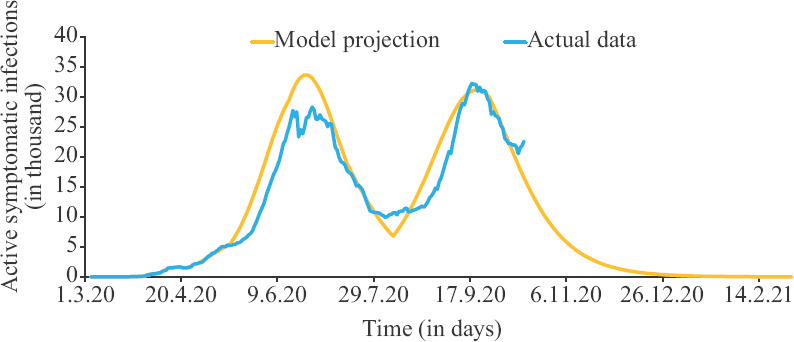
The disease spread was reduced due to initial lockdown. An increase in γ reflects healthcare and hospital services, medications and protocols put in place. In Delhi, the predictions from the model were corroborated with July and September serosurveys, which showed antibodies in 23.5 and 33 per cent population, respectively.
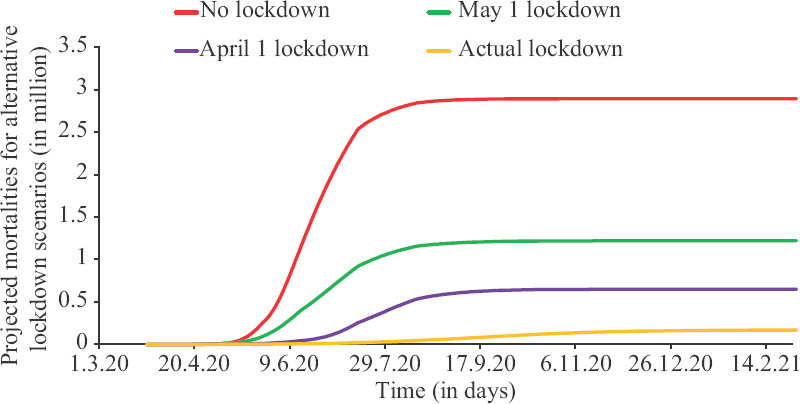
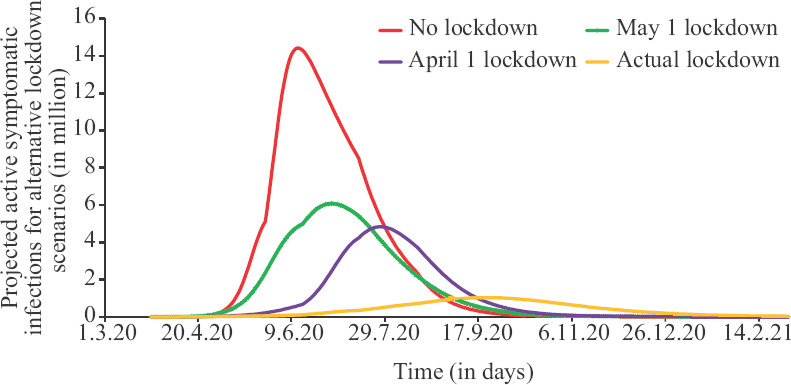
INTERPRETATION & CONCLUSIONS: The SAIR model has helped understand the disease better. If the model is correct, we may have reached herd immunity with about 380 million people already infected. However, personal protective measures remain crucial. If there was no lockdown, the number of active infections would have peaked at close to 14.7 million, resulted in more than 2.6 million deaths, and the peak would have arrived by June 2020. The number of deaths with the current trends may be less than 0.2 million.
为应对印度当前的 COVID-19 大流行,已采取并实施了多种策略来减缓病毒传播。其中包括对活跃病例的临床管理、快速制定治疗策略、疫苗计算建模和统计工具等。本文提出了一种时间序列预测的数学模型,并分析了封锁的影响。
一些现有的数学模型无法考虑无症状患者,在发病初期检测能力有限,也没有关于血清学监测的数据。在这项研究中,使用了一种新的模型,该模型是在易感-无症状-感染-恢复(SAIR)的基础上开发的,用于评估封锁的影响并对其未来趋势进行预测。使用了四个参数,即β、γ、η和ε。β衡量易感者感染的可能性,γ表示患者的康复率。β/γ的比值表示为 R(基本再生数)。
由于最初的封锁,疾病传播有所减少。γ的增加反映了医疗保健和医院服务、药物和实施的方案。在德里,模型的预测与 7 月和 9 月的血清学调查结果相符,分别显示了 23.5%和 33%的人群有抗体。
SAIR 模型有助于更好地了解疾病。如果模型正确,我们可能已经通过约 3.8 亿人感染达到了群体免疫。然而,个人保护措施仍然至关重要。如果没有封锁,活跃感染的人数将达到接近 1470 万的峰值,导致超过 260 万人死亡,而且峰值将在 2020 年 6 月前到来。按照目前的趋势,死亡人数可能不到 0.2 万。