Meyer Christian, Hofstoetter Ursula S, Hubli Michèle, Hassani Roushanak H, Rinaldo Carmen, Curt Armin, Bolliger Marc
Spinal Cord Injury Center, Balgrist University Hospital, Forchstrasse 340, 8008 Zurich, Switzerland.
Center for Medical Physics and Biomedical Engineering, Medical University of Vienna, 1090 Vienna, Austria.
J Clin Med. 2020 Nov 2;9(11):3541. doi: 10.3390/jcm9113541.
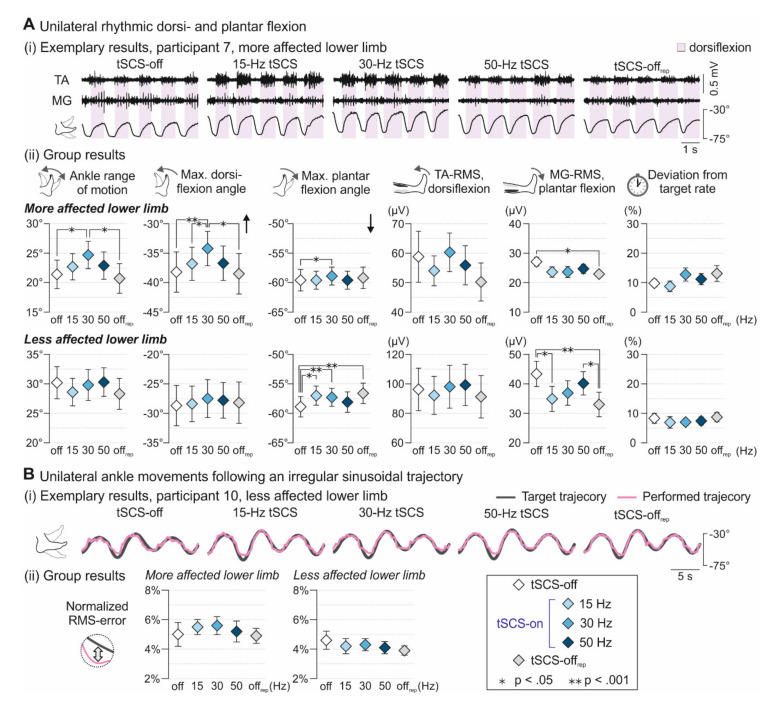
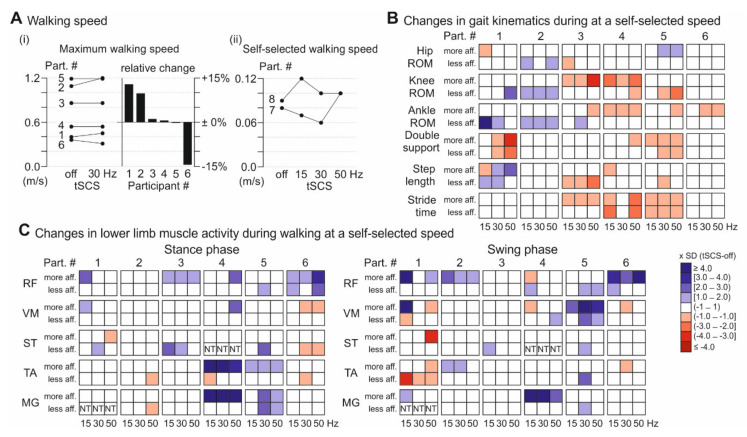
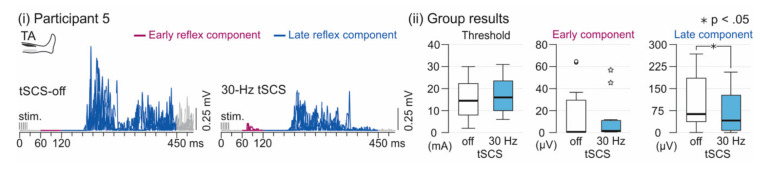
Deficient ankle control after incomplete spinal cord injury (iSCI) often accentuates walking impairments. Transcutaneous electrical spinal cord stimulation (tSCS) has been shown to augment locomotor activity after iSCI, presumably due to modulation of spinal excitability. However, the effects of possible excitability modulations induced by tSCS on ankle control have not yet been assessed. This study investigated the immediate (i.e., without training) effects during single-sessions of tonic tSCS on ankle control, spinal excitability, and locomotion in ten individuals with chronic, sensorimotor iSCI (American Spinal Injury Association Impairment Scale D). Participants performed rhythmic ankle movements (dorsi- and plantar flexion) at a given rate, and irregular ankle movements following a predetermined trajectory with and without tonic tSCS at 15 Hz, 30 Hz, and 50 Hz. In a subgroup of eight participants, the effects of tSCS on assisted over-ground walking were studied. Furthermore, the activity of a polysynaptic spinal reflex, associated with spinal locomotor networks, was investigated to study the effect of the stimulation on the dedicated spinal circuitry associated with locomotor function. Tonic tSCS at 30 Hz immediately improved maximum dorsiflexion by +4.6° ± 0.9° in the more affected lower limb during the rhythmic ankle movement task, resulting in an increase of +2.9° ± 0.9° in active range of motion. Coordination of ankle movements, assessed by the ability to perform rhythmic ankle movements at a given target rate and to perform irregular movements according to a trajectory, was unchanged during stimulation. tSCS at 30 Hz modulated spinal reflex activity, reflected by a significant suppression of pathological activity specific to SCI in the assessed polysynaptic spinal reflex. During walking, there was no statistical group effect of tSCS. In the subgroup of eight assessed participants, the three with the lowest as well as the one with the highest walking function scores showed positive stimulation effects, including increased maximum walking speed, or more continuous and faster stepping at a self-selected speed. Future studies need to investigate if multiple applications and individual optimization of the stimulation parameters can increase the effects of tSCS, and if the technique can improve the outcome of locomotor rehabilitation after iSCI.
不完全性脊髓损伤(iSCI)后踝关节控制能力不足常常会加重行走障碍。经皮脊髓电刺激(tSCS)已被证明可增强iSCI后的运动活动,推测这是由于脊髓兴奋性的调节。然而,tSCS诱导的可能的兴奋性调节对踝关节控制的影响尚未得到评估。本研究调查了在单节次的强直性tSCS过程中,对10名患有慢性感觉运动性iSCI(美国脊髓损伤协会损伤分级D级)患者的踝关节控制、脊髓兴奋性和运动的即时(即无训练)影响。参与者以给定速率进行有节奏的踝关节运动(背屈和跖屈),并在有和无15Hz、30Hz和50Hz强直性tSCS的情况下,按照预定轨迹进行不规则踝关节运动。在一个由8名参与者组成的亚组中,研究了tSCS对辅助地面行走的影响。此外,还研究了与脊髓运动网络相关的多突触脊髓反射的活动,以研究刺激对与运动功能相关的特定脊髓回路的影响。在有节奏的踝关节运动任务中,30Hz的强直性tSCS立即使受影响更严重的下肢最大背屈增加了+4.6°±0.9°,导致主动运动范围增加了+2.9°±0.9°。通过以给定目标速率进行有节奏的踝关节运动以及根据轨迹进行不规则运动的能力来评估的踝关节运动协调性,在刺激过程中没有变化。30Hz的tSCS调节了脊髓反射活动,这在评估的多突触脊髓反射中表现为对SCI特有的病理活动的显著抑制。在行走过程中,tSCS没有统计学上的组效应。在评估的8名参与者亚组中,行走功能评分最低的三名以及评分最高的一名参与者显示出积极的刺激效果,包括最大行走速度增加,或以自选速度行走时步幅更连续、更快。未来的研究需要调查多次应用和刺激参数的个体化优化是否能增加tSCS的效果,以及该技术是否能改善iSCI后运动康复的结果。