Spinal Cord Injury Center, Balgrist University Hospital, Forchstrasse 340, Zurich, Switzerland.
Department of Neurology, University Hospital and University of Zurich, Frauenklinikstrasse 26, Zurich, Switzerland.
Sci Rep. 2019 Mar 26;9(1):5232. doi: 10.1038/s41598-019-41721-0.
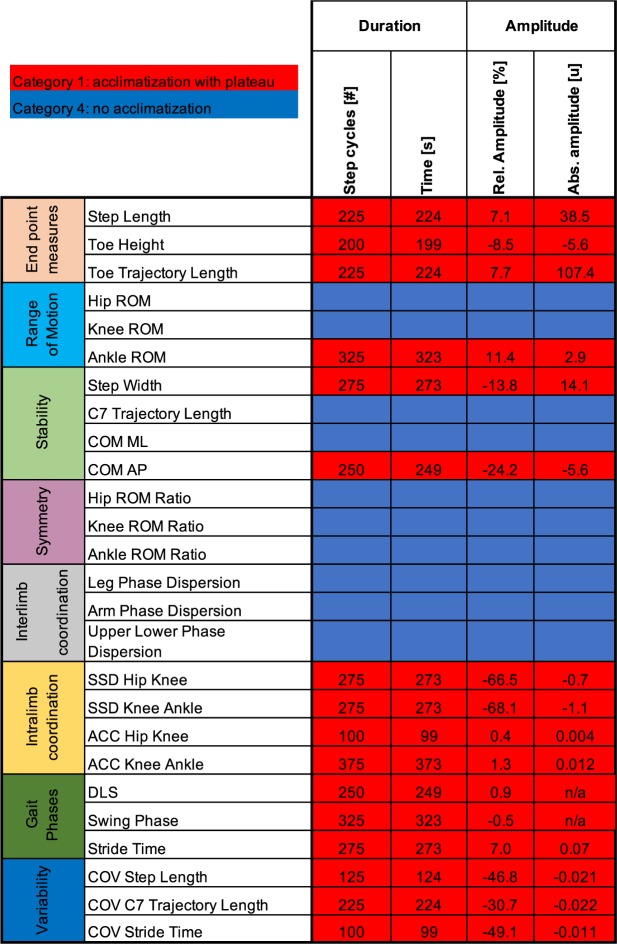
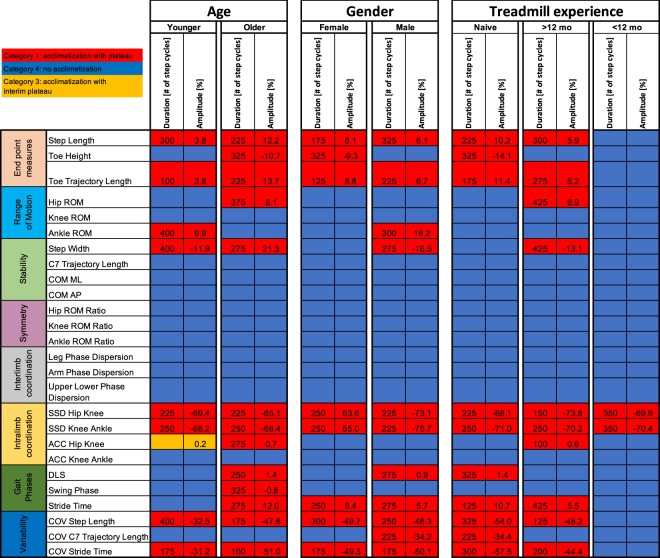
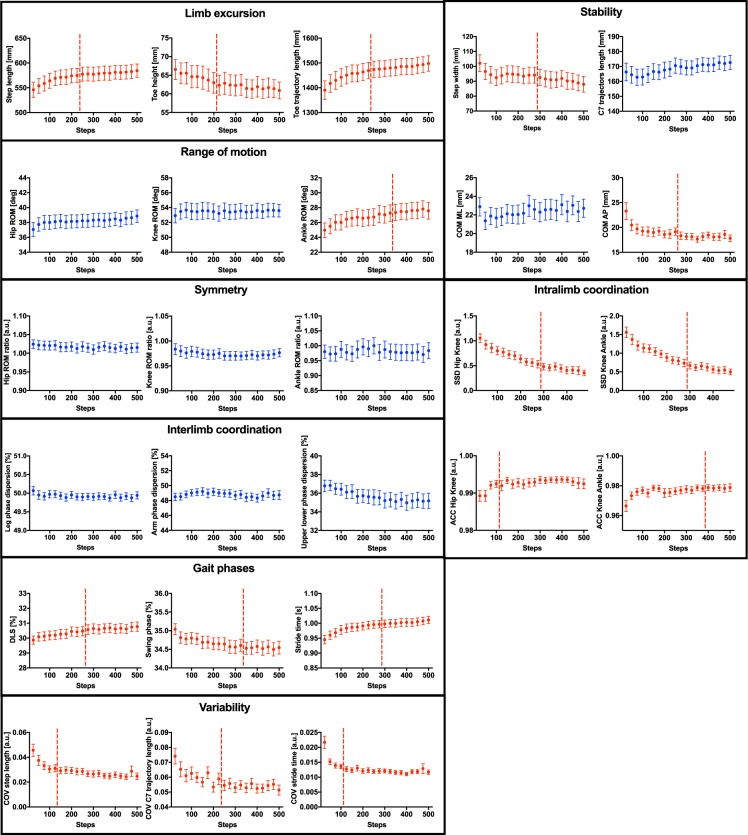
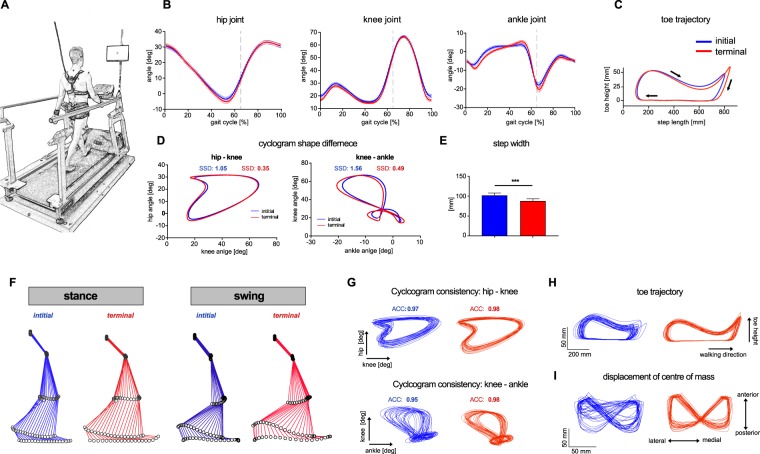
Treadmill-based gait analysis is widely used to investigate walking pathologies and quantify treatment effects on locomotion. Differential sensorimotor conditions during overground vs. treadmill walking necessitate initial familiarization to treadmill walking. Currently, there is no standardized treadmill acclimatization protocol and insufficient familiarization potentially confounds analyses. We monitored initial adaptations to treadmill walking in 40 healthy adults. Twenty-six walking parameters were assessed over 10 minutes with marker-based kinematic analysis and acclimatization profiles were generated. While 16 walking parameters demonstrated initial acclimatization followed by plateau performance, ten parameters remained stable. Distal lower limb control including ankle range of motion, toe trajectory and foot clearance underwent substantial adaptations. Moreover, intralimb coordination and gait variability also demonstrated acclimatization, while measures of symmetry and interlimb coordination did not. All parameters exhibiting a plateau after acclimatization did so within 6-7 minutes (425 strides). Older participants and those naïve to treadmill walking showed adaptations with higher amplitudes but over similar timescales. Our results suggest a minimum of 6 minutes treadmill acclimatization is required to reach a stable performance, and that this should suffice for both older and naïve healthy adults. The presented data aids in optimizing treadmill-based gait analysis and contributes to improving locomotor assessments in research and clinical settings.
跑步机步态分析被广泛用于研究行走病理,并量化治疗对运动的影响。与地面行走相比,跑步机行走需要不同的感觉运动条件,因此需要进行初始适应。目前,没有标准化的跑步机适应方案,而不充分的适应可能会混淆分析。我们监测了 40 名健康成年人在跑步机上行走的初始适应情况。使用基于标记的运动学分析评估了 10 分钟内的 26 个行走参数,并生成了适应曲线。虽然 16 个行走参数在初始适应后表现出稳定的性能,但有 10 个参数保持稳定。包括踝关节活动范围、脚趾轨迹和足廓清在内的下肢远端控制发生了显著的适应。此外,肢体间协调和步态变异性也表现出适应,而对称性和肢体间协调的测量值则没有。所有在适应后达到稳定性能的参数均在 6-7 分钟(425 步)内达到稳定。年龄较大的参与者和初次使用跑步机的参与者的适应幅度较大,但适应时间相似。我们的结果表明,需要至少 6 分钟的跑步机适应时间才能达到稳定的性能,而这对于老年人和初次使用跑步机的健康成年人来说已经足够。所呈现的数据有助于优化基于跑步机的步态分析,并有助于提高研究和临床环境中的运动评估。