Center for Molecular Medicine and Oncode Institute, University Medical Center Utrecht, Utrecht, The Netherlands.
Department of Medical Oncology, Erasmus MC Cancer institute, Erasmus University Medical Center, Rotterdam, The Netherlands.
Nat Commun. 2020 Nov 4;11(1):5584. doi: 10.1038/s41467-020-19406-4.
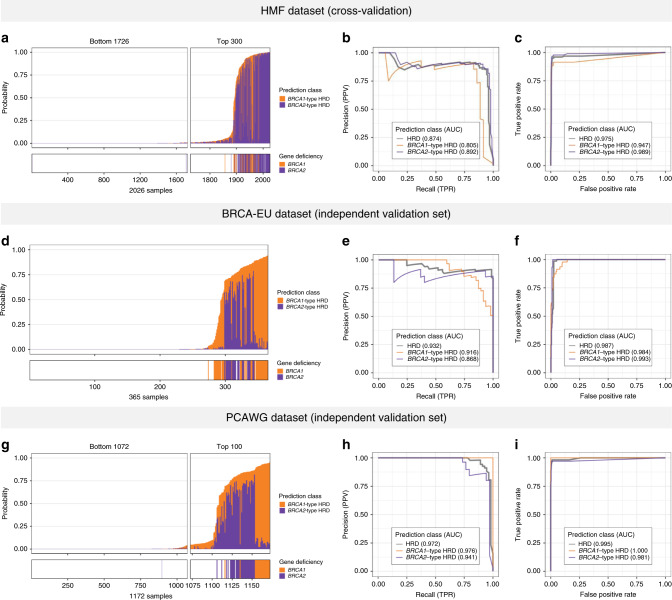
Homologous recombination deficiency (HRD) results in impaired double strand break repair and is a frequent driver of tumorigenesis. Here, we develop a genome-wide mutational scar-based pan-cancer Classifier of HOmologous Recombination Deficiency (CHORD) that can discriminate BRCA1- and BRCA2-subtypes. Analysis of a metastatic (n = 3,504) and primary (n = 1,854) pan-cancer cohort reveals that HRD is most frequent in ovarian and breast cancer, followed by pancreatic and prostate cancer. We identify biallelic inactivation of BRCA1, BRCA2, RAD51C or PALB2 as the most common genetic cause of HRD, with RAD51C and PALB2 inactivation resulting in BRCA2-type HRD. We find that while the specific genetic cause of HRD is cancer type specific, biallelic inactivation is predominantly associated with loss-of-heterozygosity (LOH), with increased contribution of deep deletions in prostate cancer. Our results demonstrate the value of pan-cancer genomics-based HRD testing and its potential diagnostic value for patient stratification towards treatment with e.g. poly ADP-ribose polymerase inhibitors (PARPi).
同源重组缺陷(HRD)导致双链断裂修复受损,是肿瘤发生的常见驱动因素。在这里,我们开发了一种基于全基因组突变痕迹的泛癌同源重组缺陷分类器(CHORD),可以区分 BRCA1 和 BRCA2 亚型。对转移性(n=3504)和原发性(n=1854)泛癌队列的分析表明,HRD 在卵巢癌和乳腺癌中最为常见,其次是胰腺癌和前列腺癌。我们确定 BRCA1、BRCA2、RAD51C 或 PALB2 的双等位基因失活是 HRD 的最常见遗传原因,RAD51C 和 PALB2 失活导致 BRCA2 型 HRD。我们发现,虽然 HRD 的具体遗传原因是癌症类型特异性的,但双等位基因失活主要与杂合性丢失(LOH)相关,在前列腺癌中,深度缺失的贡献增加。我们的研究结果表明,基于泛癌基因组学的 HRD 检测具有重要价值,对于例如聚 ADP-核糖聚合酶抑制剂(PARPi)等治疗的患者分层具有潜在的诊断价值。