Archéozoologie, Archéobotanique: Sociétés, Pratiques et Environnements, UMR 7209, Muséum national d'Histoire naturelle, CNRS, Paris, France.
Laboratoire PACEA, UMR 5199, Université de Bordeaux, Bordeaux, France.
Sci Rep. 2020 Nov 4;10(1):19070. doi: 10.1038/s41598-020-75496-6.
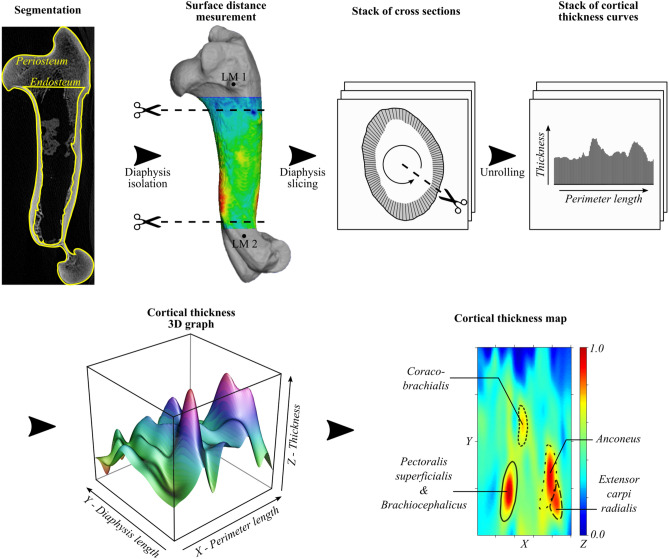
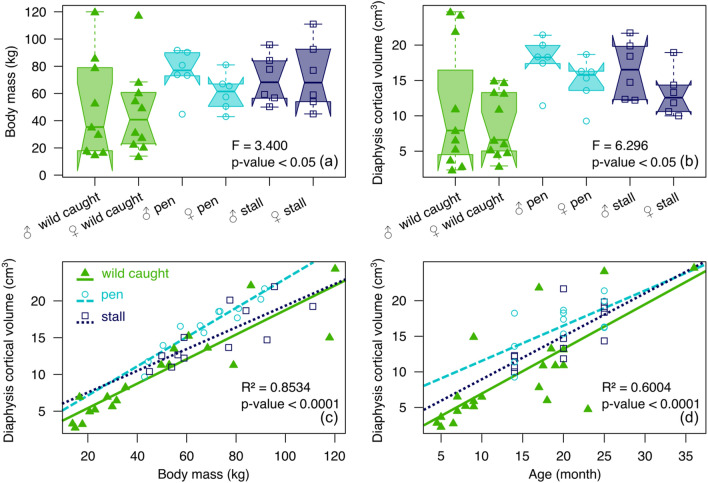
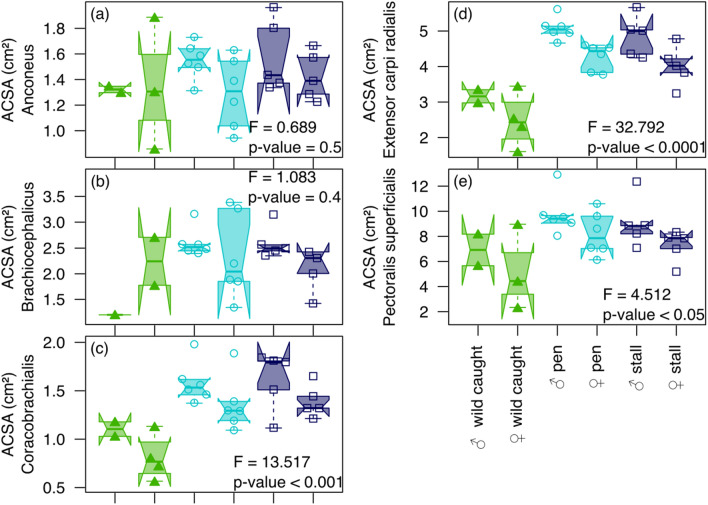
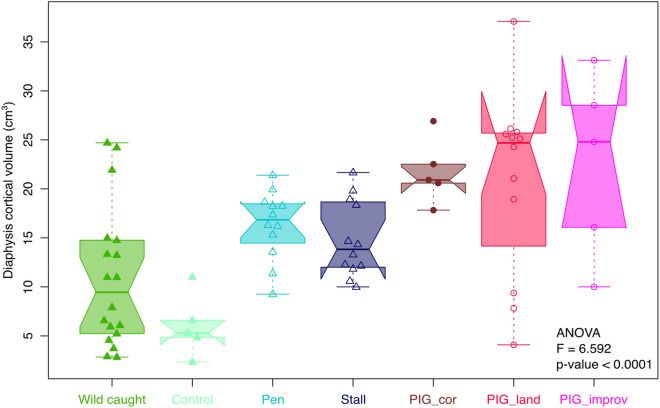
The lack of bone morphological markers associated with the human control of wild animals has prevented the documentation of incipient animal domestication in archaeology. Here, we assess whether direct environmental changes (i.e. mobility reduction) could immediately affect ontogenetic changes in long bone structure, providing a skeletal marker of early domestication. We relied on a wild boar experimental model, analysing 24 wild-born specimens raised in captivity from 6 months to 2 years old. The shaft cortical thickness of their humerus was measured using a 3D morphometric mapping approach and compared with 23 free-ranging wild boars and 22 pigs from different breeds, taking into account sex, mass and muscle force differences. In wild boars we found that captivity induced an increase in cortical bone volume and muscle force, and a topographic change of cortical thickness associated with muscular expression along a phenotypic trajectory that differed from the divergence induced by selective breeding. These results provide an experimental proof of concept that changes in locomotor behaviour and selective breeding might be inferred from long bones morphology in the fossil and archaeological record. These trends need to be explored in the archaeological record and further studies are required to explore the developmental changes behind these plastic responses.
与人类控制野生动物相关的骨骼形态标记的缺乏,阻碍了考古学对动物驯化初期的记录。在这里,我们评估了直接的环境变化(即活动减少)是否会立即影响长骨结构的个体发育变化,从而为早期驯化提供骨骼标记。我们依赖于野猪的实验模型,分析了从 6 个月到 2 岁在圈养中长大的 24 只野生出生的标本。使用 3D 形态测量映射方法测量其肱骨的骨干皮质厚度,并与 23 只自由放养的野猪和来自不同品种的 22 头猪进行比较,同时考虑到性别、体重和肌肉力量的差异。在野猪中,我们发现圈养导致皮质骨体积和肌肉力量增加,以及皮质厚度的地形变化,与沿着表型轨迹的肌肉表达有关,这与选择性繁殖引起的差异不同。这些结果提供了一个实验概念证明,即运动行为的变化和选择性繁殖可以从化石和考古记录中的长骨形态推断出来。这些趋势需要在考古记录中进行探索,并且需要进一步的研究来探索这些可塑性反应背后的发育变化。