Institute of Integrative Systems Biology (I2Sysbio), University of València and Consejo Superior de Investigaciones Científicas (CSIC), 46980, Valencia, Spain.
Foundation for the Promotion of Sanitary and Biomedical Research of Valencian Community (FISABIO), 46020, Valencia, Spain.
Sci Rep. 2020 Nov 4;10(1):19073. doi: 10.1038/s41598-020-76014-4.
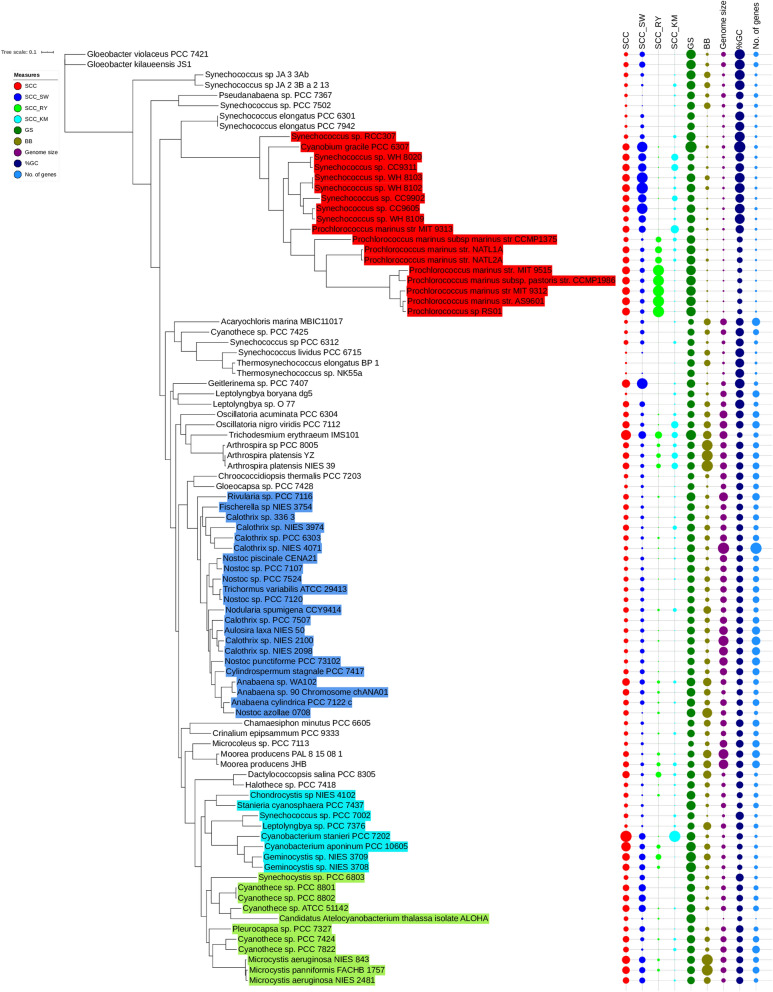
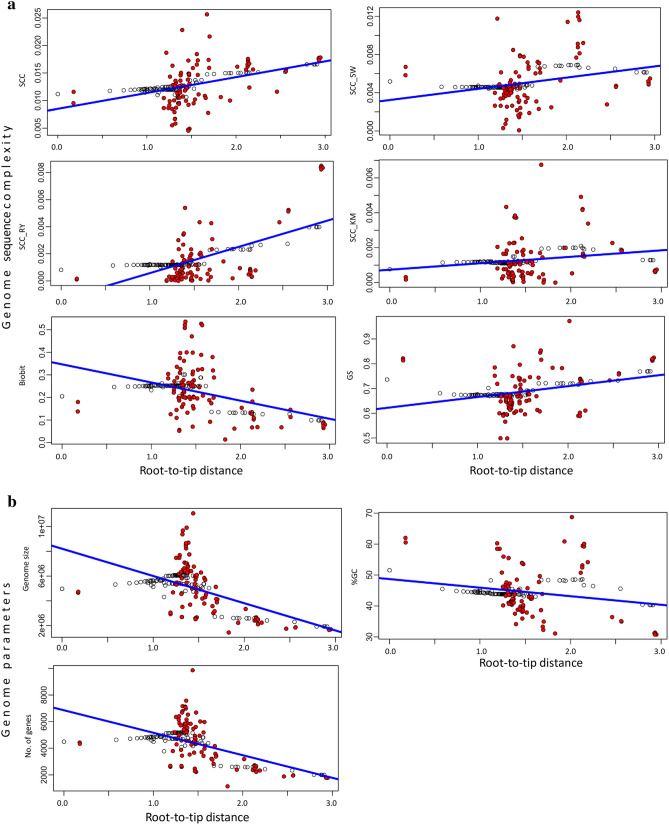
Progressive evolution, or the tendency towards increasing complexity, is a controversial issue in biology, which resolution entails a proper measurement of complexity. Genomes are the best entities to address this challenge, as they encode the historical information of a species' biotic and environmental interactions. As a case study, we have measured genome sequence complexity in the ancient phylum Cyanobacteria. To arrive at an appropriate measure of genome sequence complexity, we have chosen metrics that do not decipher biological functionality but that show strong phylogenetic signal. Using a ridge regression of those metrics against root-to-tip distance, we detected positive trends towards higher complexity in three of them. Lastly, we applied three standard tests to detect if progressive evolution is passive or driven-the minimum, ancestor-descendant, and sub-clade tests. These results provide evidence for driven progressive evolution at the genome-level in the phylum Cyanobacteria.
渐进进化,或朝着复杂性增加的趋势,是生物学中一个有争议的问题,要解决这个问题,需要对复杂性进行适当的衡量。基因组是解决这一挑战的最佳实体,因为它们编码了物种与生物和环境相互作用的历史信息。作为一个案例研究,我们已经测量了古老的蓝藻门的基因组序列复杂性。为了得到一个适当的基因组序列复杂性的度量,我们选择了不破译生物功能但具有强烈系统发育信号的度量。我们使用这些度量与根到尖端距离的脊回归,检测到其中三个度量的复杂性呈正相关趋势。最后,我们应用了三种标准测试来检测渐进进化是被动的还是主动的——最小、祖先-后代和亚群测试。这些结果为蓝藻门在基因组水平上的驱动渐进进化提供了证据。