Nigussie Tadesse, Yaekob Rahel, Geremew Mesfin, Asefa Adane
Department of Public Health, College of Health Science, Mizan-Tepi University, Mizan-Aman, Ethiopia.
Department of Midwifery, College of Health Science, Mizan-Tepi University, Mizan-Aman, Ethiopia.
Int J Womens Health. 2020 Oct 27;12:901-910. doi: 10.2147/IJWH.S267730. eCollection 2020.
Ending preventable maternal mortality remains an unfinished agenda and one of the world's most critical challenges. Skilled care at birth is one of the crucial strategies that help to prevent deaths that occur during delivery. Maternity waiting homes have been endorsed to facilitate access to skilled care during intra-partum and post-partum periods for women living in rural areas. However, the majority of pregnant mothers in Ethiopia do not use this service; hence, this study aimed to assess the predictors of intention to use maternity waiting home.
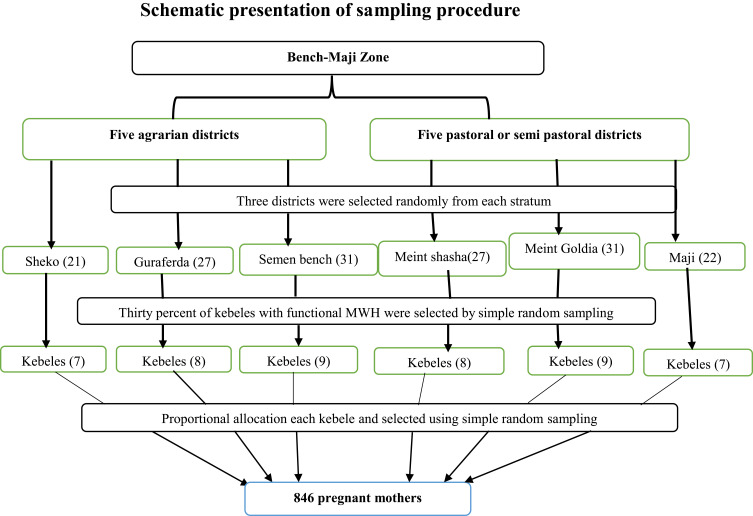
A community-based cross-sectional study was conducted from March 15 to June 20, 2018 in Bench Maji Zone, Southwest Ethiopia. A multistage sampling technique was used. The data were collected by trained data collectors using a structured pre-tested questionnaire. Data were entered into the epi data manager version 4.0.2.101 and exported to SPSS version 21 for analysis. The correlation among constructs of the theory of planned behavior was estimated. A hierarchical linear regression was used to identify predictors of intention to use maternity waiting home, and α value of less than 5% was used as a level of significance.
A total of 829 women were interviewed. The mean age of respondents was 27.1 (±5.2) years. Thirty-nine percent of the respondents used maternity waiting home previously. The attitude (β =0.12, p<0.001), subjective norm (β =0.47, p<0.001), perceived behavioral control (β =0.42, p<0.001), and ANC use during current pregnancy (β =0.07, p=0.030) were predictors of intension to use maternity waiting homes. R square was calculated to be 81%.
The intention to use maternity waiting homes was significantly associated with antenatal care use, attitude, subjective norm, and perceived behavioral control. Thus, multidimensional interventions are important to increase the intension to use MWH.
终结可预防的孕产妇死亡仍是一项未完成的议程,也是全球最严峻的挑战之一。分娩时的专业护理是预防分娩期间死亡的关键策略之一。孕产候家已获认可,有助于农村地区妇女在产前和产后获得专业护理。然而,埃塞俄比亚的大多数孕妇并未使用这项服务;因此,本研究旨在评估使用孕产候家意愿的预测因素。
2018年3月15日至6月20日在埃塞俄比亚西南部的本奇马吉地区开展了一项基于社区的横断面研究。采用多阶段抽样技术。由经过培训的数据收集员使用经过预测试的结构化问卷收集数据。数据录入Epi Data Manager 4.0.2.101版本,并导出至SPSS 21版本进行分析。对计划行为理论各构成要素之间的相关性进行了估计。采用分层线性回归来确定使用孕产候家意愿的预测因素,显著性水平设定为α值小于5%。
共访谈了829名妇女。受访者的平均年龄为27.1(±5.2)岁。39%的受访者此前使用过孕产候家。态度(β =0.12,p<0.001)、主观规范(β =0.47,p<0.001)、感知行为控制(β =0.42,p<0.001)以及本次孕期的产前检查使用情况(β =0.07,p=0.030)是使用孕产候家意愿的预测因素。计算得出的R平方为81%。
使用孕产候家的意愿与产前检查使用情况、态度、主观规范和感知行为控制显著相关。因此,多维干预对于提高使用孕产候家的意愿很重要。