Department of Epidemiology, Johns Hopkins Bloomberg School of Public Health, Baltimore, US.
Welch Center for Prevention, Epidemiology, and Clinical Research, US.
Glob Heart. 2020 Sep 22;15(1):64. doi: 10.5334/gh.814.
Whether cardiovascular disease (CVD) and its traditional risk factors predict severe coronavirus disease 2019 (COVID-19) is uncertain, in part, because of potential confounding by age and sex.
We performed a systematic review of studies that explored pre-existing CVD and its traditional risk factors as risk factors of severe COVID-19 (defined as death, acute respiratory distress syndrome, mechanical ventilation, or intensive care unit admission). We searched PubMed and Embase for papers in English with original data (≥10 cases of severe COVID-19). Using random-effects models, we pooled relative risk (RR) estimates and conducted meta-regression analyses.
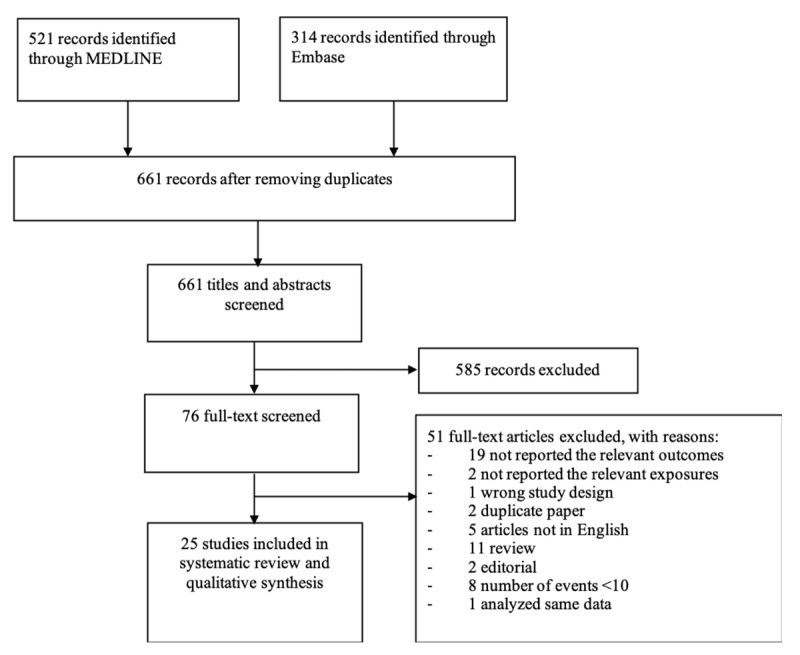
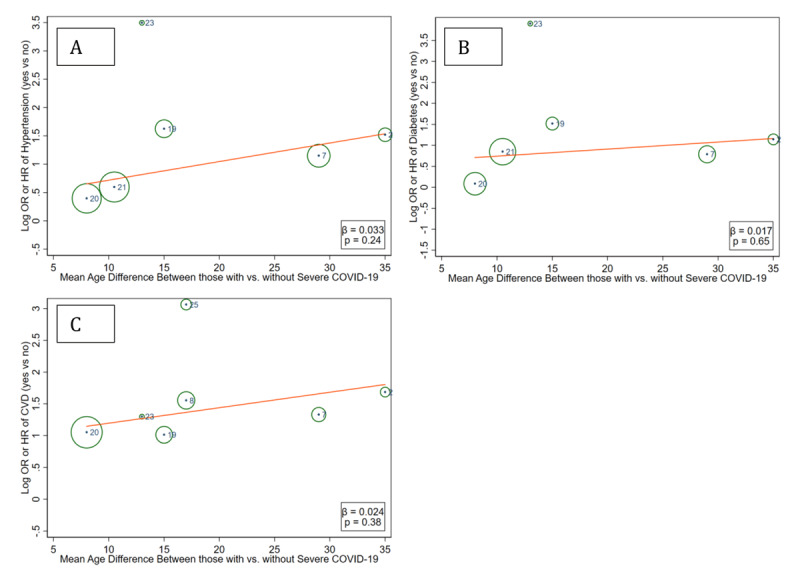
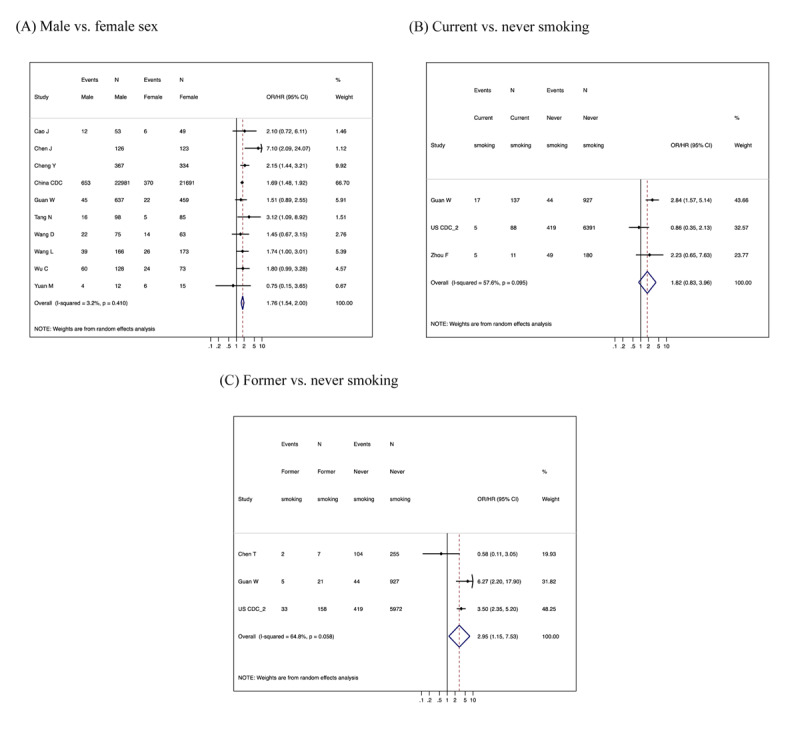
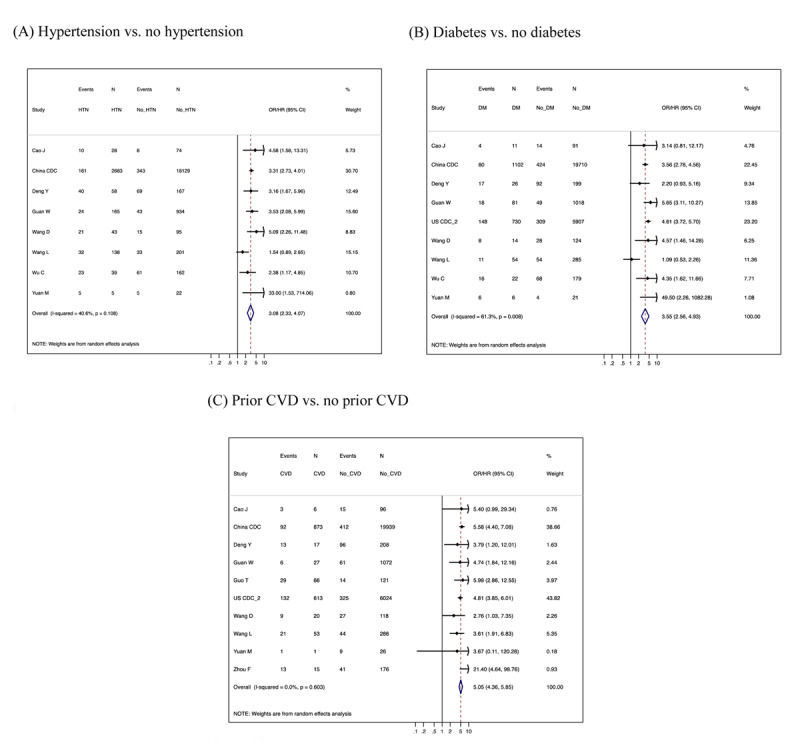
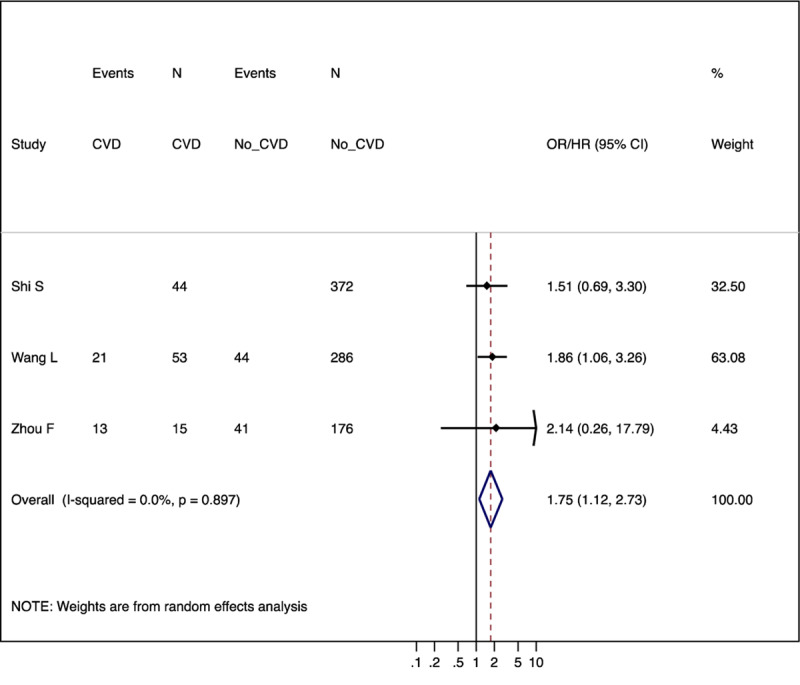
Of the 661 publications identified in our search, 25 papers met our inclusion criteria, with 76,638 COVID-19 patients including 11,766 severe cases. Older age was consistently associated with severe COVID-19 in all eight eligible studies, with RR >~5 in >60-65 versus <50 years. Three studies showed no change in the RR of age after adjusting for covariate(s). In univariate analyses, factors robustly associated with severe COVID-19 were male sex (10 studies; pooled RR = 1.73, [95% CI 1.50-2.01]), hypertension (8 studies; 2.87 [2.09-3.93]), diabetes (9 studies; 3.20 [2.26-4.53]), and CVD (10 studies; 4.97 [3.76-6.58]). RR for male sex was likely to be independent of age. For the other three factors, meta-regression analyses suggested confounding by age. Only four studies reported multivariable analysis, but most of them showed adjusted RR ~2 for hypertension, diabetes, and CVD. No study explored renin-angiotensin system inhibitors as a risk factor for severe COVID-19.
Despite the potential for confounding, these results suggest that hypertension, diabetes, and CVD are independently associated with severe COVID-19 and, together with age and male sex, can be informative for predicting the risk of severe COVID-19.
心血管疾病(CVD)及其传统危险因素是否可预测严重的 2019 冠状病毒病(COVID-19)尚不确定,部分原因是年龄和性别可能存在混杂因素。
我们对探讨预先存在的 CVD 及其传统危险因素是否为严重 COVID-19(定义为死亡、急性呼吸窘迫综合征、机械通气或重症监护病房收治)危险因素的研究进行了系统回顾。我们在 PubMed 和 Embase 上检索了以英文发表的包含原始数据(≥10 例严重 COVID-19)的论文。我们使用随机效应模型汇总相对风险(RR)估计值并进行了荟萃回归分析。
在我们的检索中,有 661 篇论文符合纳入标准,其中 25 篇论文符合纳入标准,涉及 76638 例 COVID-19 患者,包括 11766 例严重病例。在所有 8 项合格研究中,年龄较大均与所有严重 COVID-19 持续相关,60-65 岁与<50 岁相比 RR>5。有 3 项研究表明,在调整协变量后,年龄与 RR 无变化。在单变量分析中,与严重 COVID-19 显著相关的因素包括男性(10 项研究;汇总 RR=1.73[95%CI 1.50-2.01])、高血压(8 项研究;2.87[2.09-3.93])、糖尿病(9 项研究;3.20[2.26-4.53])和 CVD(10 项研究;4.97[3.76-6.58])。男性的 RR 可能与年龄无关。对于其他三个因素,荟萃回归分析表明存在年龄混杂。只有 4 项研究报告了多变量分析,但其中大多数研究显示高血压、糖尿病和 CVD 的校正 RR2。没有研究探讨肾素-血管紧张素系统抑制剂是否为严重 COVID-19 的危险因素。
尽管存在混杂的可能性,但这些结果表明高血压、糖尿病和 CVD 与严重 COVID-19 独立相关,与年龄和男性性别一起,可提供预测严重 COVID-19 风险的信息。