Maternal and Child Health Division, icddr,b, Dhaka, Bangladesh.
Department of Public Health, North South University, Dhaka, Bangladesh.
PLoS One. 2020 Nov 5;15(11):e0241185. doi: 10.1371/journal.pone.0241185. eCollection 2020.
There is dearth of information on the timeliness of antenatal care (ANC) uptake. This study aimed to determine the timely ANC uptake by a medically trained provider (MTP) as per the World Health Organization (WHO) recommendations and the country guideline.
Cross-sectional survey was done with 2,731 women having livebirth outcome in last one year in Dinajpur, Nilphamari and Rajshahi districts, Bangladesh from August-November,2016.
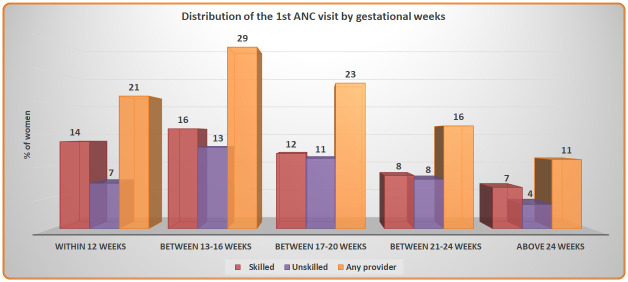
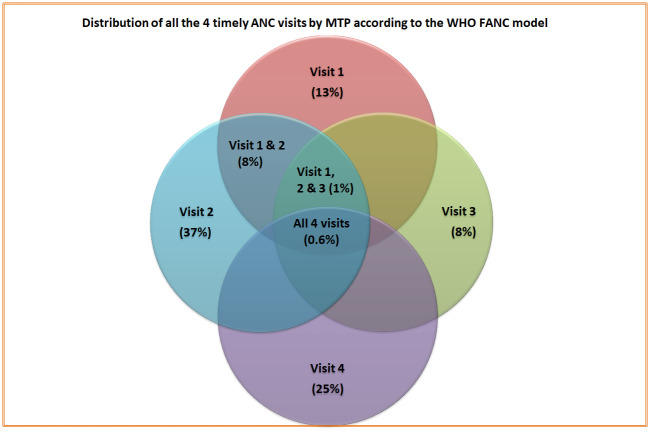
About 82%(2,232) women received at least one ANC from a MTP. Overall, 78%(2,142) women received 4 or more ANCs by any provider and 43%(1168) from a MTP. Only 14%(378) women received their first ANC at the 1st trimester by a MTP. As per 4 schedule visits by the WHO FANC model and the country guideline 8%(203) and 20%(543) women respectively received the first 2 timely ANC by a MTP; where only 1%(32) and 3%(72) received the first 3 visits timely and 0.6%(17) and 1%(29) received all the four timely visits. Factors significantly associated with the first two timely visits are: 10 or above years of schooling of women [adj. OR 2.13 (CI: 1.05, 4.30)] and their husbands [adj. OR 2.40 (CI: 1.31, 4.38)], women's employment [adj. OR 2.32 (CI: 1.43, 3.76)], urban residential status [adj. OR 3.49 (CI: 2.46, 4.95)] and exposure to mass media [adj. OR 1.58 (CI: 1.07, 2.34)] at 95% confidence interval. According to the 2016 WHO ANC model, only 1.5%(40) women could comply with the first two ANC contacts timely by a MTP and no one could comply with all the timely 8 contacts.
Despite high coverage of ANC utilization, timely ANC visit is low as per both the WHO recommendations and the country guideline. For better understanding, further studies on the timeliness of ANC coverage are required to design feasible intervention for improving maternal and child health.
有关产前护理(ANC)及时性的信息匮乏。本研究旨在根据世界卫生组织(WHO)的建议和国家指南,确定由医学培训提供者(MTP)提供的及时 ANC 利用率。
2016 年 8 月至 11 月,在孟加拉国迪纳杰布尔、尼拉帕马里和拉杰沙希区对过去一年中有活产的 2731 名妇女进行了横断面调查。
约 82%(2232 人)的妇女接受了 MTP 的至少一次 ANC。总体而言,78%(2142 人)的妇女由任何提供者提供了 4 次或更多的 ANC,43%(1168 人)由 MTP 提供。只有 14%(378 人)的妇女由 MTP 在孕早期的第 1 次就诊时接受 ANC。根据 WHO 产前护理(FANC)模型的 4 次预约和国家指南,分别有 8%(203 人)和 20%(543 人)的妇女由 MTP 及时接受了前 2 次 ANC;仅有 1%(32 人)和 3%(72 人)及时接受了前 3 次就诊,0.6%(17 人)和 1%(29 人)接受了所有 4 次及时就诊。与前两次及时就诊显著相关的因素是:妇女和其丈夫受教育年限 10 年以上[调整后的比值比(aOR)为 2.13(95%置信区间:1.05,4.30)]、妇女就业[aOR 为 2.32(95%置信区间:1.43,3.76)]、城市居住状态[aOR 为 3.49(95%置信区间:2.46,4.95)]和接触大众媒体[aOR 为 1.58(95%置信区间:1.07,2.34)]。在 95%置信区间内,根据 2016 年 WHO ANC 模式,仅有 1.5%(40 人)的妇女能够及时由 MTP 进行前 2 次 ANC 就诊,且无人能够及时进行全部 8 次就诊。
尽管 ANC 利用率较高,但按照 WHO 建议和国家指南,及时 ANC 就诊率较低。为了更好地理解,需要进一步研究 ANC 覆盖率的及时性,以便为改善母婴健康设计可行的干预措施。